
We Checked 40 Local Searches in Vancouver and Seattle: The Google Local Pack Is Still There (Mostly)

A few days ago, a Semrush-published study said Google's AI Overview had replaced the map pack on 79 of 80 local searches. That's a big claim for any local business, so on November 21, 2026 we ran a check of our own. We typed 40 local searches into Google, 20 for Vancouver and 20 for Seattle, and looked at what the page showed.
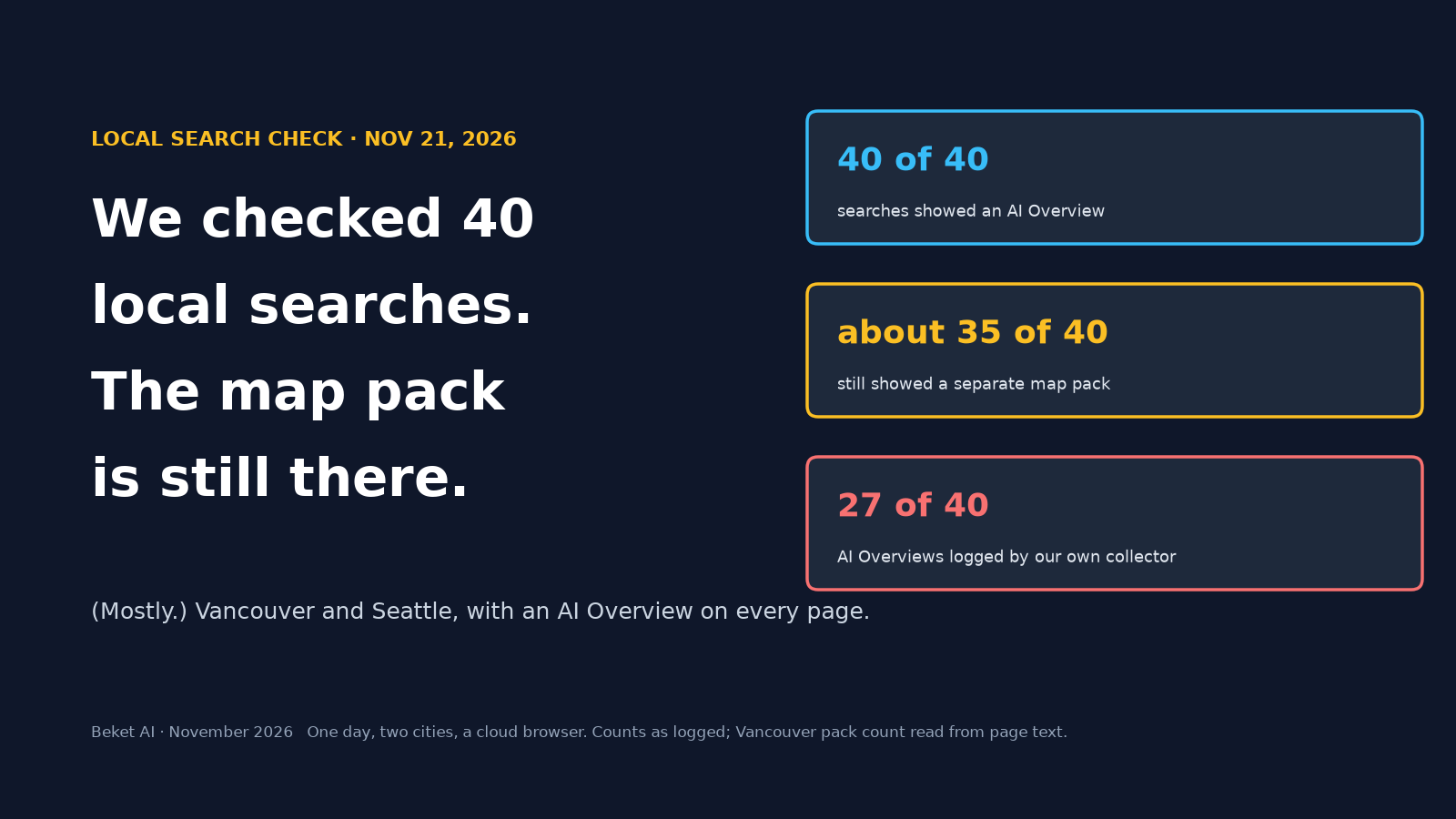
The short answer: an AI Overview showed on all 40 searches, and a separate map pack still showed on about 35 of them. The AI Overview is everywhere in our sample. The map pack, so far, isn't gone. This is one day, two cities and a cloud browser, so treat it as a snapshot, not a verdict.
What we did
We took 20 searches and ran each one in both cities. They covered 10 local services (an emergency plumber, an electrician, furnace repair, roof repair, a locksmith, a family lawyer, a personal injury lawyer, an emergency dentist, a bathroom renovation contractor and an immigration lawyer), each typed two ways. One is the bare version, like "locksmith [city]". The other is a longer question, like "I'm locked out of my home, who is a trustworthy 24 hour locksmith?"
We ran them in a cloud browser with the location set to each city. We recorded whether an AI Overview showed and whether a separate map pack (Google's "Businesses" block with a map) showed. In Seattle we also noted whether the pack sat above or below the AI Overview. We checked Seattle with screenshots. For Vancouver, we read the page text, so the Vancouver pack count is approximate, and results sometimes changed between reloads of the same search. One Seattle search also hit a reCAPTCHA, which we cleared.
At the same time, we ran the same 40 searches as prompts in a Beket AI audit in each city, on Google AI Overviews, Google AI Mode and ChatGPT. That gave us a second view of the same searches.
What we saw
| What we looked at | Result |
|---|---|
| AI Overview in the browser | 40 of 40 searches |
| Separate map pack in the browser | about 35 of 40 (Seattle 18 of 20, Vancouver 17 of 20, read from text) |
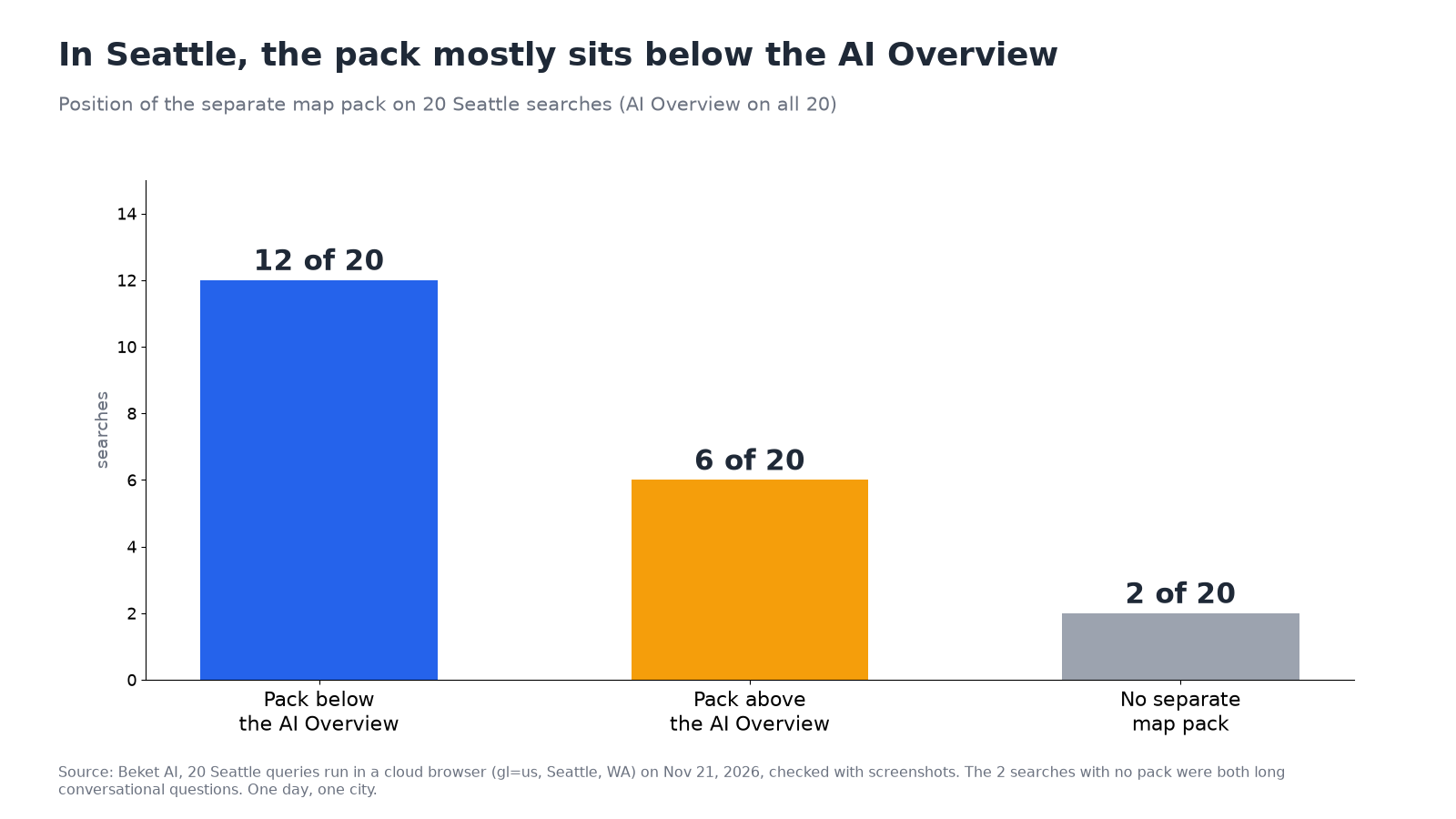
| Seattle: pack below the AI Overview | 12 of 20 |
| Seattle: pack above the AI Overview | 6 of 20 |
| AI Overview logged by Beket AI's collector, same 40 searches | 27 of 40 |
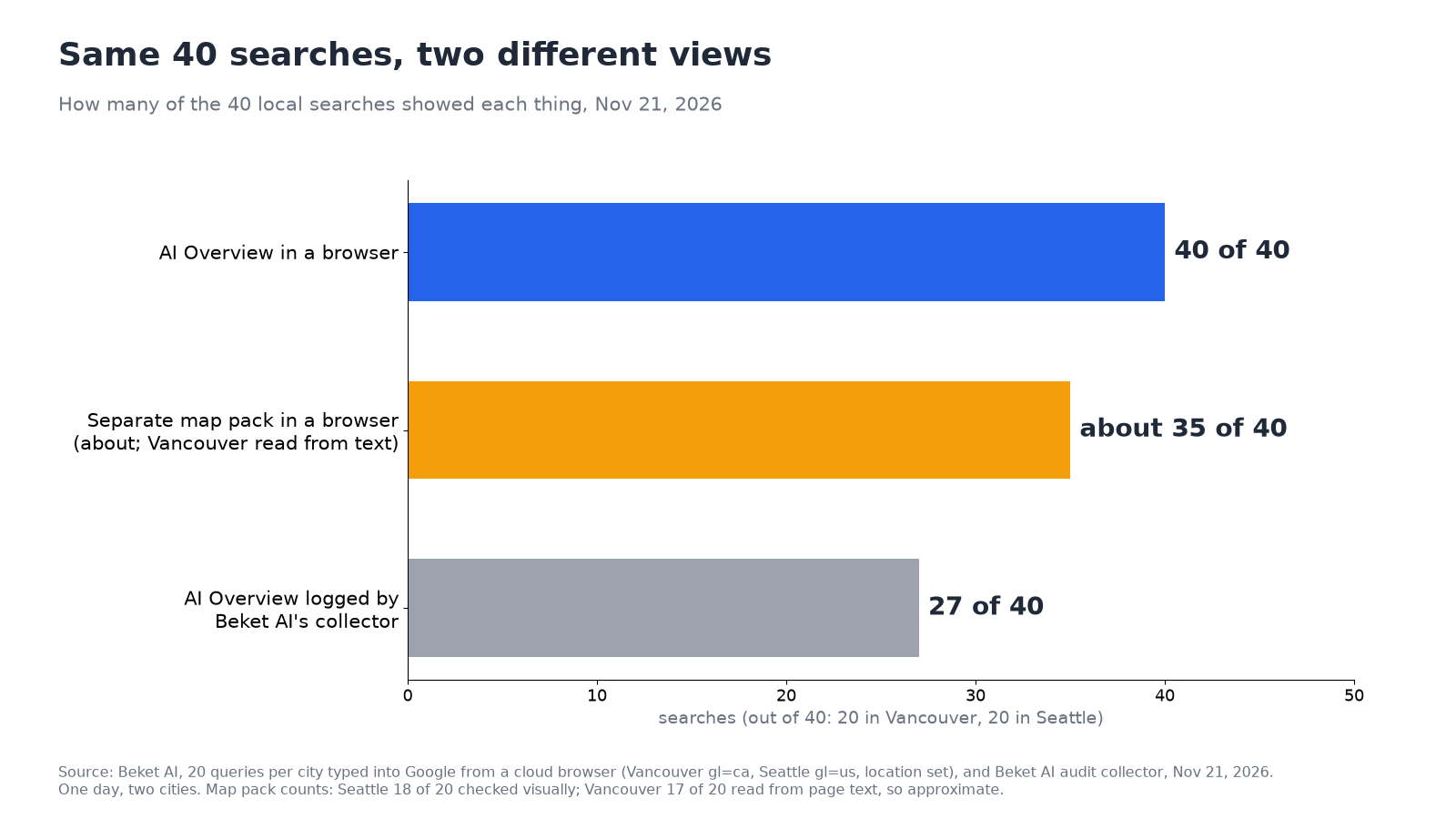
The AI Overview was on every page. That's higher than what Synup and BrightEdge reported on much larger samples. Both found AI Overviews on a minority of local pages, with a big jump for searches that describe a specific need. Our searches were all money searches for local services, and half were long questions, so it's the kind of query where AI Overviews are most common. It also fits the Semrush finding that AI Overviews on high-intent local searches have become close to universal.
The map pack mostly stayed. About 35 of 40 searches still showed a separate map pack. The 5 that didn't were 3 long conversational questions and 2 bare searches. In Seattle, both searches without a pack were long conversational questions: a furnace question and a car accident question. In Vancouver, the 3 misses were the bare emergency plumber and roof repair searches plus one long question about a car accident. With so few misses, we wouldn't read much into which type missed, but it matches the pattern from earlier studies: the longer and more specific the question, the more the AI Overview takes over.
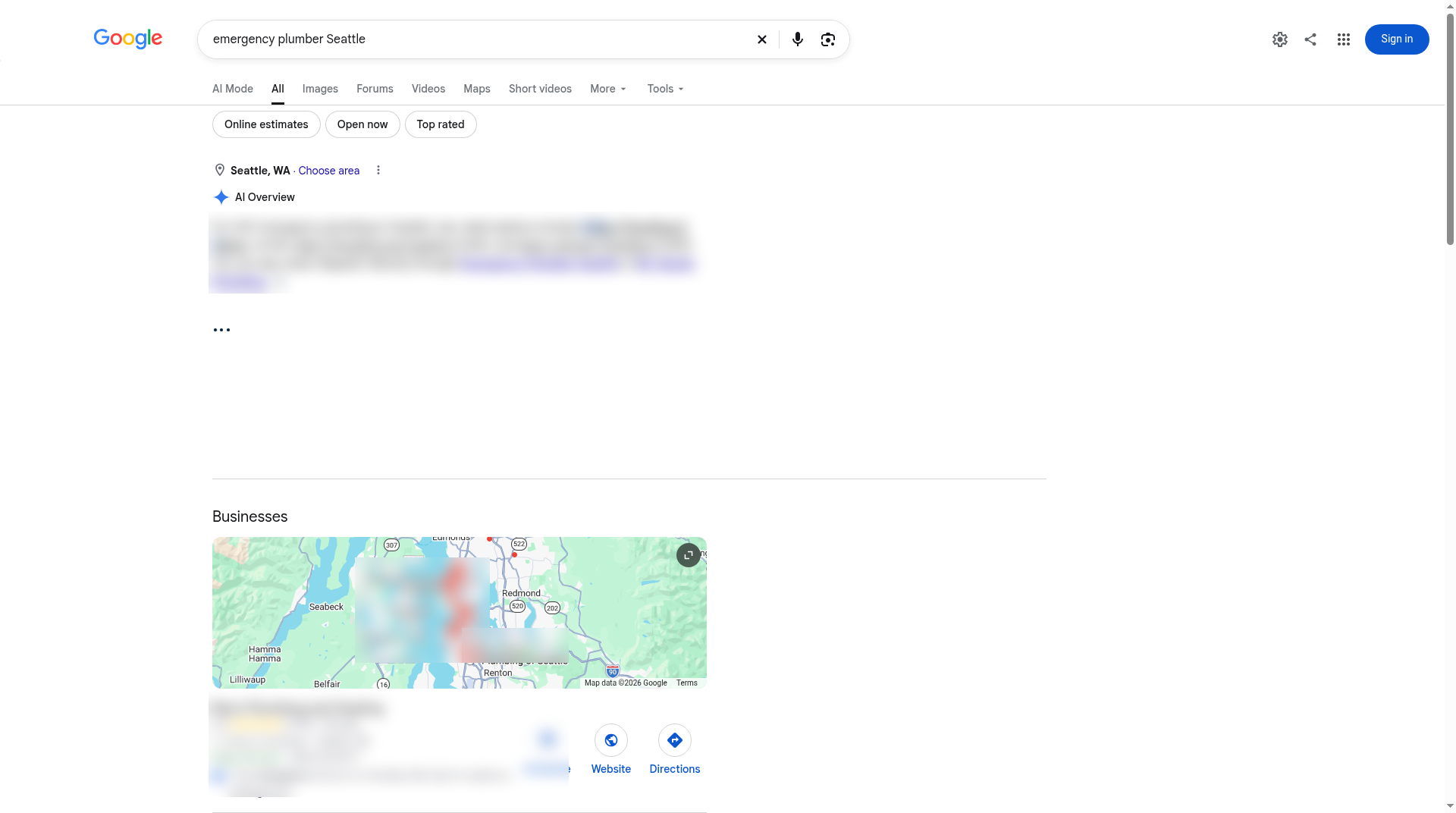
The pack mostly sat below the AI Overview. In Seattle, the pack came after the AI Overview on 12 of 20 searches and above it on 6. Here's what that looks like on one of them, with the business names blurred. The AI Overview names a short list of businesses, and a "Businesses" block with a map follows underneath.
Why this isn't the same as 79 of 80
We don't read our result as a contradiction of Semrush. The two studies measured different things:
- What was counted. Semrush looked for the AI Overview replacing the pack with business cards. We counted whether a separate "Businesses" block was on the page at all. An AI Overview can carry its own business list and still sit above a pack, as it did on most of our Seattle pages.
- Timing. Semrush's last round was captured on a single day, and its author said it could be a test or a rollout that hasn't reached everyone. Ours is one different day.
- Place and setup. Semrush searched 12 US markets by hand. We searched two cities, one of them in Canada, from a cloud browser.
- Google keeps changing this. Google has been testing different local layouts this month, so two checks a few days apart can both be right.
So the fairest reading is this: AI Overviews on local searches are close to universal in both studies, but whether the separate pack disappears depends on the search, the place, the day and the layout test Google is showing. If you want the full background on the Semrush study and the other two big local studies, read our earlier post, Is the Google Map Pack Going Away?
A warning about our own collector
Our own audit collector logged an AI Overview on only 27 of the same 40 searches. In the browser, we saw 40 of 40. In 13 searches, the collector got "no AI Overview" where the browser showed one.
We don't know exactly why. The collector fetches results automatically, once per search. Our browser check was a person looking at the page (Seattle) or reading its text (Vancouver), and in Vancouver the same search sometimes showed different things on reload. Whatever the cause, it's a useful reminder: any tool that reports whether an AI Overview showed is reporting what it saw in one fetch. If you track AI Overviews for a client, spot-check a few searches by hand before you quote a rate. We'll do the same with our own numbers.
What the AI answers named
The audit side gave us a closer look at who the engines name. Across the 20 searches in each city, on completed answers:
- Google AI Mode named about 7 businesses per answer (6.7 in Vancouver, 7.0 in Seattle).
- Google AI Overviews named about 5 (4.7 and 5.2).
- ChatGPT named 3 to 5 (3.2 in Vancouver, 5.3 in Seattle), and in 6 of the 20 Vancouver answers it named none.
- The engines rarely agreed. On the same search, 14% to 21% of the businesses one engine named were also named by another engine.
- Google AI Overviews leaned on Google's own pages. Of the 142 links the AI Overviews cited, 27 (19%) were google.com, and 25 of those looked like Google Maps or place links. ChatGPT cited google.com in 4 of its 78 links, and AI Mode cited very few links at all.
That last number is the one to remember. When Google's AI Overview names local businesses, a good part of its sourcing is Google's own listings. In practice, that means your Google Business Profile matters for the AI Overview as well as the pack. (We saw the same pattern in our larger local audits, which we covered in Which Local Businesses Does AI Recommend?)
We're not naming businesses from this audit. The point here is the pattern, and each business's result changes from day to day.
What this means for a local business
- Plan for both. On our 40 searches, the pack and the AI Overview were on the page together almost every time. Check your listing in the pack and in the AI Overview, with the bare version of your service search and the long one.
- Look at the long questions. That's where the pack went missing in our check, and where Semrush saw the biggest AI Overview growth.
- Keep your Google Business Profile complete and consistent. Categories, name, address, phone, hours and service area should match your site. If AI Overviews source from Google's own pages, this is the input you control.
- Make sure every city you serve has a real page. Our guide to service area pages vs doorway pages covers what Google allows.
- Check a few searches by hand, then track them. Spot-check by hand, as we just did, and then keep checking over time, because layouts are changing. Our guide to how to show up in Google AI Overviews has the step-by-step version. If you'd rather not run the searches yourself, Beket AI's free audit runs 25 prompts on any 3 of its 6 engines.
The bottom line
On November 21, 2026, in two cities, every one of our 40 local searches had an AI Overview, and about 35 of them still had a separate map pack. The AI Overview is taking over the top of the page, but the pack hasn't vanished, and where it sat varied by search. Whether Semrush's 79 of 80 becomes the norm is still an open question, so check your own searches this week and again next month.
Sources: Beket AI browser check and audits, November 21, 2026 (20 searches per city; Seattle checked with screenshots, Vancouver read from page text); Semrush blog, "AI Overviews are taking over the map pack" (Chris Shirlow, Nov 17, 2026).
Related posts
How to Choose a GEO Agency: 8 Questions to Ask Before You Sign (2026)
How to choose a GEO or AEO agency: 8 questions to ask before you sign, what a strong answer sounds like, and the red flags, each backed by a public source.
A Third of Shoppers Now Use AI: Why Specialists Beat Big Retailers in AI Answers (2026)
Bain says 33% of US and 36% of European shoppers use AI to shop and that AI favors specialists. Our Nov 20 Vancouver and Seattle re-run, and what to do.
Does llms.txt Work? We Checked 3,844 Sites AI Engines Cite (2026 Data)
We checked 3,844 sites cited by ChatGPT, Perplexity and AI Overviews for llms.txt. The most-cited sites had it least. Our data, other studies, what to do.