
Does llms.txt Work? We Checked 3,844 Sites AI Engines Cite (2026 Data)

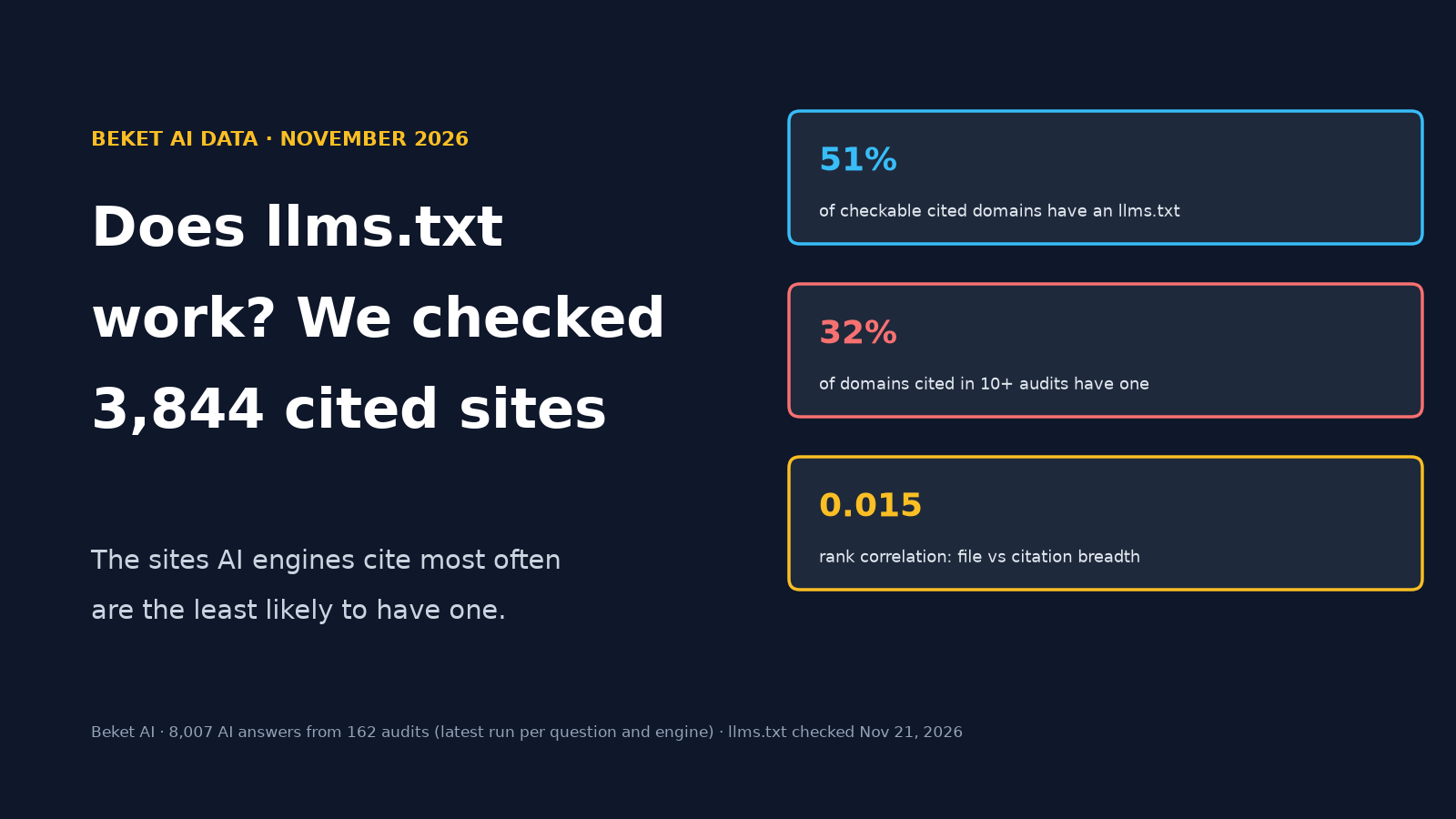
Short answer: not for getting cited. We took 3,844 websites that ChatGPT, Perplexity, Google AI Overviews and other AI engines cited in Beket AI audits and checked each one for an llms.txt file on November 21, 2026. About half had one. But the domains AI engines cited most widely were the least likely to have the file, and across the whole set there was no link between having llms.txt and being cited more often.
Two larger public studies point the same way from different angles. A third found that big sites with the file get cited more often, and its author says that's likely partly down to which brands adopt it. Below is what we checked, what we found, how it fits with that research, and where your time is better spent.
What llms.txt is supposed to do
llms.txt is a plain markdown file at the root of a site (yoursite.com/llms.txt) that summarizes what the site is and links its most important pages. Jeremy Howard proposed it in September 2024, and the proposal was updated to a v2 in August 2026. The original idea was to help language models and agents, such as coding tools reading documentation, find the right pages without crawling everything.
The idea that it helps you get cited in AI answers came later, from the SEO industry. No major AI search engine has said it uses the file to pick sources. Google says the opposite for its own products: its guide to optimizing for generative AI features says Google Search doesn't use llms.txt files, and creating one "will neither harm nor help" your visibility in Google Search, including AI Overviews and AI Mode. We compared what llms.txt, robots.txt and schema each actually control in our llms.txt vs robots.txt vs schema markup guide.
So the open question is about the other engines, and about whether sites with the file simply get cited more. That's what we tested.
How we checked
- The citations. We took every completed answer in Beket AI's audits that cited at least one source, keeping only the latest run for each question on each engine. That gave 8,007 answers from 162 audits across ChatGPT, Perplexity, Google AI Overviews, Google AI Mode, Microsoft Copilot and Gemini. Answers date from June to November 21, 2026; 77% are from October 1 onward.
- The domains. Those answers cited 18,125 distinct domains, not counting the audited businesses' own websites. We measured each domain by how many separate audits cited it, not by raw citation counts, so a domain that appears in daily re-runs of one audit doesn't look bigger than it is.
- The sample. We checked every domain cited in two or more audits (3,144 domains) plus a random sample of 700 domains cited in just one audit.
- The test. On November 21, 2026 we requested
/llms.txton each domain. A domain counted as having the file if it returned a real markdown or text file (not an HTML page, an error message or a redirect elsewhere). A 404 counted as no file. Where a site blocked us or returned a bot challenge page, we marked it "couldn't check" and left it out of the percentages. That was 460 domains, including reddit.com, linkedin.com and facebook.com.
This is an aggregate of citation data. It contains no customer names, prompts or brand results.
Finding 1: Half the cited domains have an llms.txt
Of the 3,384 domains we could check, 1,715 (50.7%) had a working llms.txt.
That's high next to public estimates. SE Ranking found the file on 10.13% of nearly 300,000 domains, PageSpeed Matters on 7.4% of the top 1 million sites, and Ahrefs on 28% of 137,210 sites using its analytics product (more on these below). The likely reason is our mix: many Beket AI audits cover marketing agencies, SaaS and software, and the directories and agency sites cited in those answers are exactly the kind of sites that adopt SEO trends early. At least 179 of the files carried a header saying a WordPress SEO plugin (Rank Math, Yoast or All in One SEO) generated them.
So the file is common among sites AI engines cite. The question is whether it is more common among the sites they cite most.
Finding 2: The most widely cited domains are the least likely to have one
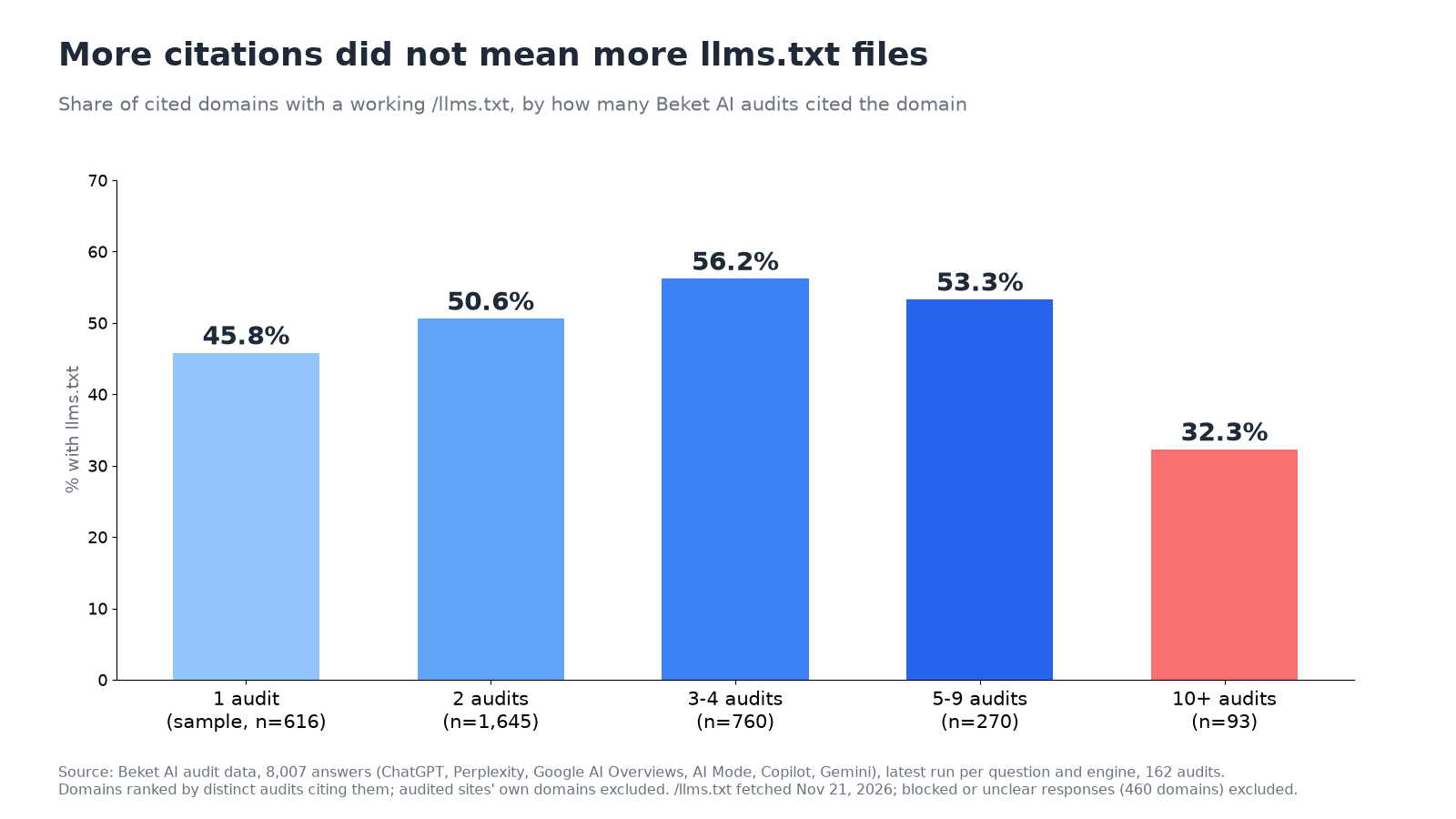
If llms.txt helped a site get cited, you would expect the share of domains with the file to rise as citation breadth rises. It doesn't.
| Cited in | Domains checked | Have llms.txt | Share |
|---|---|---|---|
| 1 audit (random sample) | 616 | 282 | 45.8% |
| 2 audits | 1,645 | 832 | 50.6% |
| 3 to 4 audits | 760 | 427 | 56.2% |
| 5 to 9 audits | 270 | 144 | 53.3% |
| 10 or more audits | 93 | 30 | 32.3% |
The share climbs a little through the middle, then drops to 32.3% for the domains AI engines lean on most. Two more ways to look at it:
- Among domains cited in two or more audits, those with the file were cited in 3.12 audits on average; those without it were cited in 3.57.
- The rank correlation (Spearman) between "has llms.txt" and the number of audits citing a domain was 0.015, which is effectively zero (2,768 domains).
Finding 3: Most of the top 25 cited domains have no file
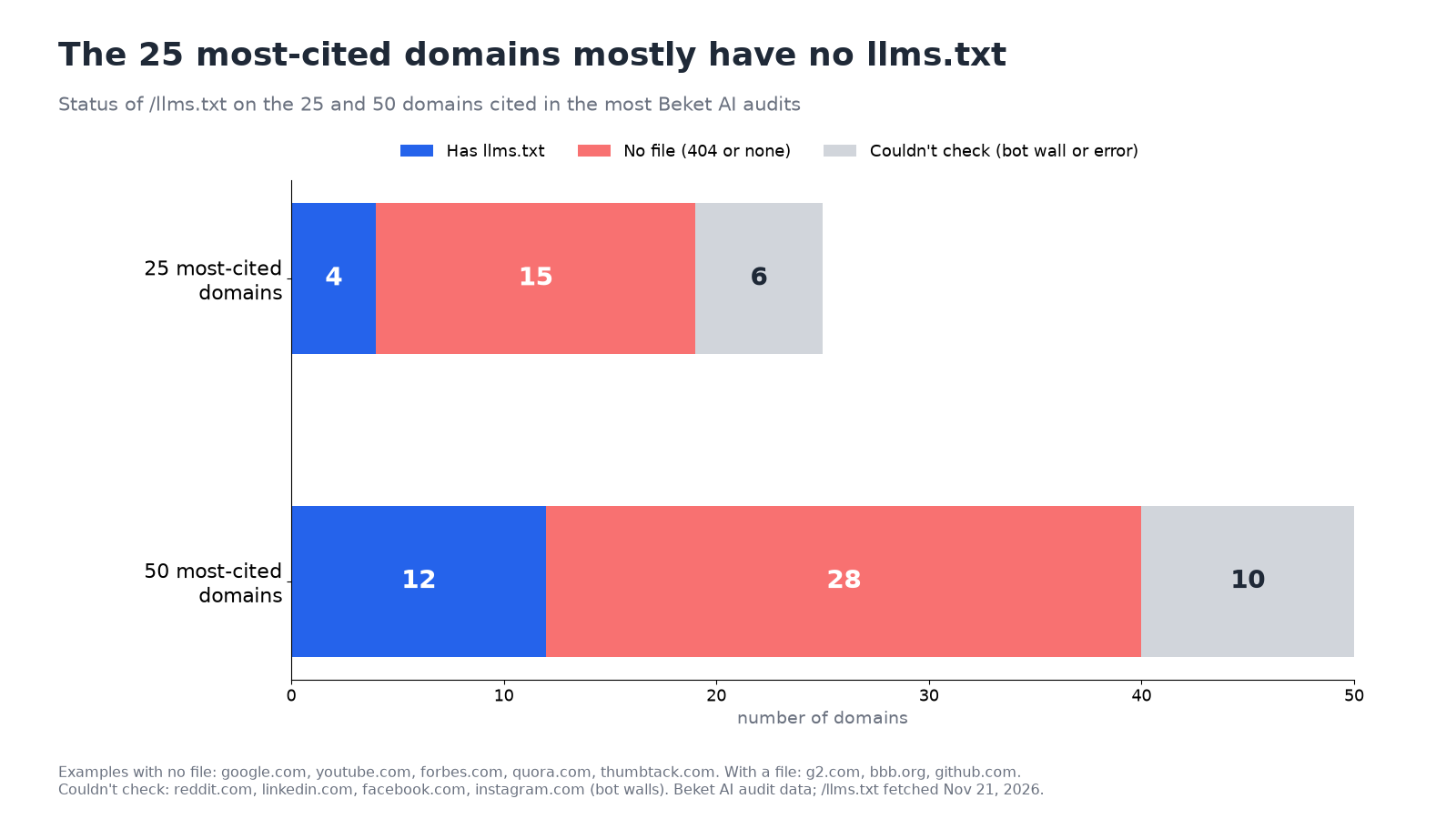
Of the 25 domains cited in the most audits, 4 had an llms.txt, 15 returned no file, and 6 blocked our check. Google.com, YouTube, Forbes, Quora and Thumbtack all returned a 404, and AI engines cited them anyway, again and again. G2, BBB and GitHub do publish one, but they sit alongside many heavily cited sites that don't.
The sites AI engines cite most are there because of what they are: big platforms, review sites, directories and publishers with a lot of content that matches the question. A text file at the root doesn't change that.
Finding 4: No engine favors sites with the file
We also split the domains by which engine cited them. The share with llms.txt was the same everywhere:
| Domains cited at least once by | Checked | Have llms.txt |
|---|---|---|
| ChatGPT | 1,568 | 49.6% |
| Perplexity | 2,593 | 50.8% |
| Google AI Overviews or AI Mode | 1,537 | 50.0% |
If one engine were reading llms.txt to choose sources, you might expect its cited domains to have the file more often. None stands out. We didn't report Copilot and Gemini separately because they appear in far fewer of these audits (15 and 9).
What other studies found
Our data looks at how widely cited sites are. Three public studies came at the question from other angles. SE Ranking found no link to citations, Ahrefs found that AI search bots rarely even request the file, and PageSpeed Matters found a link that its author cautions is a correlation, not proof.
| Study | What it measured | Key finding |
|---|---|---|
| SE Ranking (covered by Search Engine Journal in November 2025) | Nearly 300,000 domains: llms.txt presence vs how often each was cited in AI answers | 10.13% had the file. No correlation with citations, and removing llms.txt from its prediction model made the model more accurate |
| Ahrefs (June 15, 2026) | Server logs for 137,210 domains in May 2026: who actually requests llms.txt | 28% had the file; 97% of those files got zero requests that month. AI retrieval bots like OAI-SearchBot and PerplexityBot made 1.1% of the requests that did arrive |
| PageSpeed Matters (November 10, 2026) | 307 top-5,000 sites with llms.txt vs 307 rank-matched sites without: cited at least once in AI Overviews, ChatGPT or Perplexity? | 20.5% of sites with the file were cited vs 10.7% without. The author calls it a correlation, likely shaped by big English-language brands and retailers that adopt the file and get cited anyway. Only 7.4% of the top 1 million sites have one |
| Beket AI (this post, November 21, 2026) | 3,844 domains cited in 8,007 AI answers | 50.7% had the file; the most widely cited domains had it least (32.3%); correlation with citation breadth effectively zero |
How do the PageSpeed Matters numbers fit? They measure something different: whether a big site gets cited at all, not how widely. And the groups are small (63 vs 33 cited sites). Big brands that adopt new web standards early may also be the ones with the content, reviews and reputation that get them cited. Our data, which looks only at sites that were already cited, found no extra citation breadth for sites with the file.
The Ahrefs study helps explain why a direct effect is unlikely: the AI search crawlers mostly aren't asking for the file. Among named AI tools in its data, GPTBot (OpenAI's training crawler) fetched llms.txt most and Anthropic's coding agent Claude-Code came second, ahead of every AI search bot, and Slack's link-preview bot fetched llms.txt files more often than PerplexityBot. SE Ranking also found that bigger sites were no more likely to have the file: sites with over 100,001 visits had it 8.27% of the time, versus 9.88% for sites with 100 visits or fewer.
So is llms.txt worth it?
It depends on what you want it to do.
- For AI citations: no evidence it causes anything. Our data and SE Ranking's found no link. The one study that did find a link says it's likely about which brands adopt the file, and Ahrefs found AI search bots barely request it. If someone sells you llms.txt as a way to get recommended by ChatGPT or show up in AI Overviews, ask for their evidence.
- For agents and developer tools: maybe. The file was designed for coding agents and tools that read docs, and Ahrefs' data shows those are the main things that fetch it. If you publish API docs or a developer product, it is reasonable to keep one.
- Cost is close to zero. If an SEO plugin already generates one, there is no reason to remove it. Google says it won't hurt you. Just don't count it as AI visibility work.
Where the effort goes instead
Our data shows what the most-cited domains have in common: they are the places where questions in a category get answered. For most businesses, the work that moves AI citations looks like this:
- Let AI search crawlers in. Check that robots.txt doesn't block OAI-SearchBot, PerplexityBot or Googlebot, and that your firewall isn't challenging them. Our Cloudflare AI crawler guide shows how to see which bots reach your site.
- Get onto the sites AI engines already cite. Review sites, directories, industry publications and community threads came up again and again in this data. Our study of the most-cited domains lists them by engine.
- Keep your basic facts consistent. Name, services, prices, hours and locations should match across your site and every listing. That's what AI answers repeat.
- Write pages that answer the question directly. Google's own guidance says the same: prioritize normal SEO and unique, useful content over special files and "AEO/GEO hacks" (see our breakdown of Google's AI optimization guide).
How to check your own llms.txt in two minutes
- Open
https://yoursite.com/llms.txtin a browser. A working file shows plain text starting with a# Your Site Nameheading. If you see your normal 404 page or your homepage, you don't have one. - If you do have one, check that its links work and its description is current. An out-of-date summary can mislead any tool that does read it.
- Check whether anything requests it. In your server logs or Cloudflare, filter for requests to
/llms.txtand look at the user agents. If, as in Ahrefs' data, almost nothing fetches it, that tells you how much weight to give it. - Beket AI's free AI readiness check looks at robots.txt, structured data, llms.txt and Open Graph tags in one pass. Fix crawler access and structured data first.
Limits of this analysis
- Correlation, not an experiment. We compared sites with and without the file. We didn't add llms.txt to sites and watch what happened.
- We checked the file on November 21, 2026, not on the day each answer was generated. Some sites may have added or removed it since.
- Presence only. We checked that a real file exists, not how good it is.
- Our audit mix is not the whole web. It leans toward marketing agencies, SaaS and local services in Seattle and Vancouver, which is likely why adoption is so much higher than in the public studies.
- 460 domains blocked our check, including some of the most-cited platforms, so the top-25 picture is incomplete.
- AI answers change. These are the latest answers we had for each question as of November 21, 2026. Any business in our audits can request another run to see where things stand now.
The bottom line
llms.txt is a cheap file that a lot of cited sites have, and a lot of the most cited sites don't. In our data and in SE Ranking's much larger study, it shows no link to how often AI engines cite a site, and the AI search crawlers barely ask for it. Keep it if you have it, add it if you publish developer docs, and spend your AI visibility time on crawler access, the third-party sites AI engines lean on, and pages that answer real questions.
To see which sites AI engines actually cite for the questions your customers ask, and whether you're one of them, run a free Beket AI audit: 25 prompts on any 3 of 6 engines. Pro ($49/month per website) re-runs your prompts daily, sends change detection alerts and shows citation gaps, so you can see which sources get cited instead of you.
Related posts
How ChatGPT and Gemini Decide Which Brands to Name: What Two New Studies Show (2026)
Two new studies show live search, not memory, picks most brands in ChatGPT and Gemini answers. What they found, their limits, and what your site must confirm.
How to Choose a GEO Agency: 8 Questions to Ask Before You Sign (2026)
How to choose a GEO or AEO agency: 8 questions to ask before you sign, what a strong answer sounds like, and the red flags, each backed by a public source.
Is the Google Map Pack Going Away? AI Overviews Now Replace It on Some Local Searches (2026)
A new study found Google AI Overviews replacing the map pack on 79 of 80 local searches. Why other data disagrees, what our audits show, and what to check now.