
How ChatGPT and Gemini Decide Which Brands to Name: What Two New Studies Show (2026)

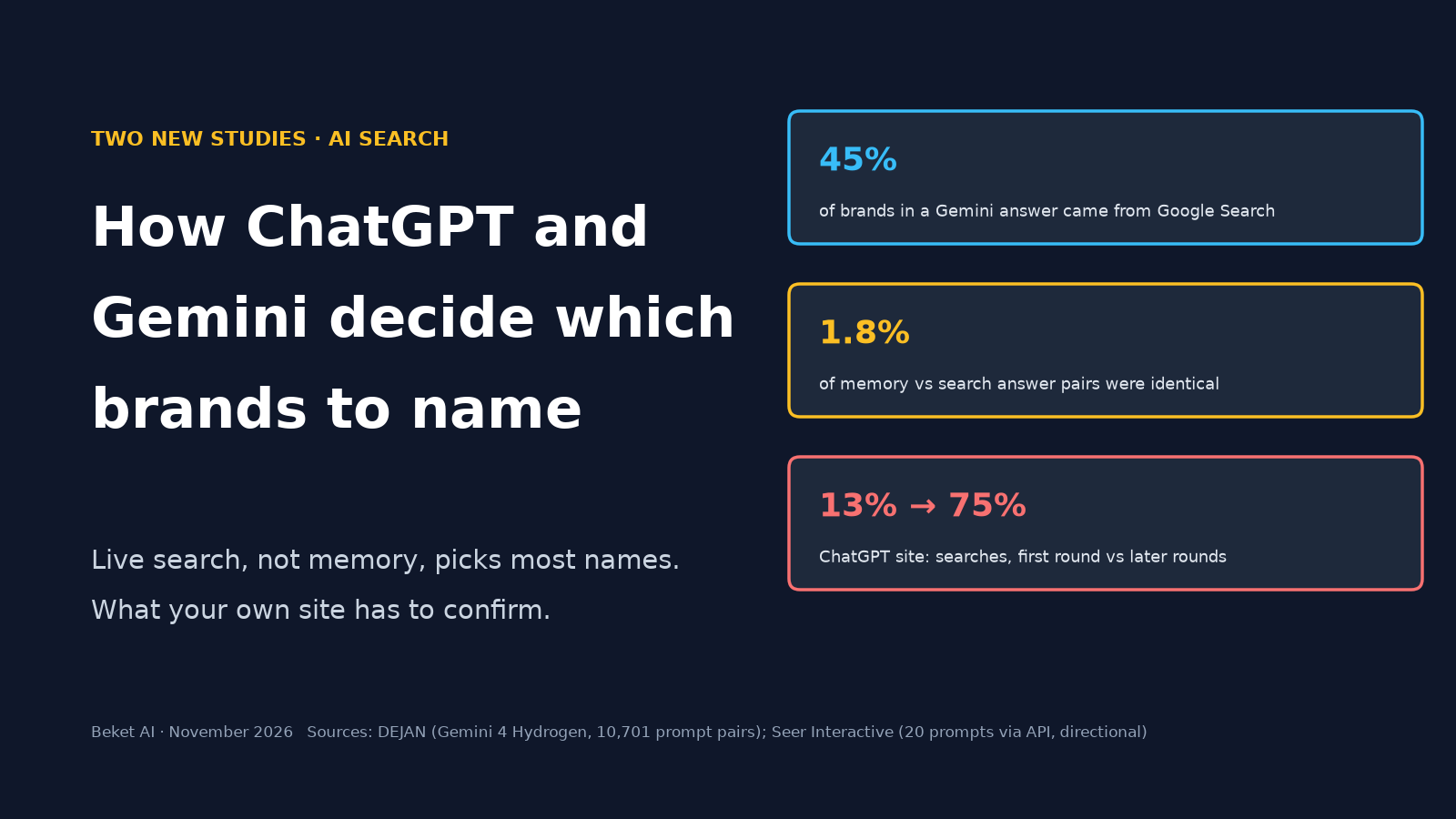
Two studies released in mid-November 2026 looked inside AI assistants as they pick brands, from two different angles. DEJAN asked Gemini 4 Hydrogen the same 10,701 brand questions twice, once from memory and once with Google Search switched on. Seer Interactive read ChatGPT's own reasoning notes, step by step, on 20 prompts. Both reach the same conclusion: most brand names an AI assistant gives you come from what it finds in live search, not from what it remembers.
That changes what a brand should do about it. This post walks through what each study measured, what each can and can't tell you, and a checklist of what your own website needs to confirm. If you have ever asked why isn't my brand showing up in ChatGPT, this is the most detailed look yet at where the decision gets made.
What the DEJAN study found about Gemini
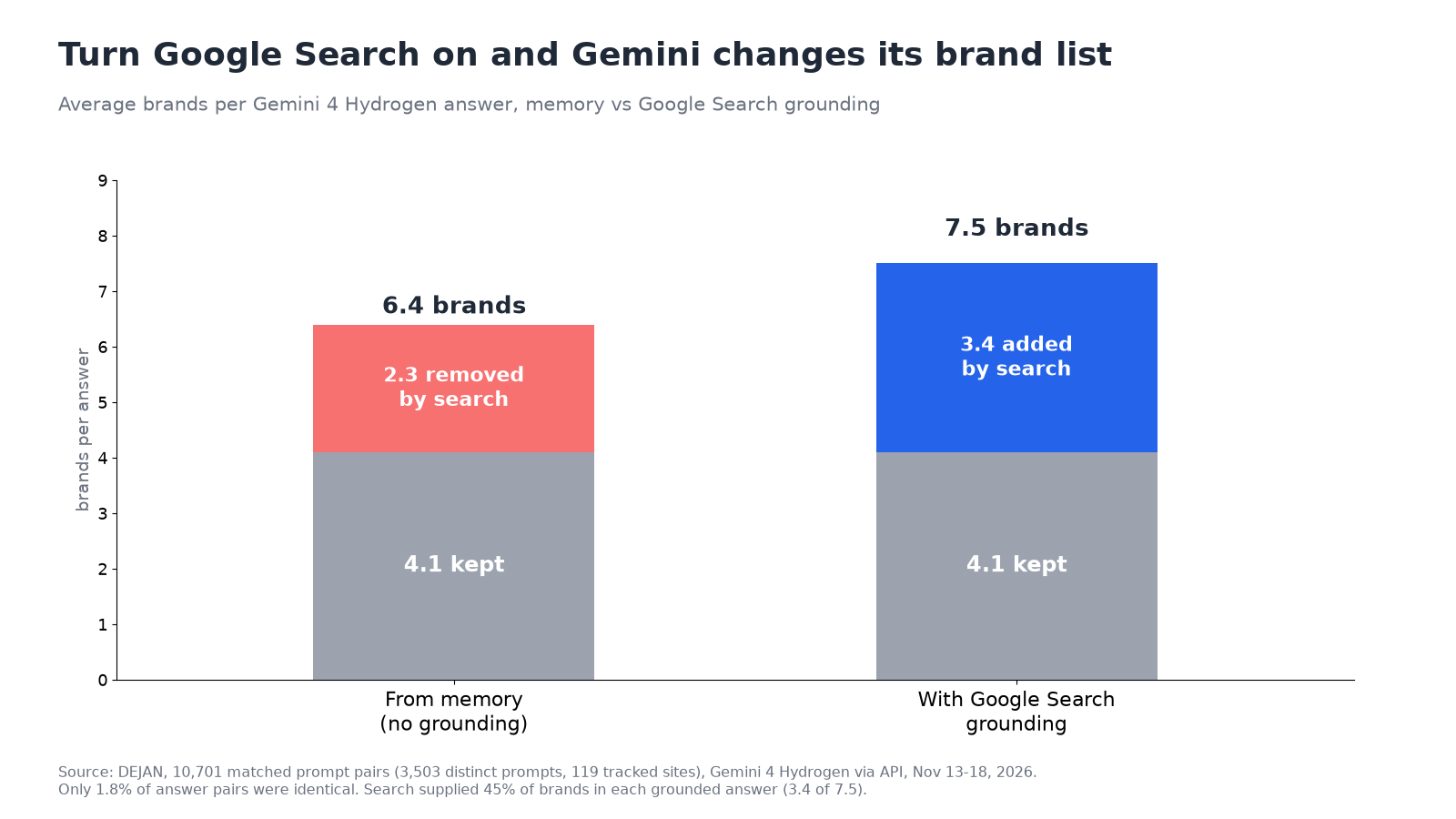
DEJAN, an SEO agency that runs an AI visibility tracking app, ran each tracked prompt on Gemini 4 Hydrogen twice: first with no grounding (the model answering from memory), then with Google Search grounding on. It matched 10,701 of these prompt pairs (3,503 distinct prompts, 119 tracked sites) collected from November 13 to 18, 2026. About 62% of the pairs were in English. The write-up says every figure is a count or a pattern match, with no language model used to score the answers.
The main numbers, per prompt pair:
| Measure | Result |
|---|---|
| Brands named from memory | 6.4 |
| Brands named with Google Search | 7.5 |
| Brands kept in both answers | 4.1 |
| Brands added by search | 3.4 |
| Brands removed by search | 2.3 |
| Answer pairs that were identical | 1.8% |
| Kept brands in the same position | 39% |
| First brand from memory still first with search | 65% |
In plain terms: turn search on, and on average 45% of the brands in the answer (3.4 of 7.5) are ones the model did not name from memory. Only 1.8% of the answer pairs came out the same.
Three patterns from the DEJAN data matter most for a brand:
- Renamed brands get replaced. ESPN BET appeared 226 times from memory and 0 times with search, and the search summaries record its rename to theScore Bet. DEJAN found 26 brands that appeared at least 20 times from memory and at most 10% as often with search. According to the model's search summaries, 13 of those had been renamed or taken over.
- Comparison sites move from the answer into the sources. NerdWallet is among the brands search removed most often, and it appears in the summaries as one of the sites the model read.
- Search widens the list. One US insurer went from 88 mentions from memory to 340 with search, and one US personal-loan brand from 112 to 326.
There is also a useful detail about checking. In the model's reasoning summaries, words like "verify", "confirm" and "double-check" showed up in 75% of the search runs against 20% of the memory runs. Date words such as "latest" or "current" showed up in 88% against 11%. When the model could search, it spent its effort checking whether brands were still current. Of 70 out-of-date brands it named in "mental check" passages, 1 reached the final answer.
What the Seer study found about ChatGPT
Seer Interactive's study took a different route. On November 4, 2026, it ran 20 real prompts through OpenAI's API (GPT-6 Luna at medium reasoning, chosen to line up with ChatGPT's default) and read every reasoning summary ChatGPT wrote on the way to its answer. Seer says the API is "directional" to what happens in the ChatGPT app, so treat the numbers as a look at how the process works, not a measure of what every user sees.
What Seer saw is a loop of reasoning and searching:
- Plan. ChatGPT sets out what matters for the question and which kinds of sources to trust. For a home insurance prompt, it planned to check "the state insurance regulator, a ratings agency, and an insurance association."
- Broad searches. It runs "best of" and review-style searches, which surface list articles.
- Shortlist. It names brands for the first time. It usually names about eight and mentions about six in the final answer. Fewer than 1 in 10 brands were named before ChatGPT's first search. 59% appeared right after the first round of broad searches.
- Targeted checks. It searches the shortlisted brands one at a time, often with the
site:operator to search a single website. In the first round of searching, 13% of queries did this. In later rounds, 75% did. - Trim and answer. In 38% of the final reasoning notes, ChatGPT gave a reason to drop an option. Of the 10 brands it flagged as ones it might trim, 9 did not make the final response.
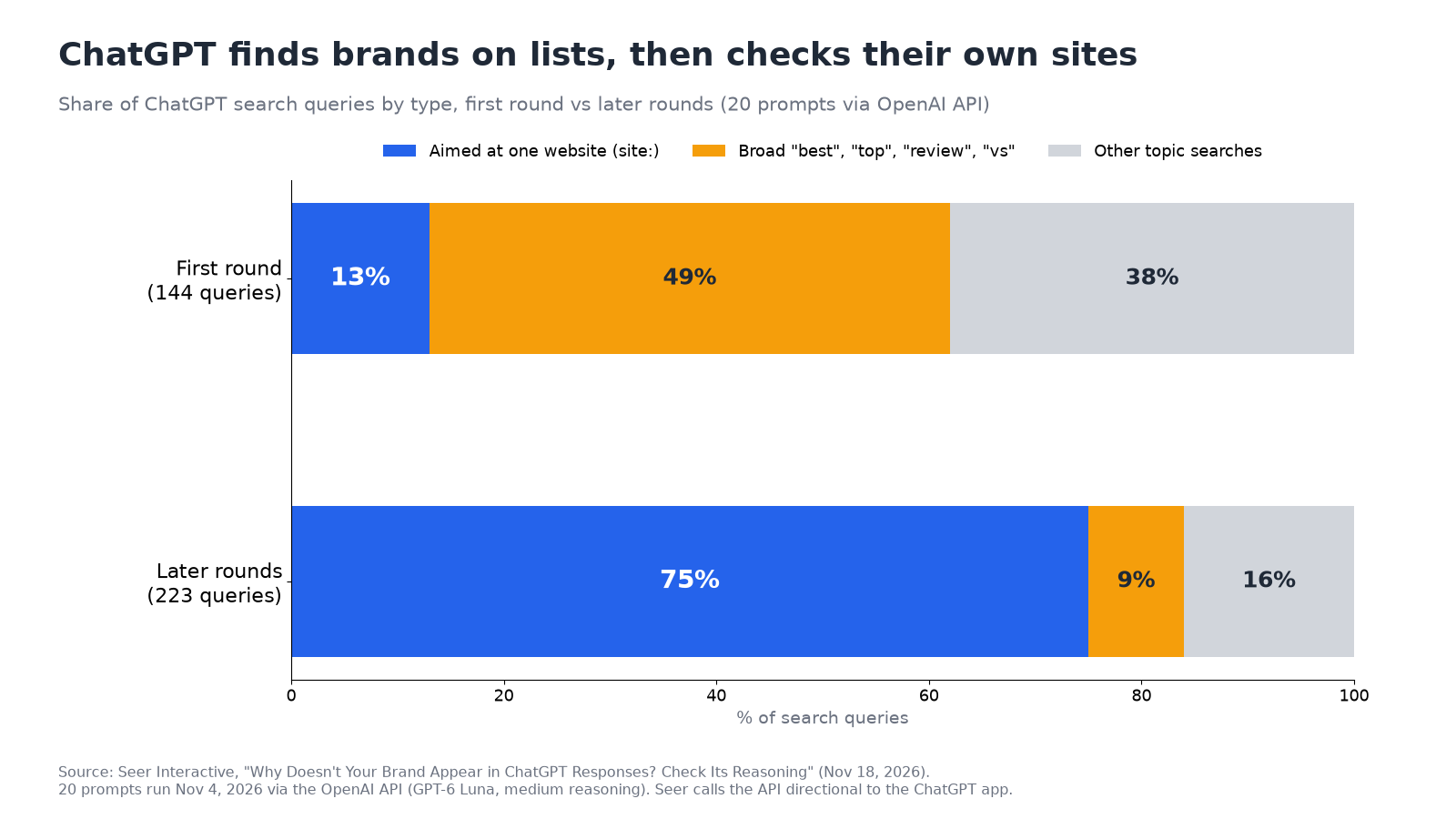
The takeaway is that ChatGPT finds brands on third-party pages, then goes to the brand's own website to check them. If the site doesn't answer the check, the brand can be dropped or listed with a caveat.
Seer sorted the reasons ChatGPT left a brand out into five groups, and rated how hard each is to fix:
| Reason a brand is left out | What it means | Effort to fix (Seer's rating) |
|---|---|---|
| Doesn't fit the exact prompt | Wrong market, buyer or use case | High, often not fixable |
| Website is missing the right signals | The official page has limited information | Low |
| Weaker on what the user asked for | A known weakness, usually kept with a caveat | High |
| Trust concerns | Not on the lists and reviews ChatGPT trusts | Medium |
| Too far down the shortlist | A sixth brand in line may get trimmed | Depends on the other four |
Seer's "low effort" item is the most practical one: surface information you already have that isn't easy to find. For a Baltimore HVAC prompt, ChatGPT wrote that it should "confirm service area and current ratings," and noted that Maryland requires specific licenses, so verifying credentials was "crucial."
Do the two studies agree?
Mostly, yes, with limits worth knowing before you lean on either one.
What they agree on: retrieval decides the list. Gemini changed 45% of its brands when search was on. ChatGPT named almost no brands before searching, and then spent most of its later searching checking the shortlisted brands one by one. Both models spent effort on whether a brand is still current and still fits the question.
What each can't tell you:
- DEJAN tested Gemini 4 Hydrogen through the API, on prompts tracked for 119 sites over six days. That isn't the same as every Google surface. It says nothing about how a Google AI Overview, AI Mode or the Gemini app behaves for your own questions.
- Seer's sample is 20 prompts, run on one day through the API. It shows how the process works. It doesn't give you a rate for how often a brand like yours gets dropped.
- Both studies come from companies that sell AI visibility services or tools. That doesn't make the findings wrong, but it's worth knowing who is reporting.
- The "mental check" finding in the DEJAN data is a quirk in how Gemini describes its own thinking. DEJAN found it in 21% of search summaries, and the final answers did not follow that wording: only 1 of 70 out-of-date brands it covered reached an answer.
Another way to see how far engines differ comes from Beket AI's own local audits. Across 34 of our study audits in Seattle, Vancouver and a few other cities, using the latest run of each question and counting each audit once, Google's AI Overviews named an average of 5.8 businesses per answer, ChatGPT 7.1, and Perplexity 4.4. Of the 1,592 business mentions in AI Overview answers, 265 (16.6%) were also named by ChatGPT for the same question. These counts come from our own entity extraction and our question sets, so read them as a snapshot, not a benchmark. The point they support is the same one the studies make: each engine builds its own list from what it retrieves, so being named by one doesn't mean being named by another. (We covered the local side in more detail in Is the Google Map Pack Going Away?)
What a brand's own site must confirm
Both studies point to the same moment: an assistant has your name from a list, and now it checks your website. This checklist covers what that check is likely to look for. Most items come straight from what the two studies observed. Two are our own suggestions and weren't tested in either study; we mark them. It's a good fit for local and service businesses, where the details are most often missing.
- Your services, in plain words. List each service on its own page or clearly labeled section, using the words customers use ("emergency plumbing", not just "solutions"). The assistant is matching your site against a specific need.
- Your service areas. Name the cities and neighborhoods you serve, and say what you don't cover. Seer found ChatGPT drops brands that don't match the user's location, and "confirm service area" came up in its own reasoning.
- Your current name. If you have rebranded, merged or been acquired, say so on your site ("Formerly known as…") and keep the old name findable. DEJAN's data shows renamed brands vanish from answers when search is on.
- Licenses, certifications and credentials. List every one that applies, with numbers where they're public. Seer says ChatGPT named exact licenses it wanted to check, and that you can't predict every requirement it will look for.
- Contact details that match everywhere. Phone, address and hours should be the same on your site and your listings. This one is our suggestion, not a finding from either study: a mismatch gives a checker a reason to doubt which business is which.
- Pricing or price ranges. Seer noted that unclear pricing was one way brands came across as less trustworthy.
- Proof from other places. Because the shortlist is built from third-party "best of" and review pages, your presence there matters as much as your own pages. See what the latest GEO research says moves a brand for what helps and what doesn't.
- Pages a crawler can read. Our suggestion, not tested in either study: the checks happen on your own pages, so key facts shouldn't sit only in images or behind a form. For how this fits the wider picture, see what decides whether AI assistants mention your company.
How to test this for your own brand
Do what Seer suggests: run the prompts your customers actually use, and read the reasoning where you can see it. In the OpenAI Playground, you can open the assistant's thought summary and its search outputs to see the queries it ran and the sources it used. Then look for three things:
- The sources it says it will trust. Are you on them?
- The must-haves it names. Does your site state them plainly?
- How many brands it plans to list. Are you named and then dropped?
For Gemini, the practical version of DEJAN's finding is to compare an answer with search and without it. If a brand appears in one and not the other, your visibility depends on what live search returns. If you need to see how ChatGPT's search step works before you test, start there.
To see which of your questions name you today, a Beket AI free audit runs 25 prompts on any 3 of its 6 engines. What you do about the results happens on your own site and on the sites that list you.
The short version
- Gemini 4 Hydrogen kept about 55% of its brands and added 45% with search on (DEJAN, 10,701 prompt pairs). Only 1.8% of answer pairs matched.
- ChatGPT named fewer than 1 in 10 brands before searching, built a shortlist from broad "best of" and review searches, then checked those brands on their own sites (13% of first-round queries, 75% of later ones). Seer's sample was 20 prompts through the API, so treat it as directional.
- Being on the lists the engines search first gets you onto the shortlist. Your own site decides whether you stay on it.
- Make your site state your services, service areas, current name and credentials plainly, and keep your details consistent everywhere they appear.
Related posts
Is the Google Map Pack Going Away? AI Overviews Now Replace It on Some Local Searches (2026)
A new study found Google AI Overviews replacing the map pack on 79 of 80 local searches. Why other data disagrees, what our audits show, and what to check now.
Does llms.txt Work? We Checked 3,844 Sites AI Engines Cite (2026 Data)
We checked 3,844 sites cited by ChatGPT, Perplexity and AI Overviews for llms.txt. The most-cited sites had it least. Our data, other studies, what to do.
Does GEO Actually Work? What 2026 Research Says Moves a Brand in AI Answers
Does GEO actually work? Three 2026 studies find honest rewrites barely move AI rankings, brand familiarity does, and fake evidence works. What it means for you.