
Generative Search Visibility: What Decides Whether AI Assistants Mention Your Company (2026)

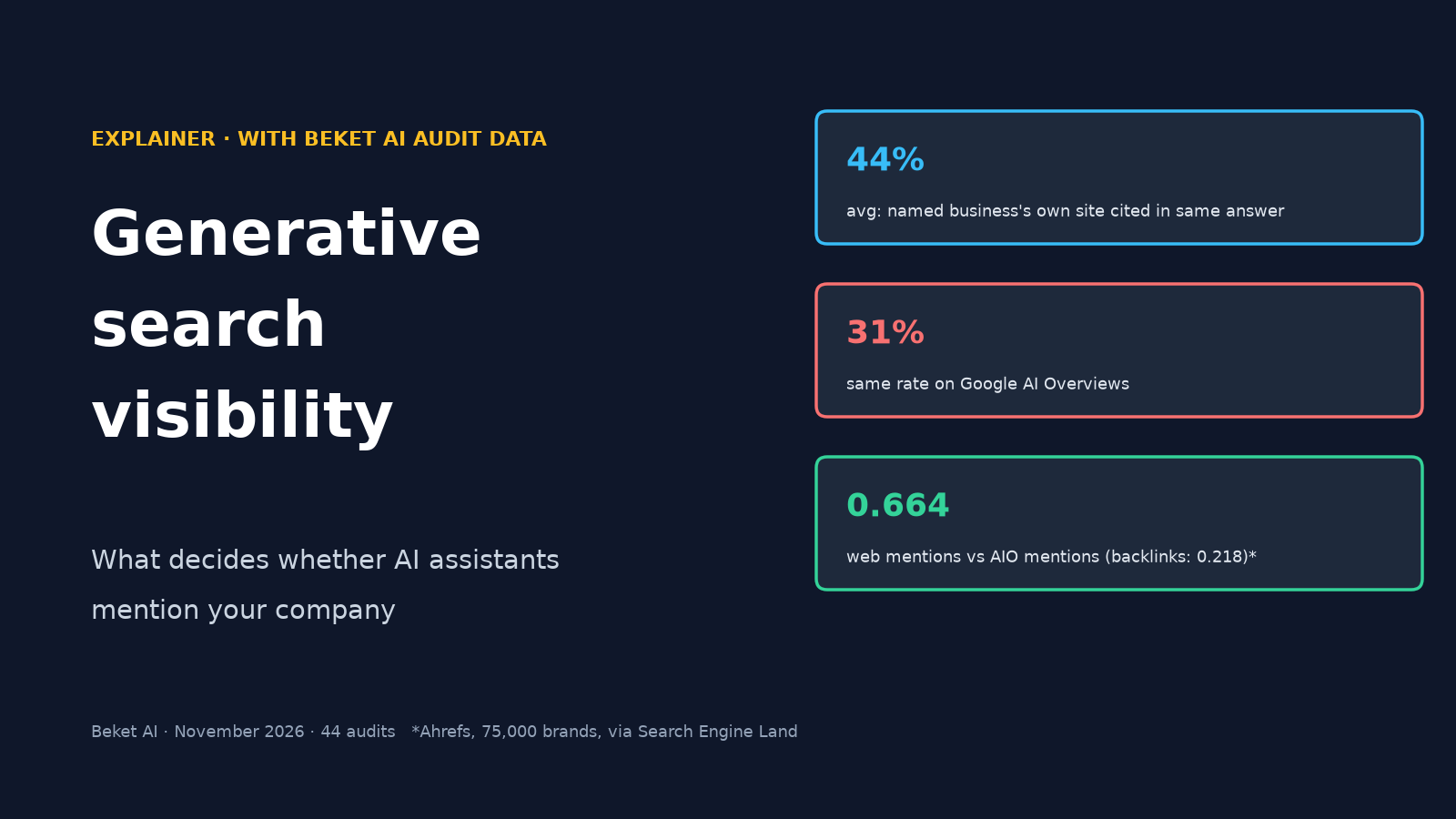
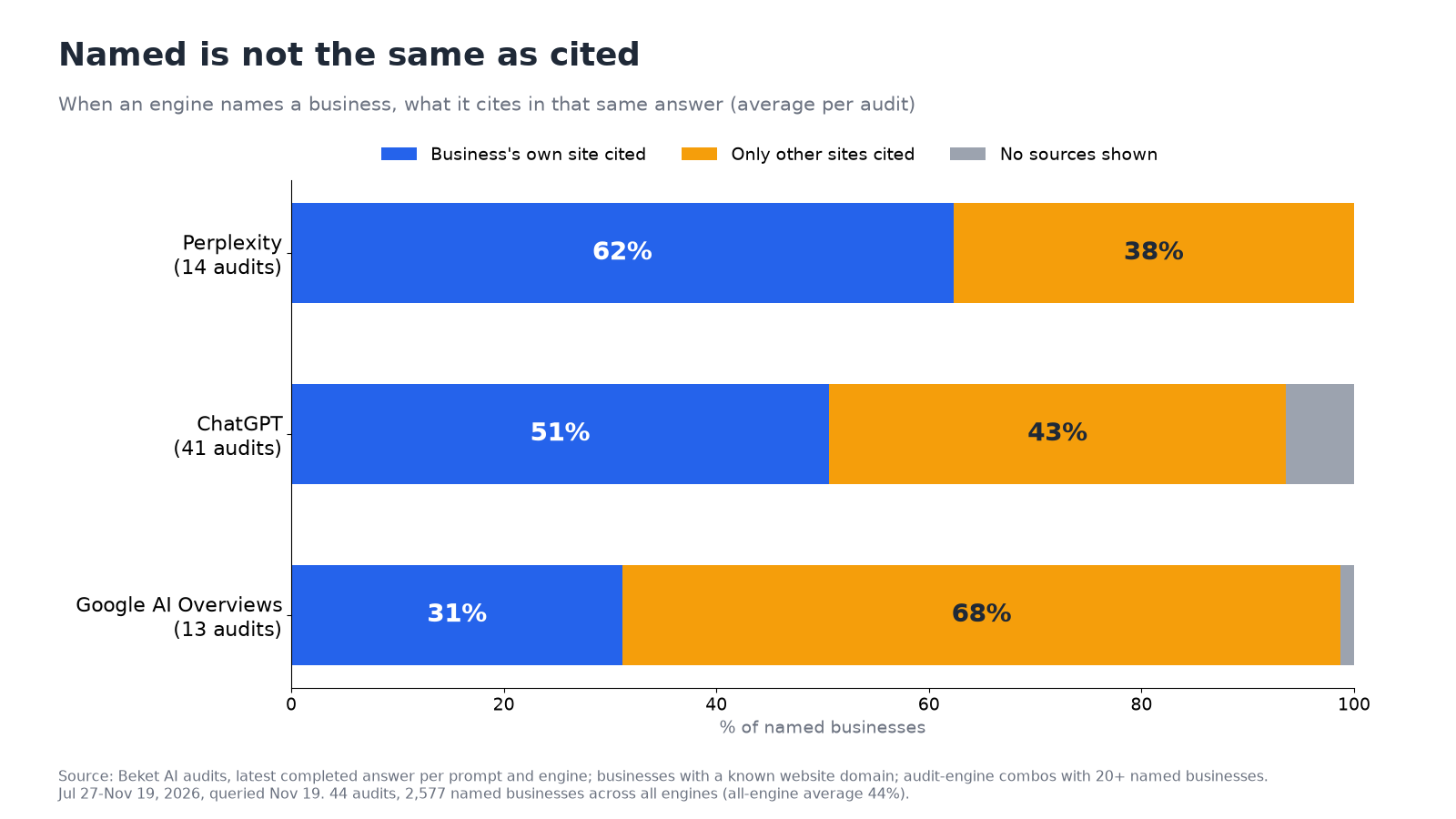
When an AI engine names a business in an answer, you'd expect it to link to that business's website. Usually it doesn't. Across 44 Beket AI audits, when ChatGPT, Perplexity or Google AI Overviews named a business whose website we could identify, that business's own site was among the cited sources only 44% of the time on average. The rest of the time the answer cited other pages, like reviews, lists, directories, forums and news, or nothing at all.
That one number explains most of what "generative search visibility" is about. Whether an AI assistant mentions your company depends partly on your site, but mostly on what the model already knows about you and what the rest of the web says. This explainer sorts the factors that public research has actually tested, ranks them by how strong the evidence is, and shows where they differ by engine.
What "generative search visibility" means
Generative search visibility is how often, and how well, AI answer engines include your company when people ask questions you should show up for. It covers ChatGPT, Gemini, Perplexity, Microsoft Copilot, Google AI Overviews and Google AI Mode. Classic search visibility asks "where do I rank?" This one asks three narrower questions:
- Mentioned: does the answer name you at all?
- Cited: does it link to one of your pages as a source?
- Described: when it names you, are the facts and the framing right?
These don't move together. You can be mentioned without being cited (the model knows you, or a review site vouches for you). You can be cited without being mentioned (your blog post is used as background for an answer that recommends a competitor). For buyers, being mentioned in a recommendation answer is usually what counts, so that's the focus here. The broader discipline of improving it is generative engine optimization (GEO).
Visibility is also measured per prompt, per engine and per day, not as one score. Answers change often. In our analysis of daily Beket AI audits, only 30.1% of next-day answers named exactly the same set of brands as the day before. So "are we visible?" is always a question about rates over many answers, not one screenshot.
Two routes into an AI answer
Every factor below works through one of two routes.
1. What the model already knows. Large language models answer from what they learned in training (often called parametric knowledge) unless they search. Some answers involve no search at all: in a pre-registered test of 235 queries, Laurelin Labs found Gemini ran no search in 47% of its answers. Even when a model does search, what it already knows shapes what it searches for. Graphite's research looked at about 957,000 ChatGPT fan-out queries from 22,953 comparison prompts that named no brand. 59.6% of those background searches contained a brand name anyway, which means the model's memory decided which brands it went looking for.
2. What the engine retrieves right now. When an engine searches, it pulls pages, picks passages and builds an answer from them. Here classic signals (being indexed, ranking, having clear and specific content) matter, and so do the third-party pages that get retrieved instead of yours.
The two routes feed each other. Graphite found that even brands mentioned on at least 15% of the pages ChatGPT cited reached only 11% median visibility when the model rarely named them without search. Being on the right pages wasn't enough if the model didn't already "know" the brand. Graphite sells AEO services and tested comparison prompts only, so treat that as a strong hint, not a law.
The factors, ranked by the evidence
Most "AI ranking factor" lists are opinion. The table below includes only factors with public data behind them, and rates the evidence honestly. "Strong" means large datasets or a pre-registered design that point the same way. "Moderate" means one good study or a consistent but correlational pattern. "Weak" means a single vendor claim or lab-only result.
| Factor | What the evidence shows | Where it matters most | Evidence |
|---|---|---|---|
| Third-party mentions (how widely and consistently other sites talk about you) | Among 75,000 brands, branded web mentions correlated 0.664 with Google AI Overview brand mentions, vs 0.218 for raw backlink count (Ahrefs data via Search Engine Land). Victorious found the strongest signals tied to being mentioned came from a brand's presence across the rest of the web (Victorious). | All engines | Strong (correlational) |
| Model familiarity (how well the model knows you without searching) | Low no-search visibility capped search visibility at an 11% median even for well-covered brands; 59.6% of ChatGPT fan-out queries contained a brand (Graphite). | ChatGPT, Gemini, any answer without search | Moderate |
| Organic ranking for the main question | Better head-query rank was strongly associated with AI Overview citation in a pre-registered test (Laurelin Labs). The #1 organic page was cited on 43.1% of AI Overview results pages, yet only 30.1% of 133,099 citations pointed to a top-10 page (PageSpeed Matters). | Google AI Overviews (much less elsewhere) | Strong for Google, weak elsewhere |
| Specific, extractable content (facts, numbers, sourced claims, visible text) | In the original GEO paper, adding citations, quotations and statistics raised a source's visibility by up to 40% in test engines (Aggarwal et al.). Text hidden in tabs and accordions held 17.4% of words on cited pages but supplied 9.5% of AI Overview quotes (PageSpeed Matters). Longer pages were cited more often (Laurelin Labs). | All engines that search | Moderate |
| Presence on the source types each engine prefers | User-generated content was 8.6% of Google AI Overviews' sources and 7.0% of AI Mode's, vs 1.1% for ChatGPT and Perplexity and 1.3% for Gemini (Searchable). Two platforms asked the same question share only 4% to 10% of the sites they cite (Victorious). | Differs by engine | Moderate |
| Basic eligibility (crawlable, indexed, snippet-eligible) | Google says a page must be indexed and eligible to show with a snippet to appear as a supporting link in AI Overviews or AI Mode, and that no special files or schema are required (Google Search Central). | Google; similar logic for other engines' crawlers | Documented requirement |
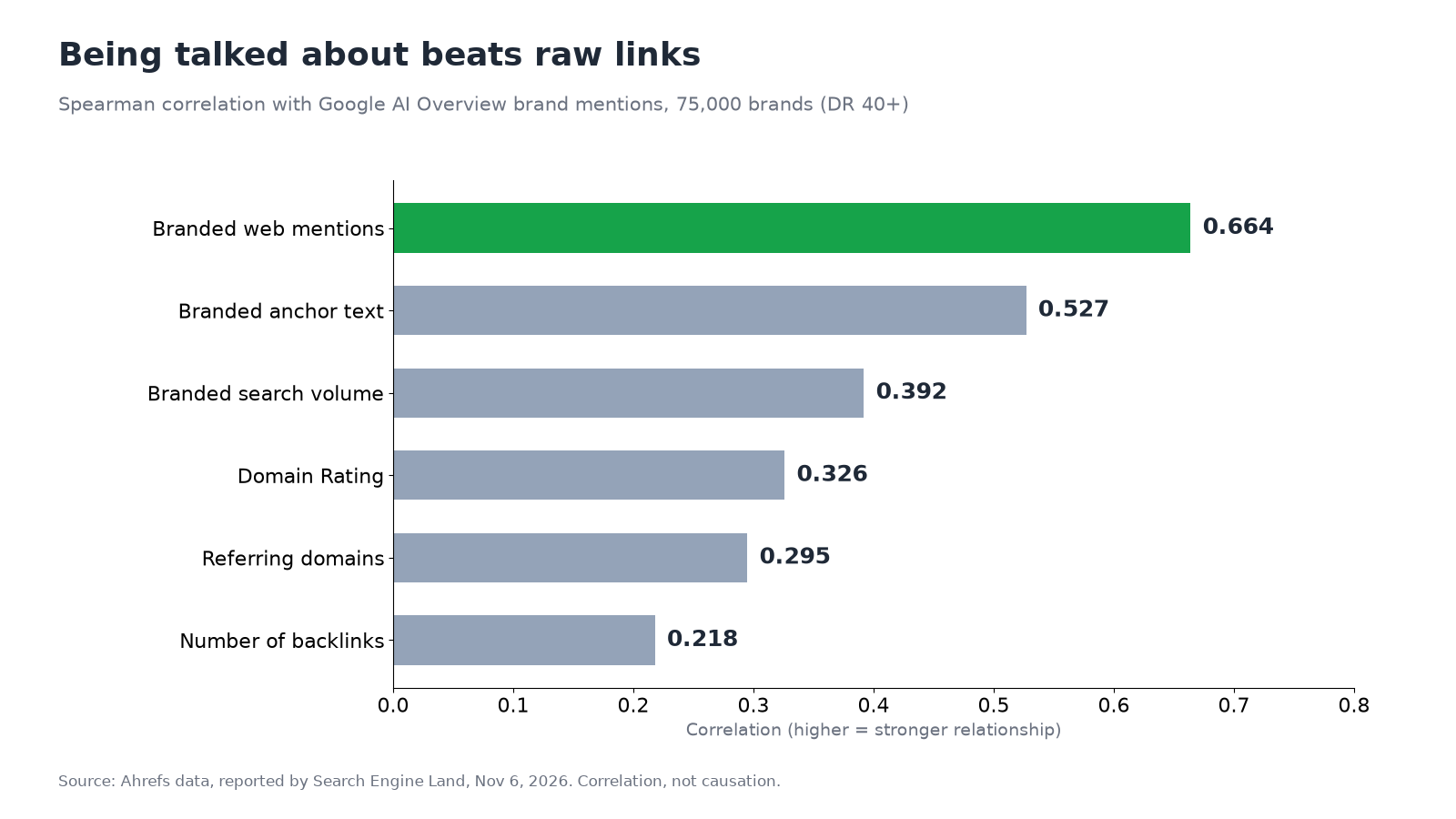
Two things stand out. First, the strongest factor isn't on your website at all. It's whether independent sources discuss you, which is why our post on why third-party signals drive AI mentions argues they outweigh your own content. Second, the factors differ by engine more than most advice admits. Ranking well on Google gets you a long way with AI Overviews. It does much less for ChatGPT or Perplexity. Victorious found 37% of AI Overview citations ranked in Google's top 10 for the same question, against 13% to 18% for ChatGPT, Perplexity and Copilot.
What the evidence says matters less than you'd think
A few popular tactics have been tested and came up short. That doesn't mean they're harmful, just that they aren't the deciding factors.
- Adding schema markup to win AI citations. Ahrefs tracked 1,885 pages that added JSON-LD and found no major citation uplift on Google AI Overviews, AI Mode or ChatGPT. AI Overview citations for those pages fell slightly (4.6%) against matched controls, a dip Ahrefs couldn't clearly pin on the schema (Ahrefs, May 2026). Schema still helps search engines understand a page, but it isn't a visibility switch. Google's own guidance says no special structured data is needed.
- Scoring pages by how many fan-out sub-questions they answer. In Laurelin Labs' pre-registered test, ranking for sub-queries, heading similarity to the query and the share of sub-queries a page answered added no out-of-sample predictive value for AI Overview citation. Head-query rank and page length did.
- Raw link volume. In the Ahrefs data, number of backlinks was the weakest of six signals tested (0.218), and about 26% of the brands studied had zero AI Overview mentions despite all having a Domain Rating above 40.
- Special "AI files." Google states you don't need new machine-readable files or AI text files to appear in AI Overviews or AI Mode.
What Beket AI's audits show: being named is not the same as being cited
To see how much of visibility happens off your site, we looked at Beket AI's own audits. For every answer that named a business with a known website, we checked whether that website was among the answer's cited sources.
| Engine | Audits | Named businesses checked | Own site cited | Only other sites cited | No sources at all |
|---|---|---|---|---|---|
| Perplexity | 14 | 388 | 62.3% | 37.7% | 0.0% |
| ChatGPT | 41 | 1,307 | 50.6% | 43.0% | 6.4% |
| Google AI Overviews | 13 | 405 | 31.2% | 67.5% | 1.3% |
Averages per audit, so each audit counts once. Across 44 audits and 2,577 named businesses on all engines, the own-site rate averaged 44.4%.
What this means in practice:
- On Google AI Overviews, two out of three times a business is named, the proof comes from someone else's page. That fits the public data on user-generated content and review sites. Your Google Business Profile, reviews, Reddit threads and YouTube coverage carry a lot of weight there.
- Perplexity is the most likely to cite you directly when it names you, so your own pages (service pages, pricing, comparisons) are worth the most there.
- ChatGPT sits in the middle, and it's the engine where an answer names businesses without showing any source at all (6.4%), the "already knows you" route at work.
These are Beket AI's own audits, not a random sample of all businesses, and answers change from day to day. They are the data the engines returned on the dates we ran them, and any business in them can request another run. Other engines (Google AI Mode, Microsoft Copilot, Gemini) had too few qualifying audits to report.
How the factors play out on each engine
The same company can be highly visible on one engine and missing on another, because each engine leans on a different mix of the factors above. A practical summary:
| Engine | What tends to decide visibility | Where to look first |
|---|---|---|
| Google AI Overviews | Organic rank for the question, plus third-party and user-generated pages | Your rankings, Business Profile, reviews, YouTube and Reddit coverage |
| Google AI Mode | Runs many related searches, leans on user-generated content more than chatbots do | Same as AI Overviews, plus pages that answer follow-up questions |
| ChatGPT | Model familiarity plus live search that often reaches beyond Google's top 10 | Mentions in lists, reviews and news; your own product and pricing pages |
| Perplexity | Live retrieval with many cited sources per answer | Clear, specific pages on your site that answer the question directly |
| Gemini | Often answers without searching at all (47% of answers in Laurelin's test) | Long-term brand coverage that shapes what the model knows |
| Microsoft Copilot | Grounded in Bing search; only 13% to 18% of ChatGPT, Perplexity and Copilot citations ranked in Google's top 10 in Victorious' data | Bing indexing and Bing Webmaster Tools, plus third-party coverage |
This table is guidance drawn from the studies above, not a documented ranking system. None of the engines publishes how it picks which businesses to name.
How to tell whether these factors are working for you
Because the factors differ by engine and answers keep changing, the only reliable way to judge your generative search visibility is to measure it directly:
- Use unbranded buyer questions. "Best accounting software for small restaurants," not "Is [Brand] good?" Unbranded questions show whether the engine picks you on its own.
- Check every engine your buyers use. Being cited on one engine says little about the others.
- Repeat the same questions over time. Track the share of answers that name you, not a single result.
- Look at the sources, not just the mentions. When you're named without your site being cited, find out which pages vouched for you. When a competitor is named instead, find out which pages vouched for them. Those pages are your to-do list. Our guide on how to get cited by ChatGPT covers the on-site side.
A free Beket AI audit runs 25 prompts on any 3 of the 6 engines and shows your score, the answers it flagged, the competitors named and a fix list. Beket AI Pro ($49 per month per site) re-checks 50 prompts daily on 3 engines, configurable up to all 6, so you can see which factors are moving your share over time. See pricing for add-ons.
How we got our numbers
- Own site cited when named: Beket AI audits, excluding demo, agency-demo and archived audits. For each prompt and engine we kept only the latest completed answer. For each answer we took the businesses Beket AI identified with a known website domain, then checked whether that domain (or a subdomain) appeared among the answer's cited sources. We kept audit and engine combinations with at least 20 named businesses, averaged per audit, then averaged across audits so each audit counts once. That left 44 audits (83 audit and engine combinations, 2,577 named businesses) with answers from July 27 to November 19, 2026, queried November 19, 2026. Businesses without a detected domain aren't included, and entity matching can miss or misattribute a small share of mentions.
- Next-day churn: from our daily audit analysis.
- All Beket AI figures are aggregates. No customer names, brands or prompts are shown.
- Public studies are linked inline. Several come from companies that sell SEO or AI visibility services (Ahrefs, Graphite, PageSpeed Matters, Searchable, Victorious), and most are correlational. We've labeled the strength of each finding in the factors table.
The short version
Generative search visibility is decided in three places: what the model already knows about you, what independent sources say about you, and what your own pages make easy to quote. The research says the second matters most overall, the first matters more than most teams assume, and the third is the part you fully control. Measure all six engines separately, because each one weighs those three differently.
Related posts
AI Brand Monitoring: A Weekly Routine to Track What AI Says About Your Brand (2026)
AI brand monitoring as a weekly routine: which prompts to run, which engines to check, what to log, how to triage wrong answers, and the tools that help.
How to Get Your Product Recommended by ChatGPT: 7 Steps for Brands and Online Stores (2026)
How to get your product recommended by ChatGPT: catalog and feed access, OAI-SearchBot, product page facts, reviews, roundups and current prices, plus our data.
Ads Now Sit Next to Bing's AI Overviews: What Changes for Organic Citations
Microsoft confirmed ads next to Bing's AI Overviews on Nov 19. What it said, what it left out, and what to check before Black Friday.