
How to Get Your Product Recommended by ChatGPT: 7 Steps for Brands and Online Stores (2026)

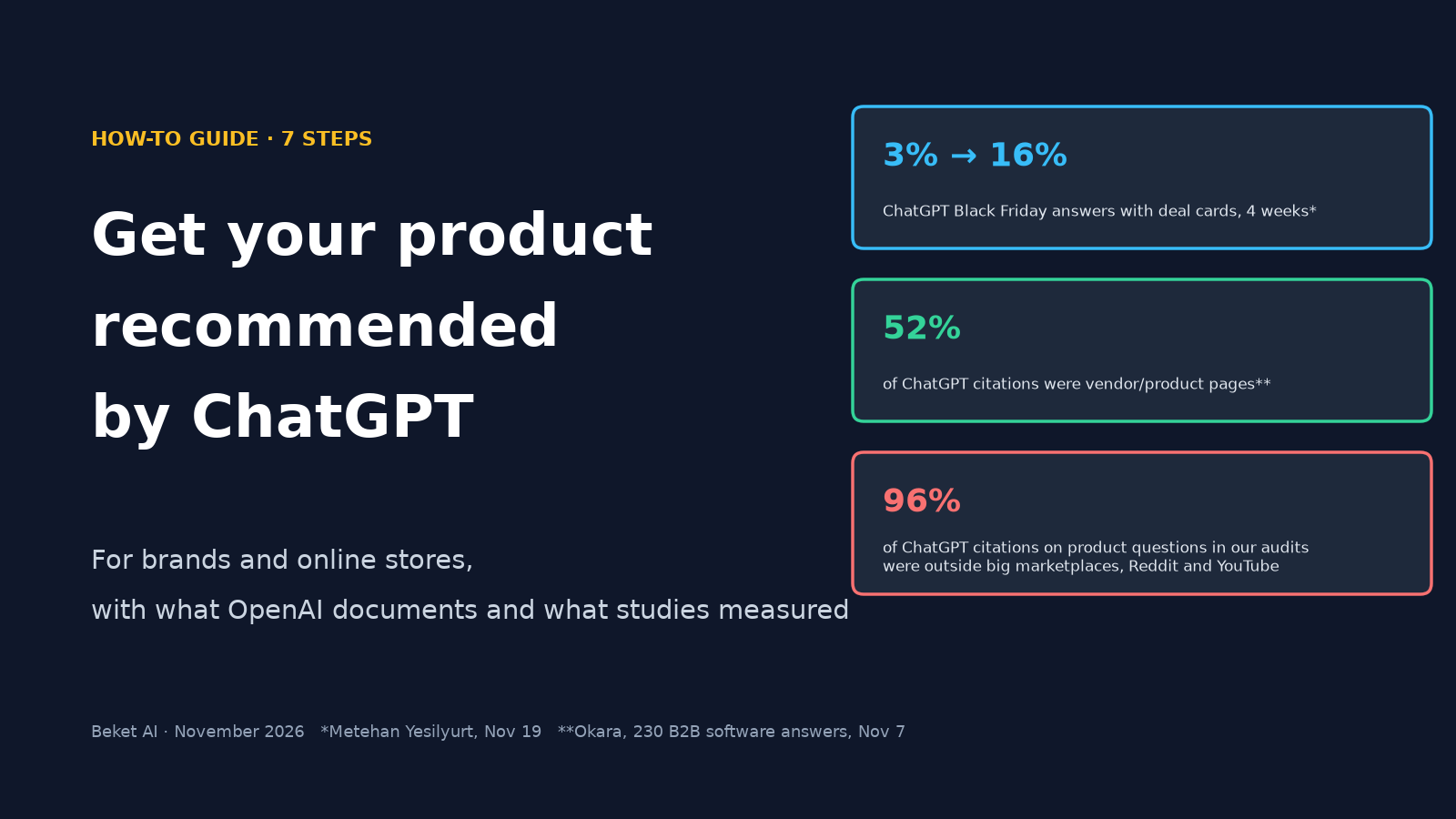
Ask ChatGPT for Black Friday hosting deals this week and you may not get a list of links at all. On November 19, Metehan Yesilyurt posted screenshots of ChatGPT answering with a card per brand: the discount, an end date, the coupon code, a Copy button and a "Get deal" button. On November 20, Search Engine Roundtable reported that Google AI Overviews now hand out promo codes too. In the Black Friday prompts Yesilyurt tracks, those deal cards went from about 3% to 16% of ChatGPT answers that show products in four weeks, while the old product carousel dropped by about half and was replaced by roughly four product cards placed inside the text.
That is the state of play if you want ChatGPT to recommend your product: the product is now part of the answer, and the answer is built from data you can partly control. This guide covers the seven steps that matter, in the order we'd do them, using what OpenAI documents and what independent research has measured. Where we have our own audit data, we show it.
Three ways a product shows up in ChatGPT
"Recommended by ChatGPT" covers three different surfaces. Each one reads different data, so each needs a different fix.
| Surface | What the shopper sees | Where the data comes from | Your main lever |
|---|---|---|---|
| Product cards | Image, price, merchant list, ChatGPT-written labels like "Budget-friendly" | Structured product metadata from merchants and third-party providers (OpenAI Help) | A complete catalog listing or feed, accurate prices |
| Named in the text | Your product in a written shortlist, with cited sources | Search results, third-party content and what the model already knows | Crawlable product pages, reviews, roundup coverage |
| Deal cards (seen Nov 2026) | Discount, end date, code, Copy and "Get deal" buttons | Promo data ChatGPT finds, including community and affiliate pages | A current, official promo page |
OpenAI is explicit that product results are not ads. Its help page says ChatGPT weighs structured metadata from first-party and third-party providers, "model responses generated by ChatGPT before it considers any new search results", and its safety policies. In other words, there are three inputs: your data, other people's content about you, and the model's prior knowledge. The seven steps below work on all three.
Step 1: Find out what ChatGPT says today
Before changing anything, write down 10 unbranded questions a real buyer would ask, such as "best carry-on backpack under $150 for business travel" or "which accounting software works for a 5-person agency". Leave your brand name out. Run each one in ChatGPT logged out, note which products are named, which sources are cited, and whether a card shows your price correctly.
Run them more than once. In an Okara study of business software questions, asking ChatGPT the same 40 questions twice on the same day produced answers that shared only 62% of their brands and 41% of their cited sources. One screenshot tells you very little; a fixed question set repeated over a few weeks tells you your real share. Our guide to how ChatGPT shopping picks products explains the selection process behind what you'll see.
Step 2: Get your catalog into ChatGPT
Product cards need product data. OpenAI's merchant page says that if you sell through Shopify or Etsy, "your catalog is already integrated, and no additional setup or application is required." Other merchants can apply to share a product feed. Two details from that page matter for planning:
- Shopping is live for ChatGPT users in the U.S., with more regions planned.
- A feed is optional if ChatGPT already crawls your site, but OpenAI says feeds give "greater control over how your products appear", including current pricing and availability.
There are no fees on purchases that start in ChatGPT, and checkout happens on your own site or app. If you're building a feed, our walkthrough of submitting a product feed to ChatGPT covers the required fields and the mistakes that get rows rejected.
Step 3: Let OAI-SearchBot read your product pages
Even with a feed, ChatGPT's written answers lean on search. OpenAI's crawler documentation separates two bots: OAI-SearchBot is for search, GPTBot is for training, and the settings are independent. You can allow OAI-SearchBot so your pages can appear in ChatGPT search while blocking GPTBot from training. OpenAI notes it can take about 24 hours for a robots.txt change to take effect.
Check three things: robots.txt doesn't block OAI-SearchBot, your CDN or bot protection isn't challenging it, and product pages render their price, specs and stock without needing a click.
Step 4: Put the facts on the product page in plain text
ChatGPT rewrites what it shows. OpenAI says it "may generate simplified product titles and descriptions" and adds labels based on information available to the model. If your page hides the facts that answer a buyer's question (dimensions, compatibility, who it's for, what's in the box, the price), the model fills the gap from someone else's page.
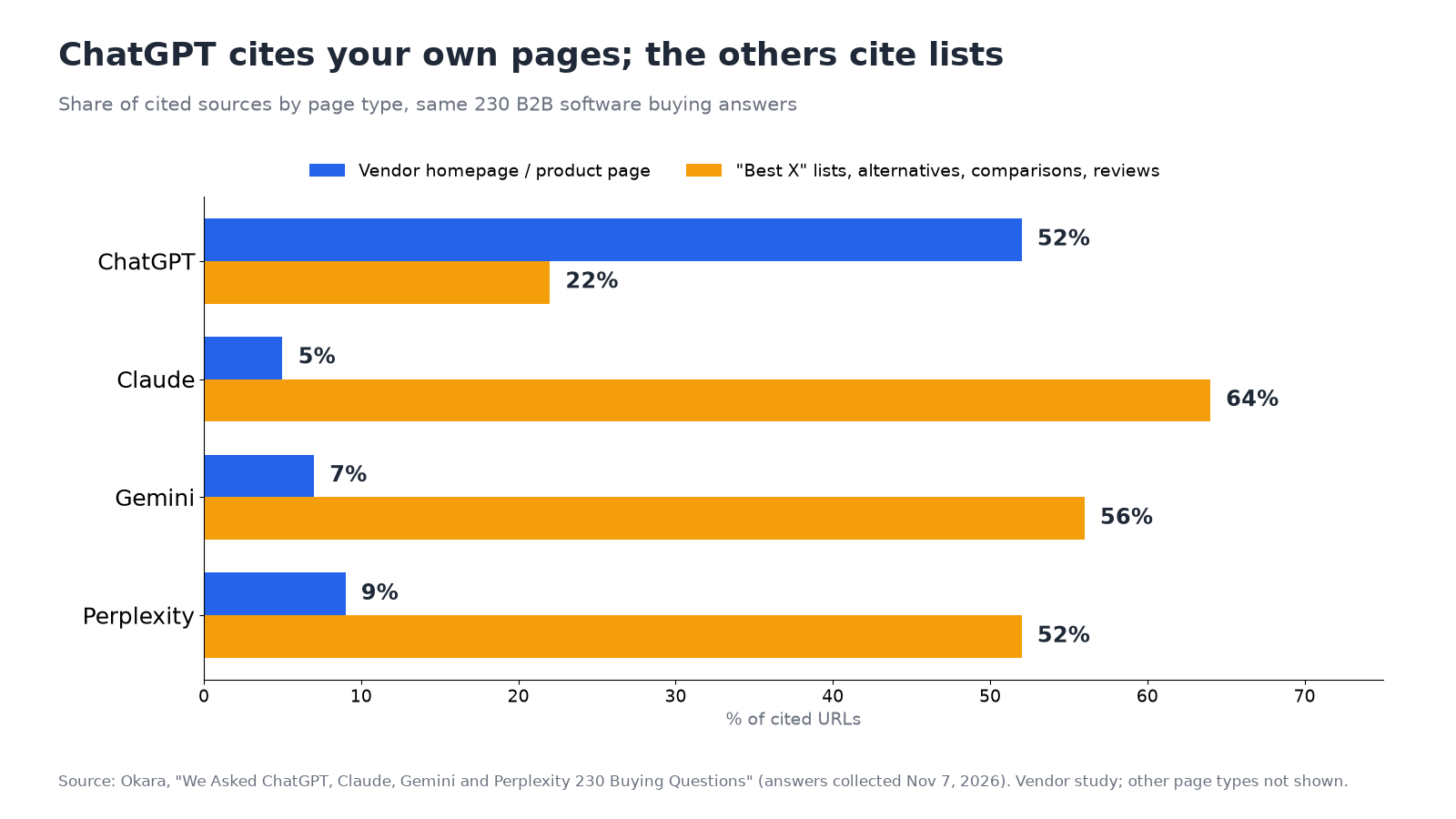
Your own page carries real weight in ChatGPT specifically. Okara grouped every URL cited across 230 software buying answers. Vendor homepages and product pages made up 52% of ChatGPT's citations, versus 5% to 9% for Claude, Gemini and Perplexity, which leaned on roundups and comparisons instead.
Write each product page so a single paragraph answers "who is this for and why pick it over the alternatives", in words a buyer would use in a question.
Step 5: Earn reviews that say something
OpenAI says ChatGPT may show review summaries "based on reviews from public websites" that highlight common likes and dislikes, and that when someone asks for options it may weigh "price, reviews, and ease of use". Reviews are not verified by OpenAI, which means what reviewers repeat about you is what the summary will repeat.
Independent research points the same way. A Columbia, Yale and MyCustomAI paper on AI shopping agents found that agents' sensitivity to price, ratings and reviews "vary sharply across models", that agents concentrate demand on a few products, and that a seller making simple, query-specific description changes "can drive significant gains in market share." The takeaway is not to game reviews but to ask customers for specific ones: what they used it for, what it replaced, what surprised them.
Step 6: Get into the lists ChatGPT reads
ChatGPT names products it already knows about, and part of that knowledge comes from third-party coverage. In the Okara data, "best X", alternatives, comparison and review pages made up 22% of ChatGPT's citations and 52% to 64% of Claude's, Gemini's and Perplexity's. If a shopper cross-checks your product in another assistant, those lists are what it reads.
Practical moves:
- Find the roundups ChatGPT cites for your category in Step 1, and pitch the ones you're missing from with a sample, specs and a clear reason you belong.
- Make sure comparison and "alternatives" pages describe you accurately; correct outdated specs or prices with the publisher.
- Keep marketplace listings consistent with your site, since ChatGPT ranks merchants partly on "whether they are the maker or primary seller", per OpenAI.
Step 7: Keep prices, stock and promo codes current
OpenAI ranks merchants on "availability, price, quality, and whether they are the maker or primary seller", and warns there may be "some delay" before price or shipping changes appear. The deal cards that showed up this month raise the stakes: Yesilyurt noted that codes like BLACKFRIDAYREDDIT were clearly pulled from community and affiliate pages, with the source shrunk to a small pill. His advice for brands: "put the real, current code on your official promo page. Otherwise AI will pick whatever it finds on Reddit."
Before November 27, publish your Black Friday offers on one official page in plain text (code, discount, dates, exclusions), make sure your feed's sale price matches it, and expire old codes on the page when they end.
What our own audits show about product questions
Beket AI's audits include questions about specific products, so we checked which kinds of sites the engines cited for them. We took the latest completed answer for each product question on each engine, sorted cited domains into big retailers and marketplaces (Amazon, Walmart, Target, Best Buy, eBay, Etsy and similar), Reddit, YouTube, Wikipedia and everything else, and averaged the shares across audits so no single audit dominates.
| Engine | Audits | Answers | Citations | Big retailers | YouTube | All other sites | |
|---|---|---|---|---|---|---|---|
| ChatGPT | 27 | 78 | 269 | 3.8% (2 audits) | 0.2% (1 audit) | 0% | 96.0% |
| Perplexity | 25 | 68 | 987 | 2.7% (4 audits) | 0.2% (2 audits) | 0% | 97.1% |
| Google AI Overviews | 26 | 55 | 331 | 0.6% (1 audit) | 2.5% (6 audits) | 5.4% (10 audits) | 91.5% |
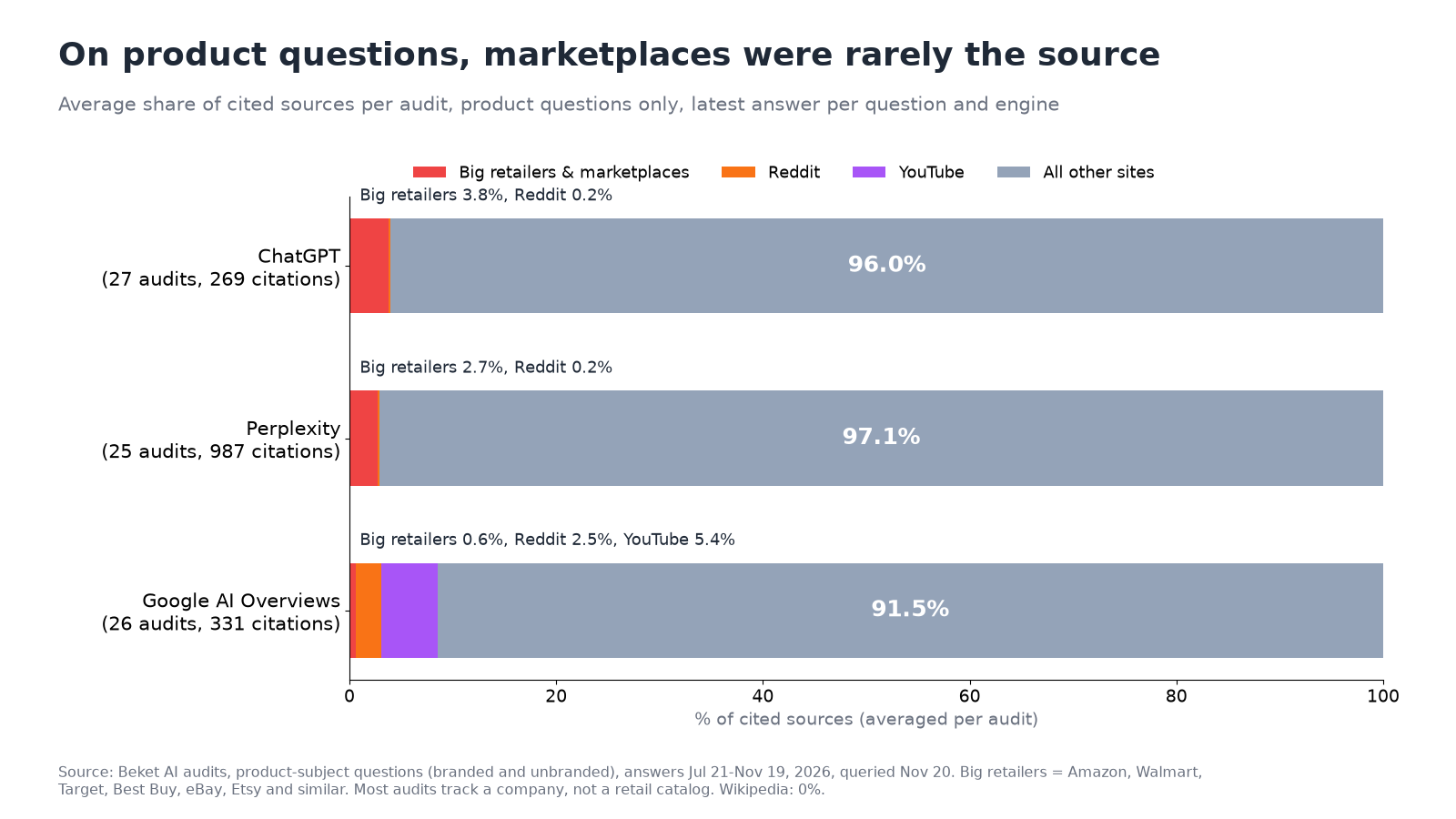
Two things stand out. Big marketplaces were rarely the cited source, even on ChatGPT, and none of the citations went to Wikipedia. Nearly everything came from other sites: brand sites, publishers, review and comparison pages and the rest of the web, which we didn't break down further. That backs up Steps 4 to 6. And Google AI Overviews was the only engine where YouTube showed up meaningfully, cited in 10 of 26 audits. If your product is visual or needs a demo, a clear video review is worth more there than in ChatGPT.
Treat this as a directional signal. Most Beket AI audits track a company rather than a retail catalog, so these are questions about a brand's products, not catalog shopping across thousands of SKUs. This is the data the engines returned between July 21 and November 19, 2026 (queried November 20); AI answers change over time, and any business can request another run.
Keep it in proportion
ChatGPT is not where most shopping happens yet. A SparkToro and Verso panel of 41,961 U.S. ChatGPT conversations, reported by Search Engine Journal, found that only 6.9% showed purchase intent and 87.9% of responses named no brand, product or business at all. We dug into what that means in how many ChatGPT chats are about buying. The upside of the seven steps above is that almost none of them are ChatGPT-only: crawlable pages, plain facts, real reviews and roundup coverage also feed Google's AI answers and Perplexity. For a store-wide version, see our GEO checklist for ecommerce.
A four-week plan
| Week | Do this | Done when |
|---|---|---|
| 1 | Write 10 unbranded buyer questions; run them in ChatGPT twice; log products, sources and card prices | You have a baseline spreadsheet |
| 1 | Check robots.txt, CDN rules and page rendering for OAI-SearchBot | Product pages load with price and specs as text |
| 2 | Confirm catalog coverage (Shopify, Etsy or a feed application); fix price and stock mismatches | Feed and page prices match |
| 2 | Rewrite top product pages with a plain-language "who it's for" paragraph and full specs | Each page answers the buyer's question on its own |
| 3 | Ask recent customers for specific reviews; list roundups you're missing from and pitch them | Outreach sent to your top missing lists |
| 3 | Publish an official promo page with current codes and dates | One page holds every live code |
| 4 | Re-run the same 10 questions and compare | You can see which answers changed |
How Beket AI fits
Step 1 and the week 4 re-check are the parts that get skipped, because doing them by hand across engines is slow. Beket AI runs your buyer questions on ChatGPT, Gemini, Perplexity, Microsoft Copilot, Google AI Overviews and Google AI Mode, and records which brands and sources each answer uses. The free audit covers 25 prompts on any 3 of the 6 engines. Pro is $49 a month per site with daily re-audits, starting at 50 prompts on 3 engines, so you can see when a product starts or stops being recommended.
Caveats
- ChatGPT's shopping formats are changing week to week; the deal cards may be a Black Friday test, as Yesilyurt notes.
- Okara's figures come from 230 business software answers, a vendor study, and may differ for physical products.
- The agent-shopping paper used controlled experiments, not live ChatGPT Shopping.
- Our own figures cover a modest number of product questions and are averaged per audit; they describe what the engines returned, not a ranking formula.
Related posts
Generative Search Visibility: What Decides Whether AI Assistants Mention Your Company (2026)
What decides whether ChatGPT, Perplexity and Google's AI answers mention your company: evidence-ranked factors, how they differ by engine, and our audit data.
YouTube in AI Overviews vs ChatGPT: Which AI Engines Cite Videos (2026 Data)
YouTube is the most-cited site in Google AI Overviews, yet ChatGPT almost never cites it. Six engines compared with Beket AI audit data and what to do for each.
AI Brand Monitoring: A Weekly Routine to Track What AI Says About Your Brand (2026)
AI brand monitoring as a weekly routine: which prompts to run, which engines to check, what to log, how to triage wrong answers, and the tools that help.