
YouTube in AI Overviews vs ChatGPT: Which AI Engines Cite Videos (2026 Data)

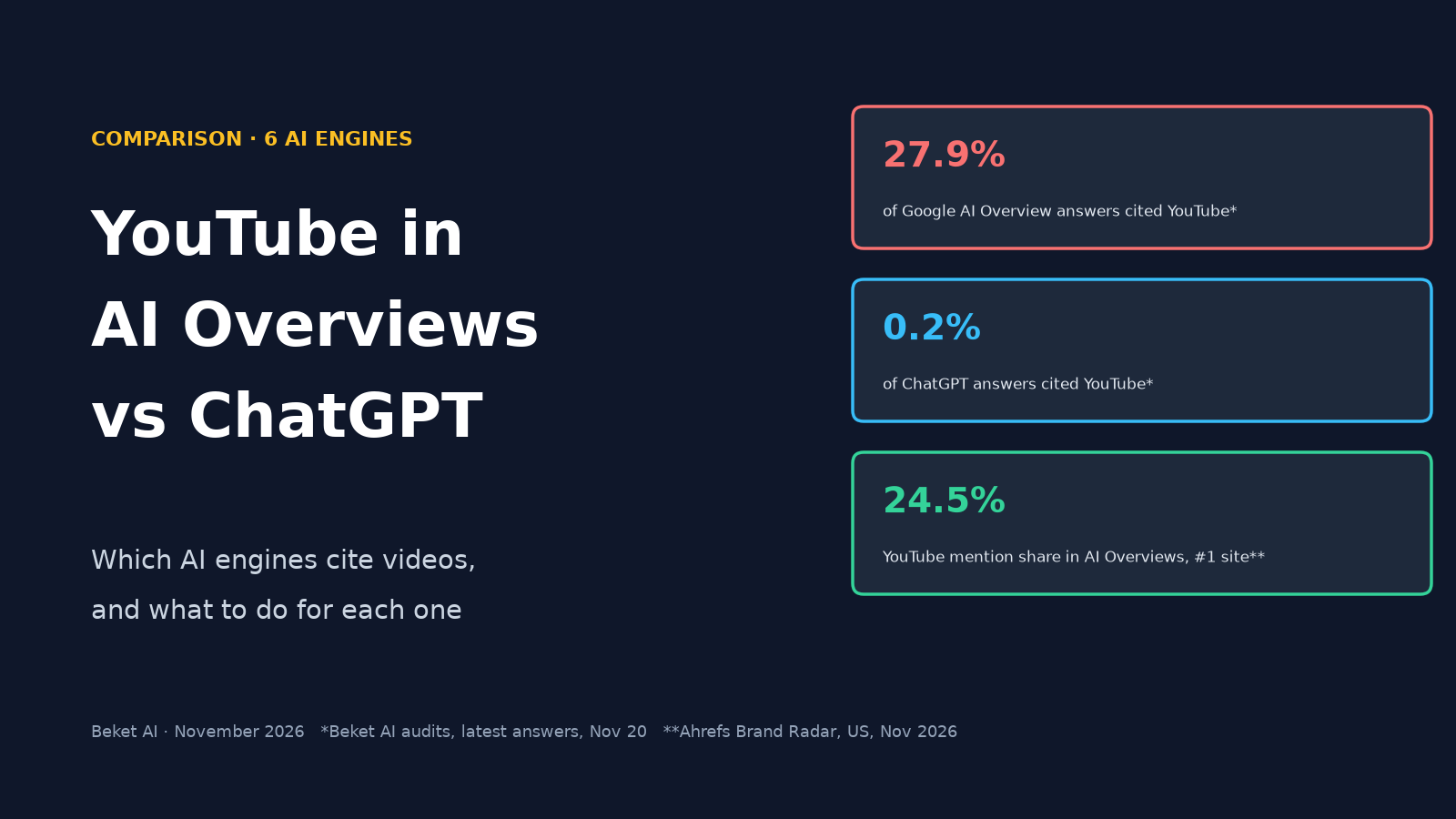
Ahrefs' monthly ranking of the 50 most-cited websites in Google AI Overviews, updated November 3, has the same name at the top again: www.youtube.com, with 24.5% mention share, ahead of Reddit at 18.1%. Put a similar question to ChatGPT and you get a very different picture. When High Salience ran the same 700 software-buying questions through both, AI Overviews linked YouTube 524 times. ChatGPT linked it zero times.
So "should we make videos for AI search?" has no single answer. It depends on which engine your buyers use. This post puts the engines side by side: what independent studies measured, what Beket AI's own audit data shows across six engines, and what to do about it for each one.
The short version: one engine loves video, the rest mostly don't
| Engine | YouTube in Beket AI audits (latest answers) | What independent studies found | What it leans on instead |
|---|---|---|---|
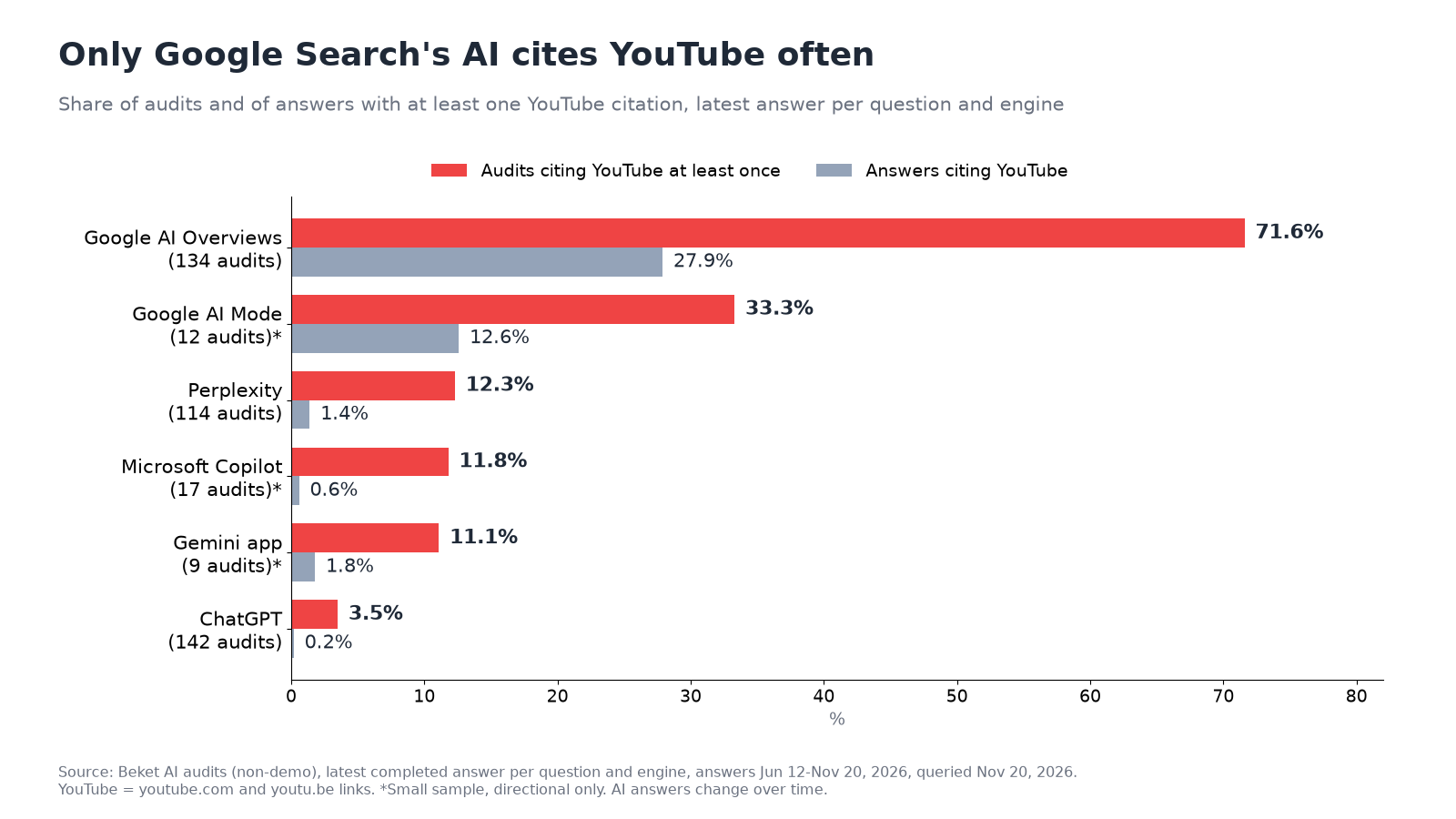
| Google AI Overviews | Cited in 71.6% of audits and 27.9% of answers (134 audits) | Most-cited site: 24.5% mention share (Ahrefs); 54.9% of Overviews cite at least one video (Suff Digital) | Mostly third-party pages: video, review and media sites, forums, blogs (High Salience) |
| Google AI Mode | 33.3% of audits, 12.6% of answers (12 audits, small sample) | YouTube was 37.1% of its user-generated sources (Searchable) | YouTube (37.1%) and Reddit (31.8%) lead its user content (Searchable) |
| Perplexity | 12.3% of audits, 1.4% of answers (114 audits) | YouTube was 4.9% of its user-generated sources (Searchable) | Reddit (47.1%) and LinkedIn (31.5%) lead its user content (Searchable) |
| Microsoft Copilot | 11.8% of audits, 0.6% of answers (17 audits, small sample) | No independent YouTube figure found | Not broken down in our data |
| Gemini app | 11.1% of audits, 1.8% of answers (9 audits, small sample) | YouTube was 4.4% of its user-generated sources (Searchable) | Reddit makes up most of its user content (81.9%) |
| ChatGPT | 3.5% of audits, 0.2% of answers (142 audits) | 0 YouTube citations in 700 answers (High Salience) | Vendors' own sites: 51% of its citations in that study |
The pattern is consistent across very different datasets. Google Search's AI features cite YouTube heavily. ChatGPT almost never does. Perplexity, Copilot and the Gemini app sit much closer to ChatGPT than to Google Search. That last one surprises people, since Gemini is also a Google product. Searchable makes the same point: Gemini "behaves like the chatbots here, not like Google Search."
What Beket AI's audit data shows
We pulled an aggregate from Beket AI's own audit database on November 20, 2026. Here is how it was built, because raw counts in this kind of data can mislead:
- One current answer per question and engine. Some audits re-run every day, and a handful of daily audits produce most of the raw citation events. We kept only the latest completed answer for each question on each engine, so a daily audit counts the same as one run once.
- Audits, not events. The headline number is the share of audits where an engine cited YouTube at least once. We also show the share of answers with a YouTube link and the average share of each audit's citations that went to YouTube.
- Demo audits excluded. No customer names, brands or prompts were read. These are aggregates only.
- What the audits cover. Mostly software, services, local businesses and B2B brands, with a mix of branded and unbranded questions. It is not a random sample of everything people ask.
| Engine | Audits | Answers | Citations | Audits citing YouTube | Answers citing YouTube | Avg YouTube share of an audit's citations | Audits citing Reddit |
|---|---|---|---|---|---|---|---|
| Google AI Overviews | 134 | 2,179 | 15,897 | 96 (71.6%) | 27.9% | 4.4% | 96 (71.6%) |
| Google AI Mode | 12 | 174 | 1,000 | 4 (33.3%) | 12.6% | 1.9% | 6 (50.0%) |
| Perplexity | 114 | 2,824 | 44,246 | 14 (12.3%) | 1.4% | 0.3% | 37 (32.5%) |
| Microsoft Copilot | 17 | 358 | 1,581 | 2 (11.8%) | 0.6% | 0.2% | 1 (5.9%) |
| Gemini app | 9 | 112 | 512 | 1 (11.1%) | 1.8% | 2.5% | 3 (33.3%) |
| ChatGPT | 142 | 3,080 | 17,359 | 5 (3.5%) | 0.2% | 0.02% | 12 (8.5%) |
Answers dated June 12 to November 20, 2026 depending on the engine (Copilot answers end October 5). AI Mode, Copilot and Gemini have small samples, so read them as directional.
Two things stand out.
AI Overviews cite YouTube in almost three answers out of ten. Across 2,179 current AI Overview answers, 27.9% linked at least one YouTube video. In ChatGPT, it was 0.2% of 3,080 answers. That is roughly a 140-to-1 gap on the same kind of questions from the same set of audits.
In AI Overviews, YouTube shows up as often as Reddit. Both were cited in 96 of 134 audits. YouTube appeared in more answers, though (27.9% against 19.0%). If you already know that Google's AI leans on Reddit, video belongs in the same conversation.
Where in the funnel AI Overviews reach for video
We split the AI Overview answers by the buyer stage each question was tagged with, and by whether the question named a brand.
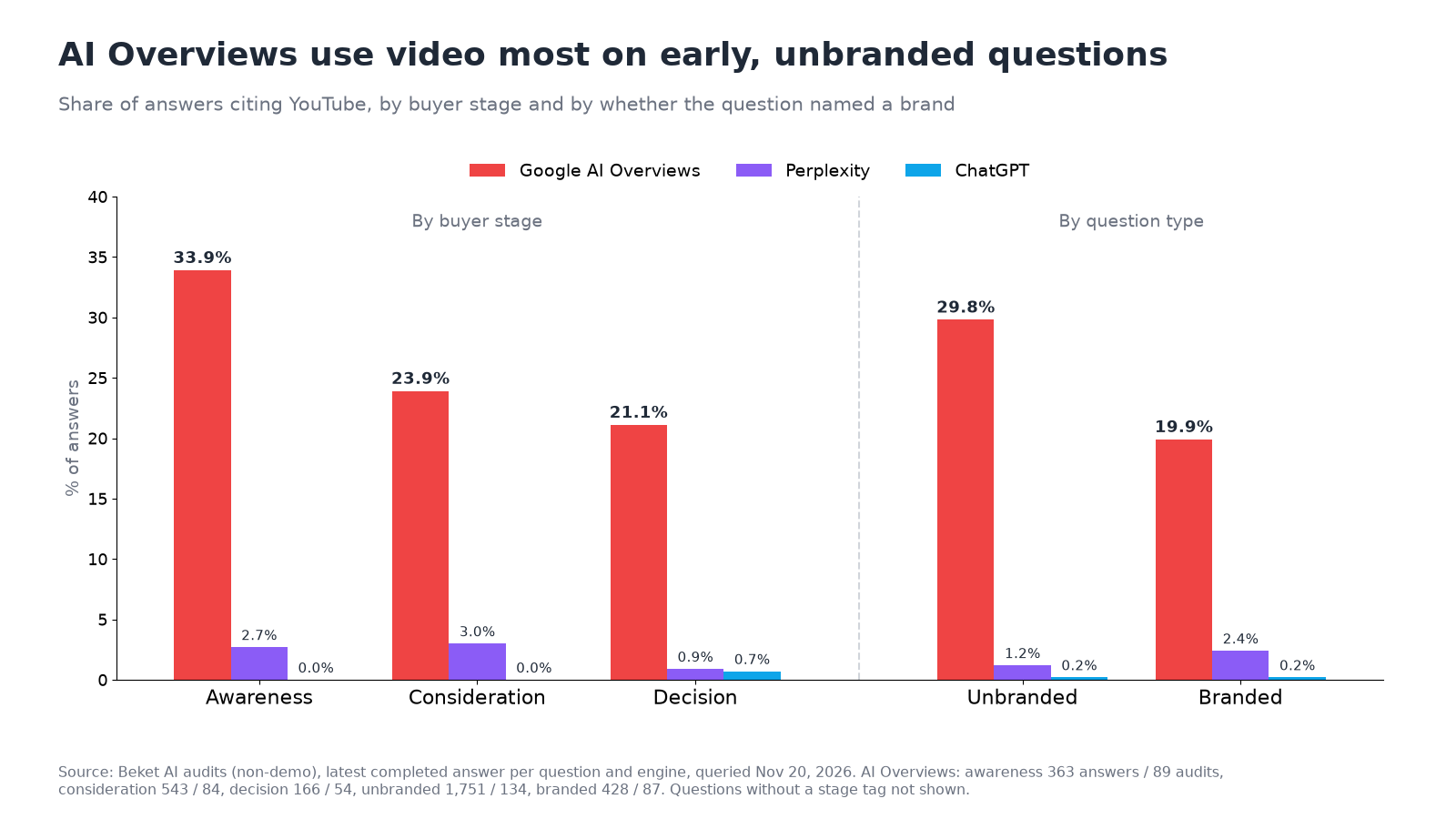
- Awareness questions get the most video. 33.9% of AI Overview answers to early "how does this work" questions cited YouTube (363 answers across 89 audits). That fell to 23.9% for consideration questions and 21.1% for decision questions.
- Unbranded questions get more video than branded ones. 29.8% of unbranded AI Overview answers cited YouTube, against 19.9% when the question named a brand. One plausible reason: a question that names a brand has an obvious text answer on that brand's own pages.
- ChatGPT stays near zero at every stage. It never went above 0.7% in any group. Perplexity peaked at 3.0% on consideration questions.
This matches what Suff Digital found by industry. In its September analysis of 7,505 AI Overviews, video was cited in 86.7% of roofing Overviews and 85.4% of software Overviews, but only 8.1% of real estate ones, where listing portals took the citations. Video wins where people want to see how something works.
What the independent studies agree on
Each study used different questions, dates and methods, so the numbers don't line up exactly. The direction does.
| Study | Sample | YouTube finding |
|---|---|---|
| Ahrefs (Brand Radar, November 2026) | US AI Overviews, all topics | #1 site, 24.5% mention share; Reddit #2 at 18.1% |
| Suff Digital (Sept 23, 2026) | 55,442 citations in 7,505 AI Overviews, 20,000 commercial searches | 14.8% of citations; 54.9% of Overviews cite at least one video |
| Position Digital (Aug 2026) | 857 AI Overview citations, 31 SaaS keywords | 14.5% of citations, more than five times Reddit's 2.7% |
| High Salience (Sept 2026) | Same 700 software questions in AI Overviews and ChatGPT | 22% of AI Overview links; 0 ChatGPT citations |
| Searchable (Oct 12-25, 2026) | 3.2M cited pages across five engines | YouTube was 32.9% of AI Overviews' user-generated sources and 1.6% of ChatGPT's |
Two more details are worth knowing before you plan around them:
- A brand's own channel is not "user content." Searchable checked who posted each page and found that half of the forum and social pages AI Overviews used came from brands, publishers or the platform, and brands' own YouTube channels were the most common case. Your channel can still be cited. It is just your own content in a different format.
- AI Overview sources move a lot. Position Digital saw Google change at least one source for 52% of keywords on identical repeat searches. One screenshot of your video in an Overview proves little.
Why the engines split this way
Nobody outside these companies can see exactly how they pick sources, so treat this as the likely explanation, not a proven one.
AI Overviews and AI Mode are built on Google Search, and Google Search already ranks videos. High Salience found a YouTube page in Google's organic top ten for 309 of its 700 questions. When the pool of results Google draws from contains videos, the Overview cites them.
ChatGPT, Perplexity and the Gemini app answer more like research assistants. They read and quote text pages. In High Salience's comparison, about half of ChatGPT's citations went to the vendors' own websites, against about one in six AI Overview links. That fits what we found when we looked at the publications AI engines cite most: ChatGPT split its links between the press and the brands, while AI Overviews leaned on YouTube.
The result is what we described in Google's AI isn't one engine, it's three: even inside Google, the source mix depends on the surface.
What to do for each engine
| If your buyers mostly use... | Put effort into | Skip or deprioritize |
|---|---|---|
| Google AI Overviews and AI Mode | Short videos that answer the exact questions buyers search, titled with the question. Clear descriptions and chapters. Embed each video on the matching page of your site. Creator reviews and walkthroughs of your product | Treating video as a brand-awareness extra only |
| ChatGPT | Your own pages: product, pricing, comparison and help pages with the facts written out in text. Coverage in the publications and review sites it cites | Expecting a YouTube video to show up as a ChatGPT source |
| Perplexity | A mix: publisher and review coverage, your own pages, and genuine Reddit and LinkedIn discussion | Video as the main play |
| Gemini app and Copilot | Text pages, as with ChatGPT. Our samples are small, so check your own category | Assuming Gemini cites like Google Search |
A few practical notes:
- Make the video findable as text. It's safest to assume engines lean on the text around a video: its title, description, chapters and transcript. Our guide to writing YouTube descriptions for AI search covers how to edit them and what the evidence does and doesn't show.
- Pair every video with a page. A video helps you in AI Overviews. The page it sits on, with the same facts in text, is what ChatGPT can cite. One piece of work then serves both.
- Start with awareness questions. In our data, that's where AI Overviews used video most (33.9% of answers). "How does X work" and "how to choose X" are good first topics.
- Know your industry. If you sell real estate, banking or mortgages, Suff Digital's numbers suggest portals and finance sites take the citations, and video does less for you.
How to check this for your own category
Industry averages tell you where to look. Your own questions tell you what to do. The check is simple:
- Write 10 to 20 unbranded questions a buyer in your category would ask, across early, middle and late stages.
- Run each one on the engines your customers actually use, ideally more than once, because sources change from run to run.
- For each answer, note whether it cited YouTube, which videos, and whether any are yours or about you.
- Repeat monthly. Compare engines separately instead of blending them into one score.
That is what Beket AI does automatically. It tracks your prompts across six engines (ChatGPT, Gemini, Perplexity, Microsoft Copilot, Google AI Overviews and Google AI Mode) and shows which domains each one cites. The free audit runs 25 prompts on any 3 of those engines, and Pro re-checks them daily from $49 a month per site.
Limits of this comparison
- Dates. The Beket AI figures come from answers collected between June 12 and November 20, 2026, and were pulled on November 20, 2026. AI answers change over time, and so do the sources engines cite. This is the data the engines returned for those questions, not a permanent rule.
- Sample. Beket AI audits skew toward software, services, local and B2B brands. AI Mode (12 audits), Copilot (17) and Gemini (9) are small samples.
- Counting. We counted youtube.com and youtu.be links. Videos shown in a carousel without a cited link may not be captured.
- Outside studies. Each used its own questions, countries and methods, so their percentages aren't directly comparable with each other or with ours. Ahrefs' figure is mention share among top sources, not share of all citations.
Businesses that track their category with Beket AI can request another run at any time to see whether the picture has changed.
Related posts
How to Get Your Product Recommended by ChatGPT: 7 Steps for Brands and Online Stores (2026)
How to get your product recommended by ChatGPT: catalog and feed access, OAI-SearchBot, product page facts, reviews, roundups and current prices, plus our data.
AI Search This Week: Gemini and ChatGPT Agents Start Booking and Buying (Nov 20, 2026)
Gemini can now call and book businesses for free, ChatGPT got a wallet, and only 6.9% of ChatGPT chats show buying intent. The week in AEO, GEO and SEO.
Generative Search Visibility: What Decides Whether AI Assistants Mention Your Company (2026)
What decides whether ChatGPT, Perplexity and Google's AI answers mention your company: evidence-ranked factors, how they differ by engine, and our audit data.