
Which Publications Does AI Cite Most? A 2026 Study of ChatGPT, Perplexity and AI Overview Sources

Study date: November 15, 2026
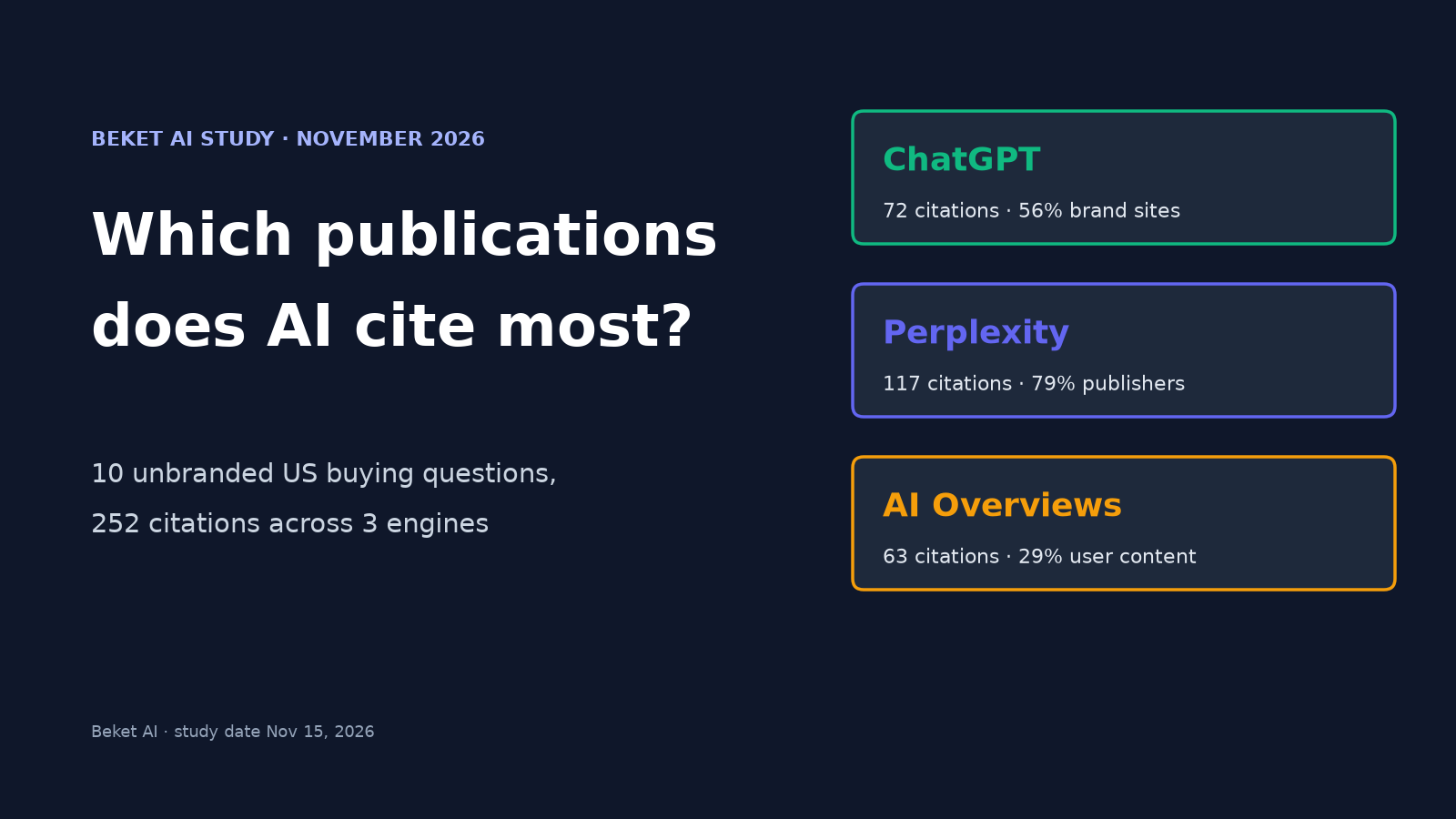
Ask three AI engines the same ten shopping questions and you get three different reading lists. Perplexity sends you to review publishers. ChatGPT sends you to the brands themselves almost as often as to the press. Google AI Overviews sends you to YouTube.
That’s the short version of a study we ran on November 15, 2026. We asked ChatGPT, Perplexity and Google AI Overviews ten unbranded “what’s the best…” questions as a US, English-language user, then logged every source each answer cited: 252 citation events in total. To check whether those patterns hold beyond ten questions, we also looked at the latest run of 166 audits stored in Beket AI, counting each audit once.
These are the answers the engines returned on one day. They aren’t our ranking of any publication, and AI answers change over time.
Key numbers
| Study date | November 15, 2026 |
| Market | United States, English |
| Questions | 10 unbranded buying questions (full list below) |
| Engines | ChatGPT, Perplexity, Google AI Overviews |
| Answers recorded | 28 of 30 (AI Overviews answered 8 of 10) |
| Citation events | 252 (Perplexity 117, ChatGPT 72, AI Overviews 63) |
| Distinct domains (host names) cited | 124 |
| Most cited domain | rtings.com, 21 citations (8.3%) |
| Domains cited by all three engines | 3 (rtings.com, techradar.com, wired.com) |
The most cited domains
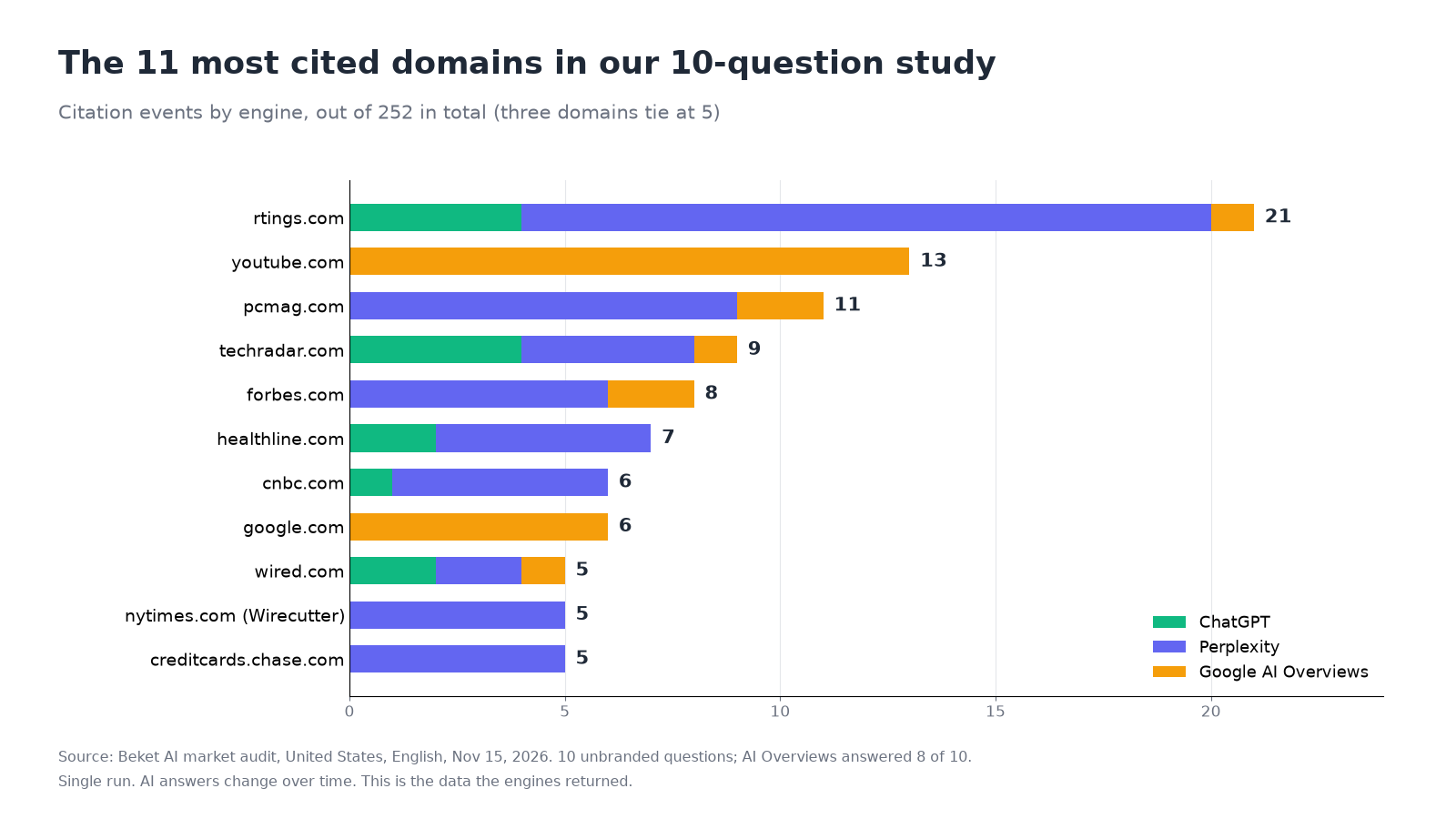
One domain stood well above the rest. RTINGS, the lab-testing review site, was cited 21 times, on all three engines and for five of the ten questions (robot vacuums, running shoes, college laptops, VPNs and mattresses). The next ten domains took between 5 and 13 citations each.
| Rank | Domain | Citations | Share of 252 | Type | Engines that cited it |
|---|---|---|---|---|---|
| 1 | rtings.com | 21 | 8.3% | Publisher | All three |
| 2 | youtube.com | 13 | 5.2% | User content | AI Overviews only |
| 3 | pcmag.com | 11 | 4.4% | Publisher | Perplexity, AI Overviews |
| 4 | techradar.com | 9 | 3.6% | Publisher | All three |
| 5 | forbes.com | 8 | 3.2% | Publisher | Perplexity, AI Overviews |
| 6 | healthline.com | 7 | 2.8% | Publisher | ChatGPT, Perplexity |
| 7 | cnbc.com | 6 | 2.4% | Publisher | ChatGPT, Perplexity |
| 7 | google.com | 6 | 2.4% | Search pages | AI Overviews only |
| 9 | wired.com | 5 | 2.0% | Publisher | All three |
| 9 | nytimes.com | 5 | 2.0% | Publisher | Perplexity only |
| 9 | creditcards.chase.com | 5 | 2.0% | Brand | Perplexity only |
Those 11 domains account for 96 of the 252 citations (38.1%). The other 113 domains share the remaining 156, and 98 of the 124 domains were cited by only one engine.
Two details stand out. All five New York Times citations were Wirecutter review pages, so the “newspaper” in this list is really a product-testing desk. And the only brand in the top 11 is a Chase credit card site, cited five times by Perplexity for the travel credit card question. Brands still got plenty of citations overall (79 of 252), but they were spread across 57 vendor sites, most with one or two links each.
Across all 252 citations, publishers took 138 (54.8%), brand and vendor sites 79 (31.3%), user content such as YouTube and Reddit 20 (7.9%), and other pages 15 (6.0%).
Engine by engine
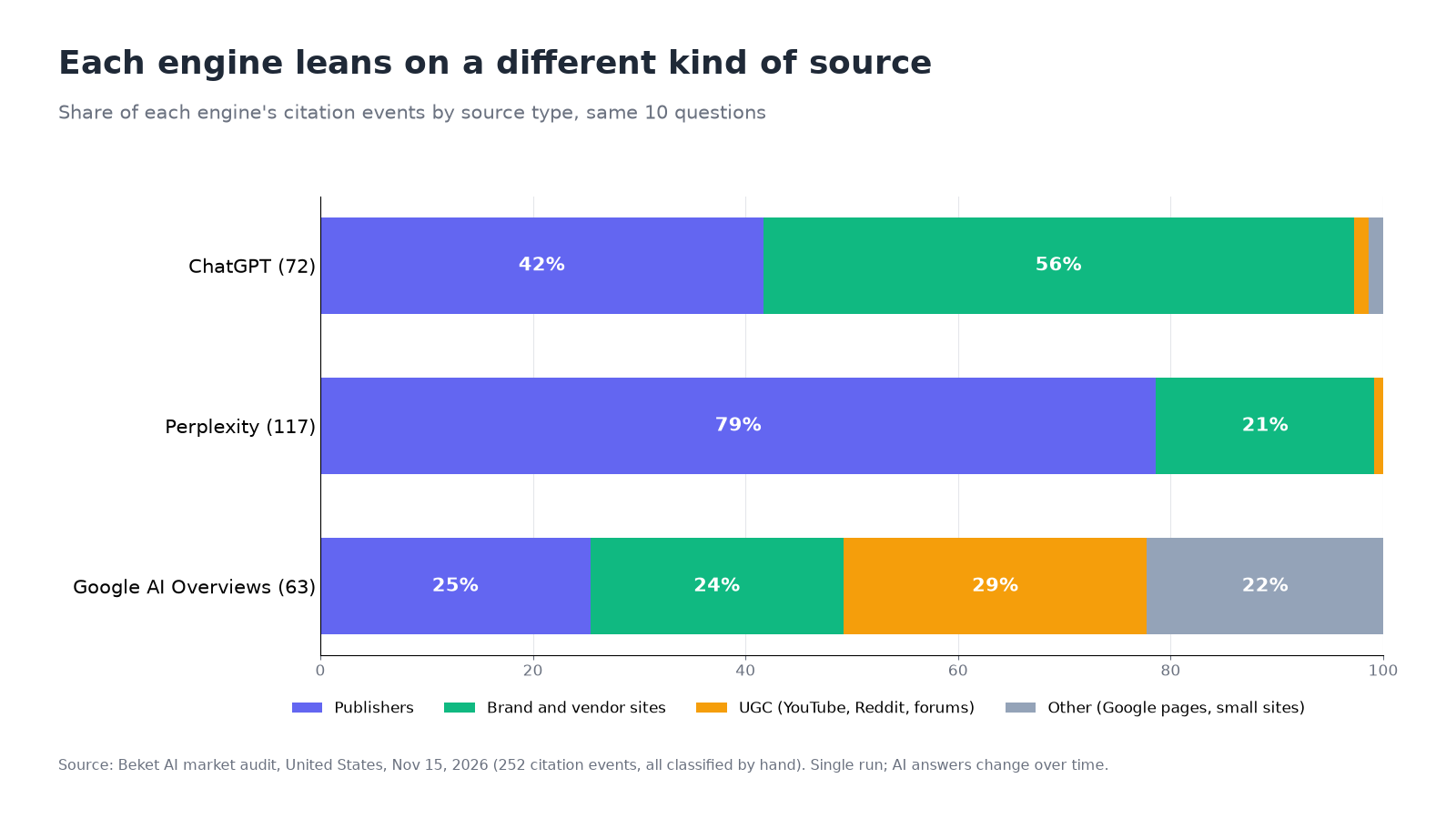
The overall table hides how differently the three engines behave.
| Engine | Citations | Publishers | Brand sites | User content | Other | Top domains |
|---|---|---|---|---|---|---|
| Perplexity | 117 | 92 (78.6%) | 24 (20.5%) | 1 | 0 | rtings.com 16, pcmag.com 9, forbes.com 6 |
| ChatGPT | 72 | 30 (41.7%) | 40 (55.6%) | 1 | 1 | rtings.com, runningwarehouse.com and techradar.com, 4 each |
| Google AI Overviews | 63 | 16 (25.4%) | 15 (23.8%) | 18 (28.6%) | 14 (22.2%) | youtube.com 13, google.com 6, reddit.com 4 |
Perplexity cited the most sources (about 12 per answer) and most of them were editorial. It is the engine that behaves most like a reader of review publications: RTINGS, PCMag, Forbes, CNBC, Healthline and Wirecutter carried most of its answers.
ChatGPT cited fewer sources (about 7 per answer) and was the only engine where brand sites outnumbered publishers. For the CRM and project management questions it linked straight to vendors such as HubSpot, Pipedrive, Zoho, Asana, Monday.com, Trello and Notion. No single domain got more than 4 of its 72 citations, so its sources were the most spread out.
Google AI Overviews answered 8 of the 10 questions; it returned no answer for the travel credit card and college laptop questions, so those two are missing rather than counted as zero. Where it did answer, more than a fifth of its citations went to YouTube, and it was the only engine that cited YouTube, Reddit or Google’s own search and Shopping pages in any volume. That matches public data: Searchable’s study of 3.2 million cited pages (Oct 12 to 25, 2026) found 8.6% of AI Overviews sources were posted by individual users, against about 1.1% for ChatGPT and Perplexity.
Only rtings.com, techradar.com and wired.com were cited by all three engines. Another 23 domains were cited by exactly two.
Who led each question
The winner changed with the topic. Review labs led the gadget questions, finance media led credit cards, health publishers led therapy, and brands led meal kits.
| Question | Most cited domains (citations) | Citations, all engines |
|---|---|---|
| Best CRM for a small business | pcmag.com 3, youtube.com 3 | 25 |
| Best project management software | asana.com 4, youtube.com 4 | 26 |
| Best running shoes for beginners | rtings.com 5, runningwarehouse.com 4, google.com 4 | 30 |
| Best robot vacuum for pet hair | rtings.com 10, techradar.com 3 | 28 |
| Best travel credit card | cnbc.com 5, creditcards.chase.com 5, nerdwallet.com 4 | 25 |
| Best VPN | cnet.com 3 | 24 |
| Best meal kit delivery service | everyplate.com, greenchef.com, healthline.com, hellofresh.com, 2 each | 29 |
| Best laptop for college students | rtings.com 3 | 18 |
| Best mattress for back pain | ncoa.org 3 | 23 |
| Best online therapy service | healthline.com 5 | 24 |
The college laptop and travel credit card totals are lower partly because AI Overviews didn’t answer them.
What 166 audits add
Ten consumer questions are a narrow window, so we also looked at citation data already stored in Beket AI: audits run between June 11 and November 15, 2026 across eight engines. Raw counts would be misleading here. Twenty-nine audits re-run every day, and together they produced 67.7% of all stored citation events. So we kept only the latest run of each audit, dropped demo audits and the sites of the brands being tracked, and ranked domains by how many of the 166 audits cited them.
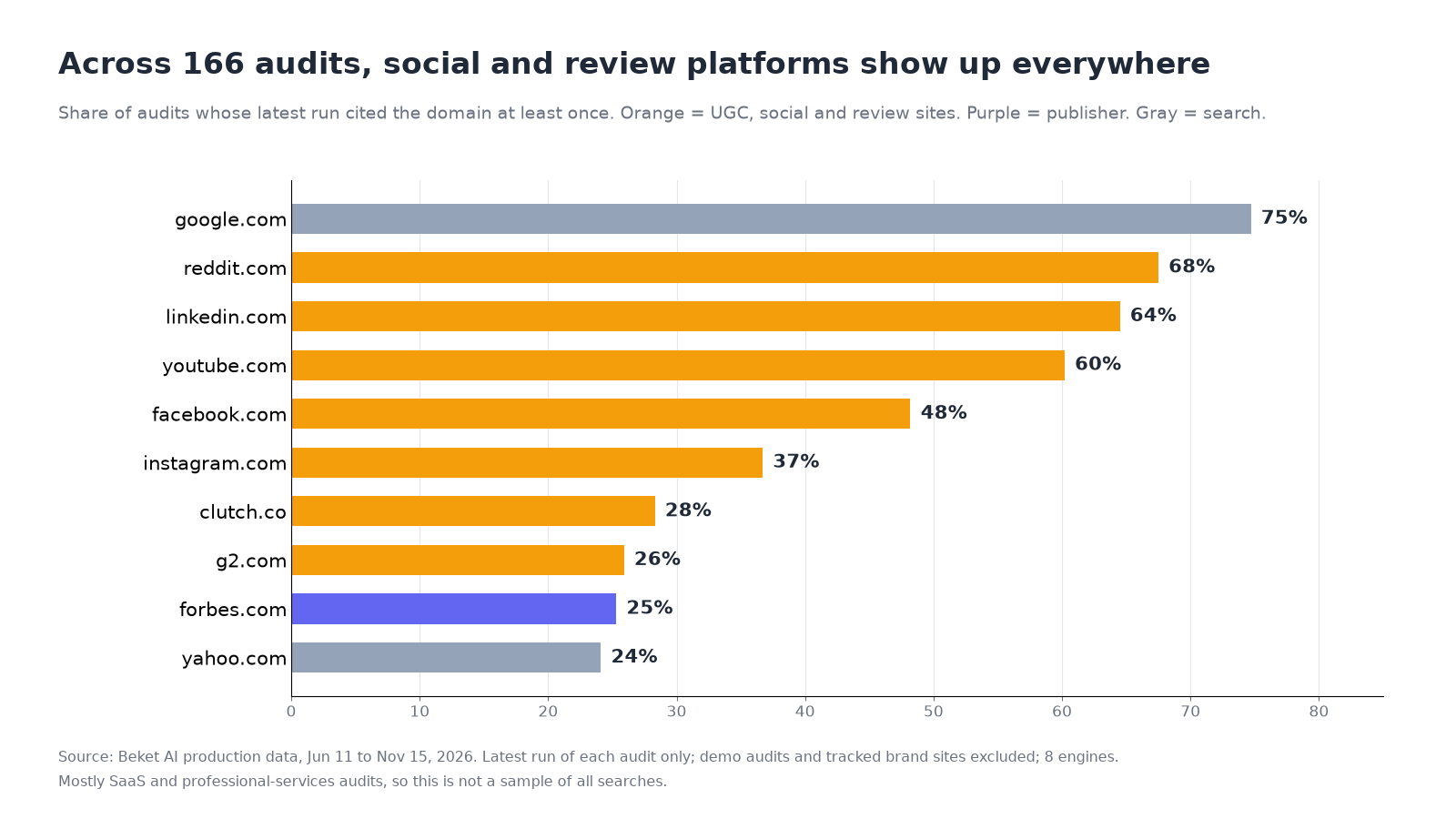
The picture is very different from the consumer study. Google pages were cited in 75% of audits, Reddit in 68%, LinkedIn in 65% and YouTube in 60%. Forbes was the only publisher in the top 10, at 25%. Review and directory sites such as Clutch and G2 ranked higher than any newsroom.
The reason is the mix of questions. Most audits in Beket AI are for software and professional-services businesses, where buyers ask about agencies, vendors and local providers. Those categories have few lab-style review publications, and in this data the engines leaned on platforms, directories and vendor pages instead. Publishers were only 9.9% of latest-run citation events in that data, against 54.8% in our consumer study.
Counting each audit once also changed the ranking. On raw event counts, Semrush, HubSpot, Microsoft and OpenAI were all in the top 10, because a few daily audits cited them on every run. Counted once per audit, all four fell out of it, and Facebook, Instagram, Forbes and Yahoo moved in. If you track your own citations, check whether a few repeated prompts are driving your totals in the same way.
What the public research says
Our numbers line up with larger public datasets in some ways and differ in others.
- Muck Rack’s October 2026 “What Is AI Reading?” release reports that earned media still drives more than 84% of AI citations. It also found journalism was 22% of AI citations in September, down from 27% in May, and only 212 domains were cited by all four major AI providers.
- The same release found ChatGPT repeated just 41% of its cited domains when the same prompt ran twice in a day, against 94% for Perplexity.
- First Page Digital’s Singapore tracking study (164,540 answers, Oct 9 to Nov 7, 2026) found ChatGPT cited only about 50% of the previous day’s sites for the same question, Google AI Overviews about 40% and Perplexity about 88%.
That last point matters for reading any single-day study, ours included. Perplexity’s sources are fairly stable from day to day, so its preference for review publishers is probably a durable pattern. ChatGPT’s and AI Overviews’ lists shift much more, so treat their exact top domains as a snapshot.
What this means if you want to be cited
Find out which publications your category runs on. For gadgets it was RTINGS and PCMag; for credit cards, CNBC and NerdWallet; for therapy, Healthline. Run your own buyer questions and roll the cited URLs up to outlets, as in our guide on building a media list from AI citations.
Pitch differently for each engine. Perplexity favored editorial reviews. ChatGPT linked to vendor pages almost as often, so your own comparison and pricing pages matter there. Our guide on how to get cited by ChatGPT covers the on-site side.
Don’t ignore video and community content for Google. In our study, AI Overviews was the engine most likely to cite YouTube and Reddit. A useful product video can count there in a way it won’t on Perplexity.
For B2B and local services, check the platforms first. In the 166-audit data, LinkedIn, Reddit, Clutch and G2 showed up far more often than any newsroom. We wrote more on this in your AI citations are coming from somewhere you aren’t looking, and our digital PR for AI search guide covers how to earn coverage on the sources that matter.
Method and caveats
- Audit: one Beket AI market audit, run Sunday, November 15, 2026, 4:39 to 4:48 PM Pacific Time, targeting the United States in English. Engines: ChatGPT, Perplexity and Google AI Overviews.
- Questions: 10 unbranded buying questions across ten consumer and software categories, chosen for real buyer intent. Each was asked once per engine.
- Coverage: 28 of 30 answers were generated. Google AI Overviews returned no answer for the travel credit card and college laptop questions; those are listed as missing, not counted as zero.
- Counting: a citation event is one cited URL in one answer. Shares are of the 252 events. Domains are counted by host name, so creditcards.chase.com and chase.com are counted separately.
- Source types: every cited domain was labeled by hand as publisher, brand or vendor, user content (YouTube, Reddit, forums, review platforms) or other (Google pages and small sites). Some calls are judgment calls.
- 166-audit data: aggregate figures only, from audits stored in Beket AI between June 11 and November 15, 2026. We used the latest run of each audit, excluded demo audits and tracked brand sites, and ranked by share of audits. No customer, brand or prompt details are included. That data is mostly software and professional-services audits, so it isn’t a sample of all searches.
This is the data the engines returned in a single run, and AI answers change over time. If you’d like this study run again, or run for your own category, you can ask Beket AI for another run.
All 10 questions
- What’s the best CRM for a small business?
- What’s the best project management software?
- What are the best running shoes for beginners?
- What’s the best robot vacuum for pet hair?
- What’s the best travel credit card?
- What’s the best VPN?
- What’s the best meal kit delivery service?
- What’s the best laptop for college students?
- What’s the best mattress for back pain?
- What’s the best online therapy service?
Bottom line
There isn’t one list of “the publications AI cites.” In our ten-question study, review labs like RTINGS dominated when Perplexity answered, ChatGPT split its links between the press and the brands, and Google AI Overviews leaned on YouTube. In the wider Beket AI data, platforms like LinkedIn, Reddit and Clutch mattered more than any newsroom. The useful question is which sources each engine trusts for your category.
Beket AI’s free audit runs 25 of your buyer questions across three engines and shows which sources each one cites, so you can see your own list.
Related posts
Best AI Tools for PR Agencies in 2026: Monitoring, AI Visibility and Reporting, Compared
The best AI tools for PR agencies in 2026: Muck Rack, Cision, Meltwater, Semrush, Ahrefs, Scrunch and Beket AI, compared on AI visibility and price.
Beket AI vs Ahrefs: AI Visibility and Agent Analytics Compared (2026)
Beket AI vs Ahrefs Brand Radar for AI visibility: prompt tracking prices, engines, bot analytics and AI traffic, from published pages (Nov 2026).
How to Build a Media List From AI Citations (Free Template)
Build a media list from the outlets ChatGPT and Perplexity already cite: 7 steps, a scoring rubric, real Vancouver audit data and a free CSV template.