
Digital PR for AI Search: How to Earn Coverage ChatGPT and Perplexity Actually Cite (2026)

When we asked ChatGPT, Perplexity and Google AI Overview unbranded questions about hiring a lawyer in New York City, the most cited source wasn't a newspaper. It was the New York City Bar Association, with 23 citations. For Los Angeles marketing agencies it was Clutch, with 69. Across five of our recent city studies, news sites and publishers made up 49 of the 945 citations that went to each study's ten most cited domains. Directories, rankings and listing portals made up 497.
That doesn't mean journalism stopped mattering. Industry-wide, it is still about a fifth of what AI engines cite. It means "digital PR for AI search" isn't one tactic. The coverage that gets you named depends on which pages the engines already trust for your buyers' questions, and you can look that up before you pitch anyone.
This guide shows how: the public numbers, what our own audit data adds, and a six-step workflow with a checklist at the end.
What digital PR for AI search actually means
Classic digital PR earns coverage and links to build authority and referral traffic. For AI search the goal shifts: you want your name, described accurately, on the pages ChatGPT, Perplexity and Google's AI answers retrieve when someone asks a question you should be the answer to. A link is nice. A credible mention on a page the engine actually cites is the part that counts.
So the work has two halves PR teams don't always connect. First, find out which sources the engines use for your category. Then, check whether the answers change after your coverage lands. Everything in between is ordinary, good PR.
The public numbers: earned media dominates, journalism is shrinking
The largest public dataset on this is Muck Rack's "What Is AI Reading?" research from its Generative Pulse team. The October 2026 edition draws on more than 40 million AI responses and 207 million citations from 2026, plus 1,020 unbranded consumer prompts run in September across ChatGPT, Claude, Gemini and Perplexity.
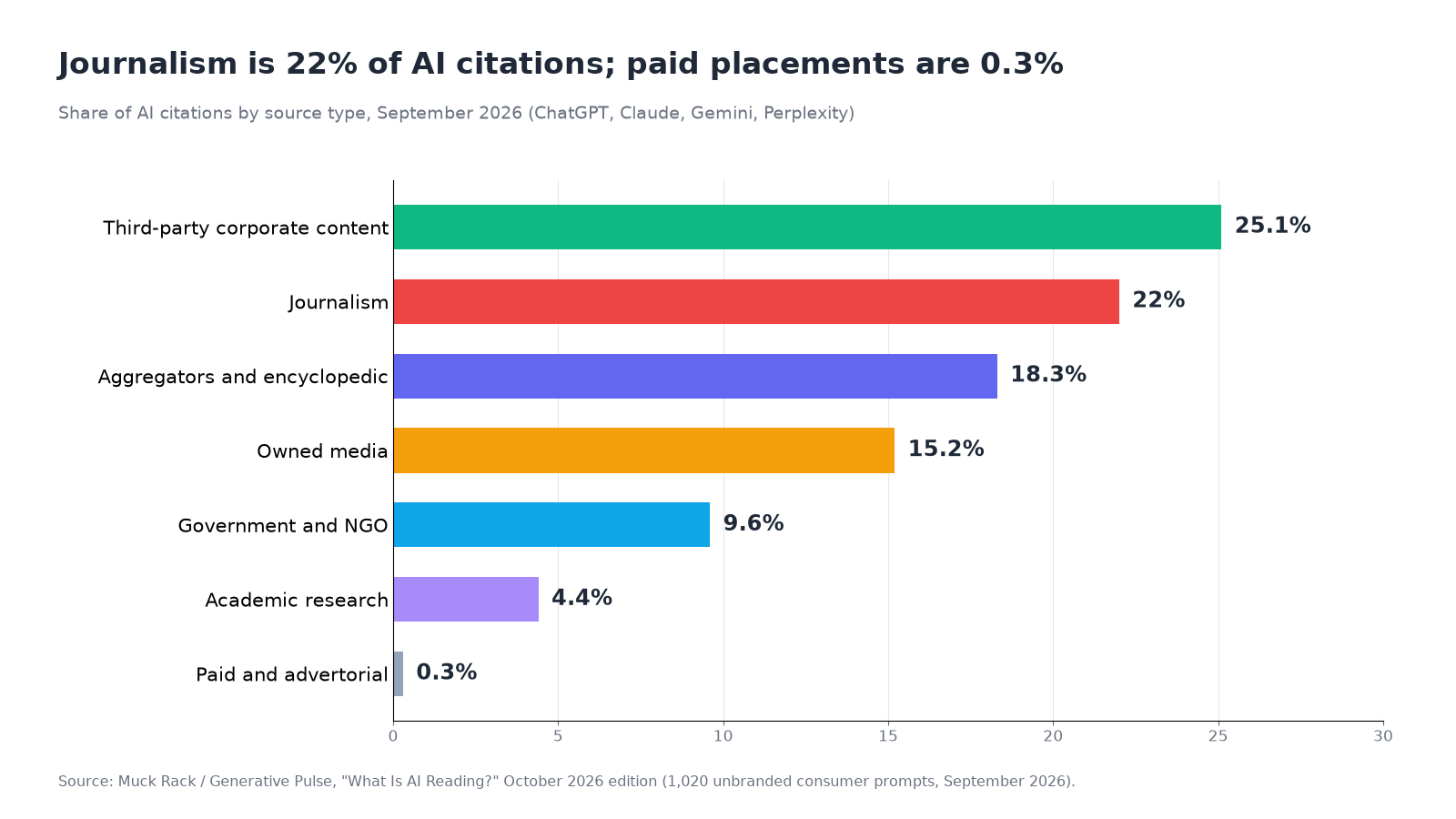
| Finding (Muck Rack, Oct 2026 edition) | Number |
|---|---|
| Citations from earned and third-party sources | More than 84% (82% to 89% across four editions) |
| Paid and advertorial content | 0.3% |
| Journalism's share of citations | 22% in September, down from 27% in May |
| Journalism's share of ChatGPT citations | 28.1% in January, 22% in September |
| Owned media (brand sites) | 15.2%, up from 13.7% |
| Domains cited by all four AI providers | 212 |
| Cited domains repeated when the same prompt ran twice in a day | ChatGPT 41%, Gemini 45%, Perplexity 94% |
Three findings from the same release matter most for PR planning:
- Pay-to-play underperforms. In ChatGPT's Forbes citations, editorial content beat the paid Councils program by about 1.7 to 1.
- Crawler access matters. 81% of major publishers that block Claude's search crawler got almost no Claude citations, compared with 12% of those that allow it. An outlet that blocks an engine's crawler can't easily earn you citations in that engine.
- The engines read different parts of the web. Several major publishers dropped to near zero in ChatGPT citations while other providers kept citing them. A placement that shows up in Perplexity may do nothing in ChatGPT.
Muck Rack's earlier write-up of the May edition adds two useful details. Industry-trend questions drew more than twice the journalism citations of how-to questions, and press releases showed up almost only in industry-trend answers. And Axios was among ChatGPT's top three cited domains in 13 of 17 industries, while The New York Times and Reuters were not in the top three for any. The outlet your CEO wants isn't always the outlet the engine cites.
What our own studies add: for service businesses, the cited media are often directories
Muck Rack's prompts are broad consumer questions. Many businesses care about narrower ones: "best mortgage broker in NYC," "top marketing agency in Los Angeles." We looked at the cited domains in five Beket AI market audits run between Nov 7 and Nov 12, 2026. Each one asked unbranded questions on ChatGPT, Perplexity and Google AI Overview, and we grouped each study's ten most cited domains by type.
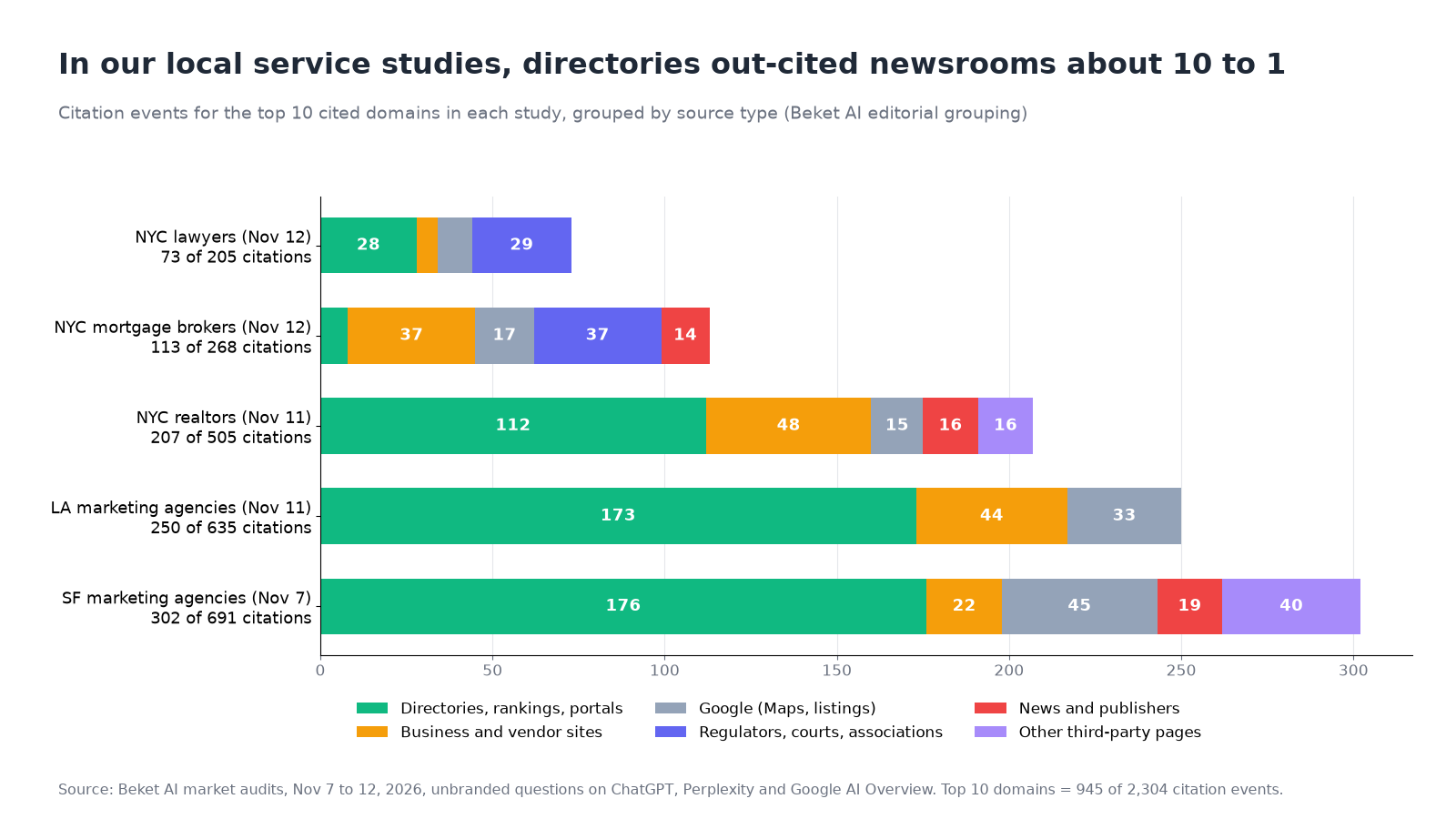
| Study (date) | Top cited domains | News or publisher domains in the top 10 |
|---|---|---|
| NYC lawyers (Nov 12) | nycbar.org 23, justia.com 14, google.com 10 | None |
| NYC mortgage brokers (Nov 12) | dfs.ny.gov 21, homelendingadvisor.chase.com 18, google.com 17 | brickunderground.com 8, bankrate.com 6 |
| NYC realtors (Nov 11) | realtor.com 57, streeteasy.com 27, compass.com 26 | realestate.usnews.com 16 |
| LA marketing agencies (Nov 11) | clutch.co 69, google.com 33, sortlist.com 29 | None |
| SF marketing agencies (Nov 7) | clutch.co 64, sortlist.com 48, google.com 45 | marketing.sfgate.com 19 |
What stands out:
- Directories and rankings carried the agency studies. Clutch, Sortlist, the Semrush agency directory, DesignRush, The Manifest and Expertise.com took 173 of the 250 top-10 citations in our Los Angeles marketing agencies study.
- Regulated categories lean on official sources. For NYC lawyers and mortgage brokers, the bar association, the courts, the state Department of Financial Services, the CFPB and the NMLS registry together took 66 citations.
- The publishers that did appear were niche or local. A New York real estate site, a personal finance publisher, a U.S. News real estate section and SFGATE's marketing section. No national business outlet made a top 10.
Read this as a direction, not a law. It covers five audits, only the top 10 domains in each (945 of 2,304 citation events), and the source-type grouping is our own editorial call. Each study is a single run, and AI answers change over time. It is enough to say that for service businesses, a strong Clutch profile or a spot on the right ranking can do more than a national feature.
How to run digital PR for AI search: 6 steps
1. Write 10 unbranded questions your buyers actually ask
Start from real wording, not keyword tools alone: sales calls, support tickets, reviews. Keep your brand name out, because you want to see who the engines recommend when the buyer doesn't know you yet. Our guide to prompt research from support tickets walks through building this list. Ten good questions beat fifty near-duplicates.
2. Record which domains each engine cites, per engine, more than once
Run every question on ChatGPT, Perplexity and Google AI Overview and log each cited URL. Keep the engines separate, since they overlap so little. Run the set at least twice on different days: with ChatGPT repeating only 41% of its cited domains on a same-day rerun, one pass will mislead you. Google AI Overview won't appear for every question, so note which ones had no overview rather than counting them as zero.
3. Sort the cited domains into pitch types
Roll the URLs up to domains and give each one a type. Each type needs a different approach:
| Source type | Examples from our data | What earns you a place |
|---|---|---|
| Newsrooms and trade press | Brick Underground, U.S. News real estate | Data, a clear news hook, an expert quote on a trend |
| Directories and review platforms | Clutch, Justia, Realtor.com, Expertise.com | A complete, accurate profile and genuine client reviews |
| Rankings and award lists | Best Lawyers, Chambers, Doyle's Guide | Their published submission or research process |
| Official bodies and associations | nycbar.org, dfs.ny.gov, NMLS | Accurate licensing records, membership, member directories |
| Third-party comparison pages | Bankrate, vendor-written "best of" lists | Facts the author can check: pricing, scope, proof |
If you work with a PR team, this table becomes the media list. Most PR plans start from outlets the brand wants to be in. This one starts from outlets the engines already use.
4. Pitch what each source type accepts, and skip pay-to-play
Journalists want something new. Since industry-trend questions draw the most journalism citations, original data about your market is the strongest pitch. If you put out a release to support it, our guide to writing press releases for AI search covers the structure that tends to get cited.
For directories and rankings, the work is less glamorous and often matters more: claim the profile, fill every field, keep services and service areas current, and ask happy clients for reviews in the platform's own process. Paid placements are a weak bet. Muck Rack found paid and advertorial content at 0.3% of citations, and Forbes editorial beat its paid program about 1.7 to 1 in ChatGPT.
5. Make the coverage easy for an engine to use
Before you chase a placement, check that the outlet's robots.txt doesn't block the AI search crawlers you care about (OAI-SearchBot for ChatGPT search, PerplexityBot for Perplexity). Give journalists and directory editors the same name, category, location and one-line description you use everywhere else, so the engine connects the mention to you. A link back to your site helps it confirm the facts. As we covered in why brand mentions are the new backlinks, an accurate unlinked mention on a trusted page still counts. A wrong price or old service list on that page counts against you.
6. Re-run the same questions after coverage lands
Use the same 10 questions, on the same engines, a few weeks after a placement goes live, and then on a regular schedule. Look for three changes: whether the new outlet is now cited, whether your name now appears in answers, and whether the description is accurate. Judge it on trends over weeks, not one screenshot, since cited sources move from day to day.
Where Beket AI fits
Beket AI handles the measurement steps: 1, 2 and 6. A free audit runs 25 unbranded prompts across ChatGPT, Perplexity and Google AI Overview and shows which businesses each engine names and which sources it cites. Pro, at $49 a month, re-audits daily starting at 50 prompts across the same three engines. Agency, at $245 a month, covers 5 sites. Beket AI doesn't place coverage or pitch journalists. It tells you where to aim and whether it worked.
Run a free audit on beket.ai to see which sources the engines cite for your buyers' questions.
Checklist: digital PR for AI search
- [ ] 10 unbranded buyer questions, written in customers' own words
- [ ] Each question run on ChatGPT, Perplexity and Google AI Overview, at least twice on different days
- [ ] Every cited URL logged per engine and rolled up to domains
- [ ] Domains sorted into newsrooms, directories, rankings, official bodies and comparison pages
- [ ] Directory and review profiles claimed, complete and consistent
- [ ] Ranking and award submission processes noted, with deadlines
- [ ] At least one data-led story pitched to the trade or local press the engines cite
- [ ] Target outlets checked for blocked AI search crawlers
- [ ] No budget spent on paid "best of" placements in place of earned coverage
- [ ] Same questions re-run after coverage lands, then tracked over weeks
Related posts
How to Use a ChatGPT Business Profile for GEO and AEO (And What It's Missing)
How to claim a ChatGPT business profile, use it for GEO and AEO, and what official Insights leave out: no prompts, citations, competitors or sentiment.
Best SEO Conferences 2026–27: Dates, Prices, AI Sessions
Remaining 2026 SEO conferences and 2027 dates (SMX Munich, brightonSEO, SMX Advanced) with official prices, venues, AI search sessions and networking tips.
GEO for Law Firms: How to Get Your Firm Recommended by ChatGPT (Data From 3 City Studies)
GEO for law firms, built on our Seattle, Vancouver and NYC lawyer studies: which engines name firms, what they cite instead, and 7 steps to get recommended.