Best AI Tools for PR Agencies in 2026: Monitoring, AI Visibility and Reporting, Compared

A client forwards a screenshot from ChatGPT. Their main competitor is the first recommendation, the client isn’t mentioned, and the email has one line: “Can we fix this?” A year ago a PR agency could treat that as an SEO problem. Now it’s a coverage problem. The outlets and guides an AI answer pulls from are often the same ones your team pitches, so tracking AI answers has become part of PR measurement.
The tool market followed. The big media databases have added AI visibility dashboards, SEO suites have launched PR toolkits, and dedicated AI visibility trackers now sell agency plans. This guide compares the options a PR agency is most likely to shortlist. Prices and features come from each vendor’s own pages, read on November 15, 2026, with links. Where a vendor publishes no price, we say so.
Four jobs a PR agency needs AI tools for
“AI tools for PR” covers everything from press release writers to chatbots that draft pitches. For a PR agency in 2026, four jobs matter most, and no single tool here does all four equally well:
- Find the outlets and journalists AI already cites for a client’s category, so the media list targets sources that feed AI answers.
- Pitch and manage relationships: contacts, email sends, follow-ups.
- Monitor coverage: who wrote about the client, where and with what sentiment.
- Track AI answers and report them: whether ChatGPT, Perplexity or Google’s AI features name the client, how they describe it, which sources they cite, and how that changes after a campaign.
Media databases are strongest on jobs 1 to 3 and are adding job 4. AI visibility trackers are built for job 4 and leave the pitching to other tools. Most agencies end up with one of each.
The shortlist at a glance
| Tool | Main job | AI engines named on its pages | Published price |
|---|---|---|---|
| Muck Rack (AI Visibility, Generative Pulse) | Media database, pitching, monitoring | Not listed on the pricing page | None. Custom quote, three agency plans |
| CisionOne AI Visibility Dashboard | Media intelligence suite | 9: ChatGPT, Gemini, Claude, Perplexity, Grok, DeepSeek, Google AI Overview, Google AI Mode, Mistral | None. Demo request |
| Meltwater GenAI Lens | Media and social monitoring | ChatGPT, Gemini, Claude, Perplexity, Grok, DeepSeek and others | None |
| Semrush AI PR Toolkit (formerly Prowly) | AI-cited media lists, outreach, monitoring | Not specified (“LLM-cited media”) | $149, $279 or $499 a month |
| Semrush AI Visibility Toolkit | AI visibility tracking | ChatGPT and Google AI Mode named for prompt tracking | $99 a month |
| Ahrefs Brand Radar | AI visibility tracking and index | AI Overviews, AI Mode, ChatGPT, Perplexity, Gemini, Copilot; Claude for custom prompts | From $50 a month (custom prompts) |
| Scrunch | AI visibility tracking | Core: ChatGPT, Perplexity, Google AIO, Copilot. Enterprise: 9 | Agency Core $500 a month |
| Beket AI Agency | AI visibility tracking and client reports | 3 engines per website | $245 a month for 5 websites |
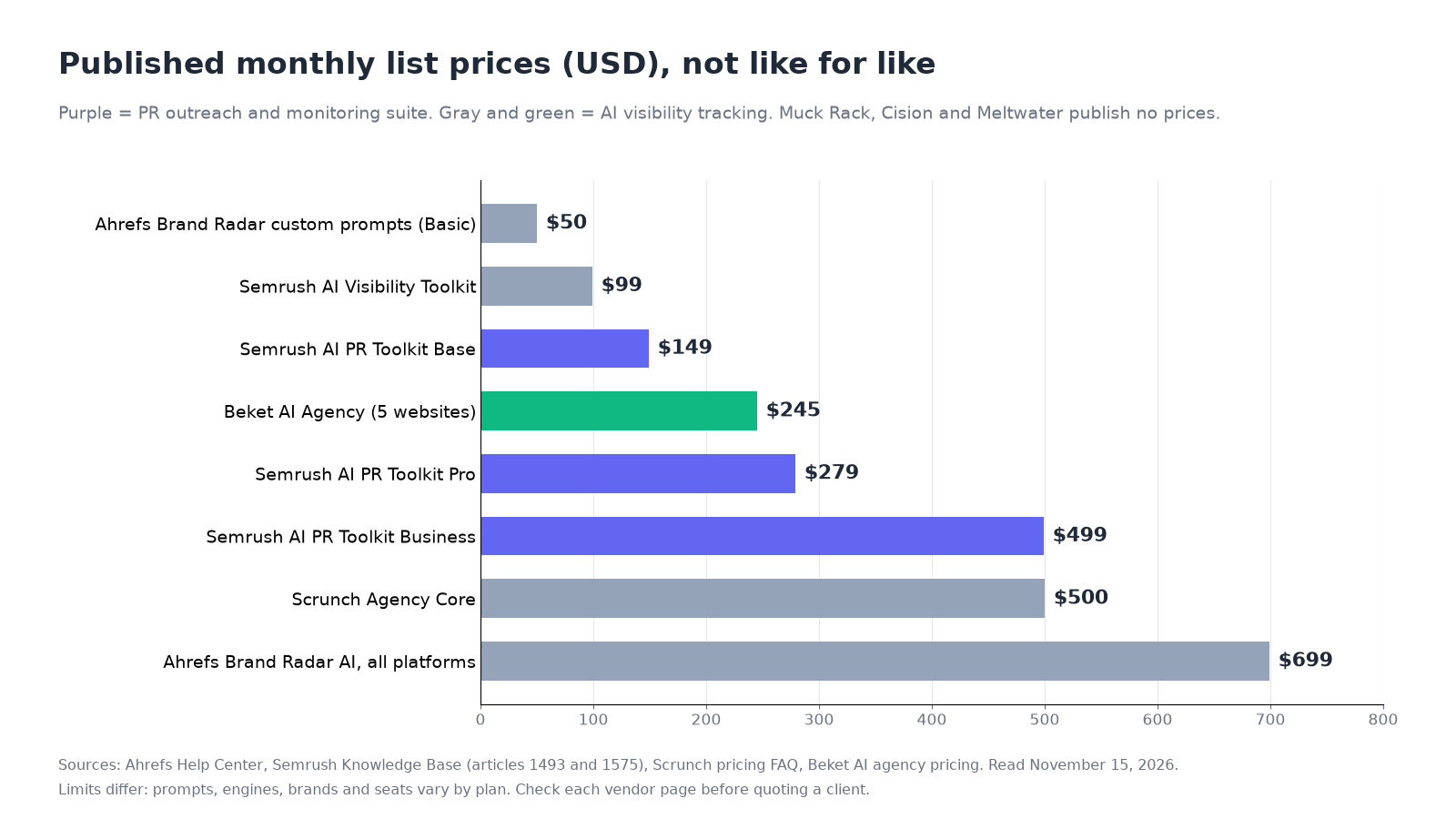
Those bars aren’t like for like. A $99 plan with 25 tracked prompts for one domain and a $245 plan covering five client websites are priced on different units. Use the chart to see the price bands, then check limits on each vendor page.
Media databases with AI visibility built in
These are the tools most PR agencies already pay for. Adding AI visibility there keeps it in the same dashboards as coverage, which makes reporting easier. The tradeoff: none of the three publishes prices, and we couldn’t find a published method for how their AI numbers are sampled.
Muck Rack: AI Visibility inside the platform, Generative Pulse on its own
Muck Rack now has two AI products. Its pricing page lists AI Visibility, which tracks “how often your brand appears in leading AI answers, how sentiment shifts, and which journalists and outlets shape those responses.” The idea is to guide outreach and show how earned media builds AI visibility. Pricing is a custom proposal based on factors such as user count, and Muck Rack offers three plans for agency customers.
Separately, Muck Rack opened early access to Generative Pulse as a standalone platform. Its announcement says no Muck Rack subscription is needed. It describes a framework called SEEN (share of answer, evaluation, error rate, narrative), tracing each answer back to sources including journalists and outlets in Muck Rack’s media data, and asking the same question from different places and audiences. A full launch is planned for early 2027.
Best for: agencies already on Muck Rack that want AI citations tied to the journalists they pitch. Muck Rack also publishes useful research: its October 2026 release reports that earned media drives more than 84% of AI citations.
Ask before you buy: which tier includes AI Visibility, which engines it queries and how often.
CisionOne AI Visibility Dashboard
Cision launched its AI Visibility Dashboard inside CisionOne on July 14, 2026, powered by data from Trajaan. It names the widest engine list in this roundup: ChatGPT, Gemini, Claude, Perplexity, Grok, DeepSeek, Google AI Overview, Google AI Mode and Mistral. Teams can benchmark share of voice against competitors, see sentiment, see which prompts and topics the brand appears in, and see which journalists, publications and domains get cited. The product page stresses that it sits next to media monitoring, social listening and outreach in one platform.
Best for: agencies whose clients already report out of CisionOne and need AI answers in the same deck as coverage.
Ask before you buy: price (quote only), how many prompts are included, and how often they’re re-run.
Meltwater GenAI Lens
Meltwater’s GenAI Lens runs your custom prompts across ChatGPT, Gemini, Claude, Perplexity, Grok and DeepSeek. It reports mention frequency, sentiment, prevalence scores, competitive share of voice, and the websites and journalists the models cite. Its pages describe runs every 24 to 48 hours, and in one answer on the same page weekly, so confirm the cadence in your contract. Meltwater’s 2026 Year-End Release notes add a 13-widget AI Brand Visibility dashboard template, alerts when a brand’s mention rate rank changes, branded web reports, and Mistral as an add-on source that brings coverage to 11 AI sources.
Best for: agencies running social listening and media monitoring in Meltwater that want AI answers alongside them.
Ask before you buy: price, prompt limits, and whether alerts and branded reports are on your tier.
The SEO suites: Semrush and Ahrefs
Semrush AI PR Toolkit (formerly Prowly)
Prowly is now the Semrush AI PR Toolkit. It’s the only tool here that starts from the media list rather than the AI answer. Per Semrush’s plan guide:
- Base, $149 a month: find media outlets and Reddit threads cited by LLMs, find journalists, send targeted pitches, manage lists.
- Pro, $279 a month: adds follow-ups, result analysis, weekly updates on LLM-cited media, and media coverage monitoring.
- Business, $499 a month: adds competitor coverage mapping, AI-generated story angles, share of voice, sentiment and reach benchmarks, and multi-brand tracking in one de-duplicated dashboard. Semrush says this plan suits agencies managing multi-brand portfolios.
All three have a 7-day free trial, though sending email and viewing or exporting contacts are limited or unavailable until you pay.
Best for: small and mid-size agencies that want an affordable media database with an “AI-cited outlets” view built in.
Semrush AI Visibility Toolkit
The AI Visibility Toolkit costs $99 a month with no free trial. It includes 1 project, 1 domain for Brand Performance, 25 tracked prompts and 10 CSV exports a day. Extra domains or locations cost $99 each, 50 more prompts cost $60 a month, and every extra user needs their own $99 license. Prompt tracking is daily and names Google AI Mode and ChatGPT. Brand Performance reports (share of voice, sentiment, narratives) update weekly.
Best for: agencies already in Semrush for SEO clients. For a PR roster the per-domain and per-user add-ons grow fast, so price a full client book before committing.
Ahrefs Brand Radar
Brand Radar works two ways. The AI index, built from Ahrefs’ prompt database, costs $199 a month per platform or $699 a month for all platforms. Custom prompt tracking comes in tiers: $50 for 2,500 checks a month, $100 for 7,000 or $250 for 25,000. One check is one prompt on one platform. Paid Ahrefs plans from Lite up include a small allowance, starting at 150 checks a month. It covers AI Overviews, AI Mode, ChatGPT, Perplexity, Gemini and Copilot, plus Claude for custom prompts, where each check uses 8 checks. Ahrefs notes it can’t currently gather new Grok data. Brand Radar also tracks web mentions, which helps when you need to show coverage that has no link.
Best for: checking competitors’ AI visibility before a pitch, without setting anything up.
Dedicated AI visibility trackers
Scrunch
Scrunch’s pricing help page lists Agency Core at $500 a month and Agency Enterprise on custom pricing. The brand Core plan ($250 a month) shows the kind of limits involved: 125 prompts, 5,000 responses a month and four engines (ChatGPT, Perplexity, Google AI Overviews, Copilot). Enterprise covers nine engines, including Claude, Gemini, Meta AI and Google AI Mode. Its pricing page also lists citation and source tracking, sentiment analysis and AI bot traffic. Looker Studio access isn’t on brand Core.
Best for: larger agencies that want site audits and content tooling next to tracking. Check the agency tab for per-brand limits.
Beket AI Agency
Beket AI is ours, so weigh this section with that in mind. Agency costs $245 a month for 5 websites, billed monthly. That’s Pro’s $49-per-website rate with a five-site minimum. Each website gets 50 prompts on 3 engines, re-audited daily, with white-label client report decks and unlimited user and client seats. Pitch audits (25 prompts, live for 30 days) let you show a prospect how AI describes them before you sign them. Beket AI doesn’t pitch journalists or place coverage. It measures what AI says about each client, flags wrong answers and gives a list of fixes your team can act on.
Best for: PR agencies with several clients that want daily AI answer tracking at a published per-client price, next to the media database they already use.
What our own audit data says about choosing
One reason to care which engines a tool covers: different engines cite different outlets. In a Beket AI market audit of Vancouver holiday shopping (Oct 29, 2026, 25 unbranded questions), we sampled 147 unique cited links. Sixteen editorial outlets showed up. ChatGPT cited 8 of them and Perplexity cited 9, and only one, Destination Vancouver, appeared in both.
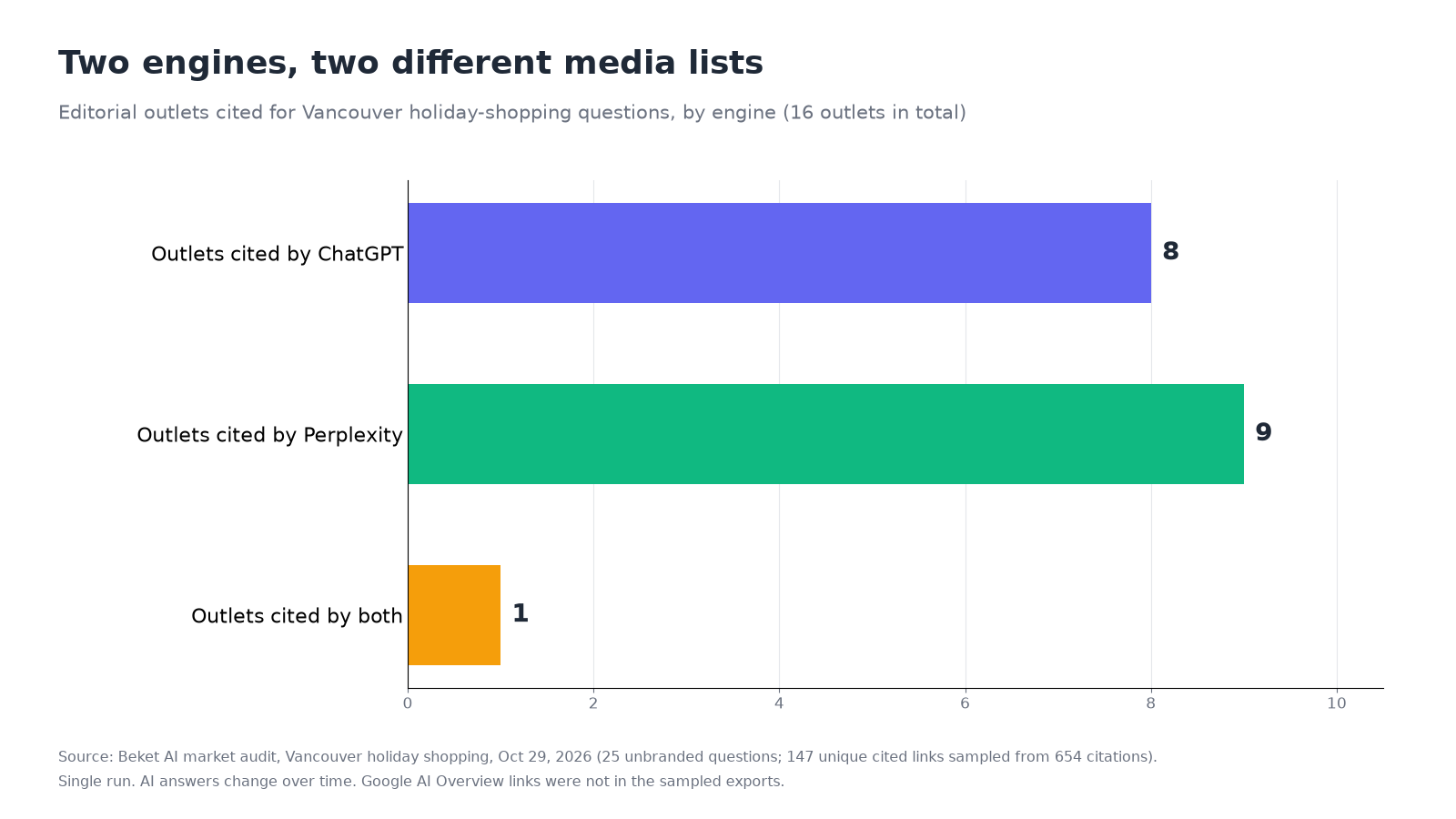
That was a single run of one audit, and AI answers change over time. Muck Rack’s October release found ChatGPT repeated only 41% of its cited domains when the same prompt ran twice in a day, against 94% for Perplexity. Two practical takeaways follow:
- A tool that tracks one engine gives you half a media list. Check the engine list against where your clients’ buyers actually ask.
- Daily or repeated runs matter more than any one snapshot. One run is noisy, especially on ChatGPT. Prefer tools that re-run prompts on a schedule and keep history.
The full walkthrough, with the outlet table and a free template, is in how to build a media list from AI citations.
Which stack fits which agency
| Agency situation | A sensible pairing |
|---|---|
| Boutique, 3 to 10 clients, no media database yet | Semrush AI PR Toolkit (Base or Pro) for lists and outreach, plus a per-website AI tracker such as Beket AI Agency |
| Already on Muck Rack, Cision or Meltwater | Ask your account manager for the AI module price and limits first. Add a separate tracker if you need more prompts, daily runs or per-client white-label reports |
| SEO-heavy agency with PR clients | Semrush AI Visibility Toolkit or Ahrefs Brand Radar if the team already works in them. Watch the per-domain and per-user add-ons |
| Enterprise clients that ask for API access and SSO | Scrunch Enterprise lists both on custom pricing. Ask the media suites the same question |
Whatever you choose, report AI visibility the way you report coverage: a baseline before the campaign, the same unbranded questions after, and the cited sources next to the placements you earned. Our guide on how agencies report AI search visibility to clients walks through what to put in that report. The AI visibility platforms for agencies comparison goes deeper on agency plan pricing. For the pitching side, digital PR for AI search covers the kind of coverage AI answers actually cite.
Start with one client
Before you buy a stack, look at the answer that started all this. Run a free Beket AI audit on one client: 25 prompts across ChatGPT, Perplexity and Google AI Overview. You’ll see whether AI names them, what it says, and which sources it leans on. That tells you which of the four jobs above you need a tool for first.
Related posts
How to Build a Media List From AI Citations (Free Template)
Build a media list from the outlets ChatGPT and Perplexity already cite: 7 steps, a scoring rubric, real Vancouver audit data and a free CSV template.
Which Publications Does AI Cite Most? A 2026 Study of ChatGPT, Perplexity and AI Overview Sources
Which sites do ChatGPT, Perplexity and Google AI Overviews cite? A Beket AI study of 252 citations on 10 US buying questions, plus 166 audits.
Digital PR vs Link Building: Which One Gets You Cited in AI Search?
Digital PR vs link building for AI search: what each does, what Ahrefs' mention studies show, where links still matter, and how to split the budget.