
How to Build a Media List From AI Citations (Free Template)

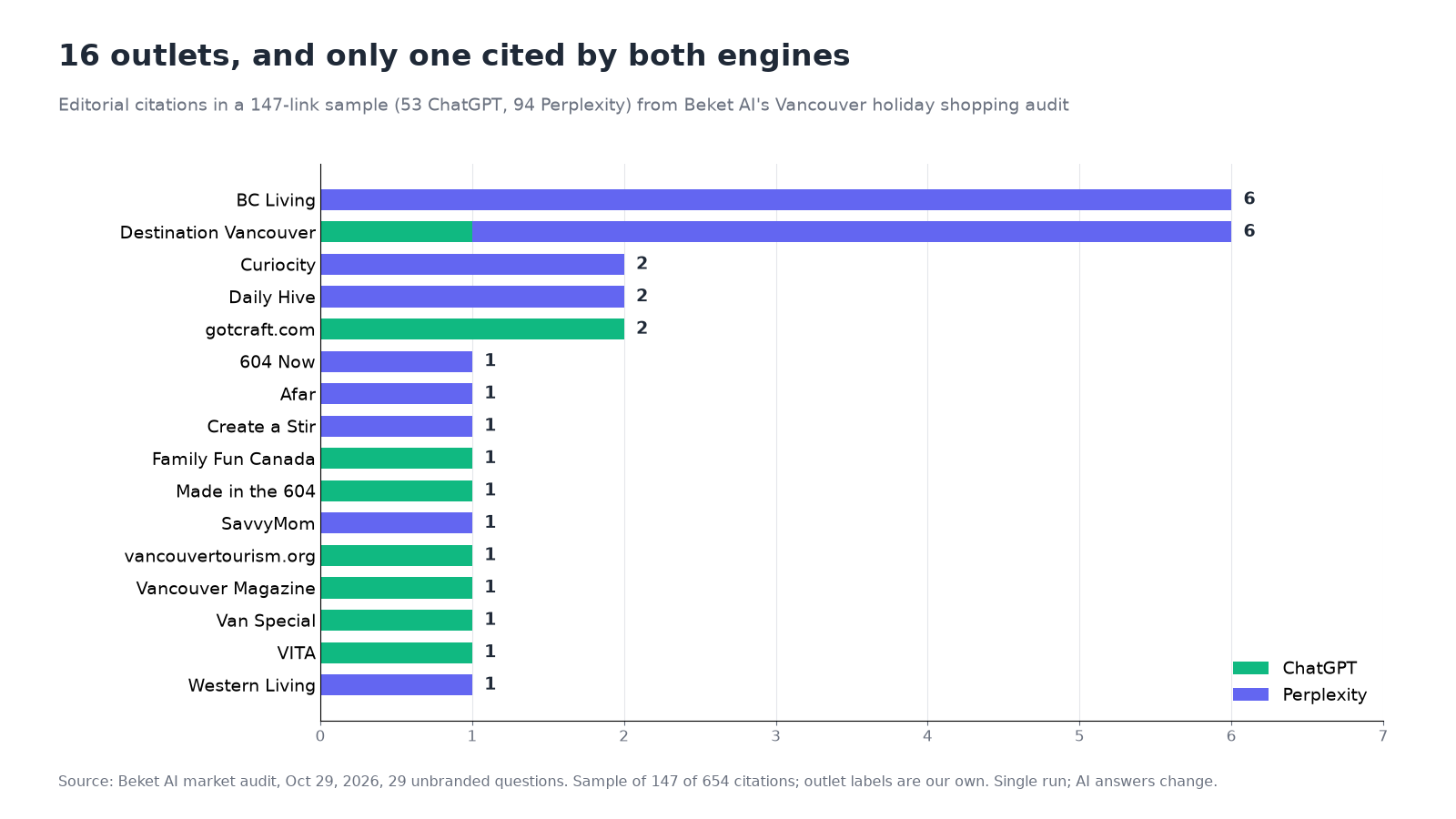
Ask a PR team for a Vancouver holiday-gift media list and you’ll likely get the big names: the daily paper, the TV stations, maybe a national lifestyle title. Then look at a sample of what AI engines actually cited when we asked Vancouver shopping questions in an October 29 audit. The outlets were BC Living, Destination Vancouver, Curiocity, Daily Hive, SavvyMom, Vancouver Magazine and VITA, plus a handful of local blogs and craft-fair calendars. Only one of the 16 outlets was cited by both ChatGPT and Perplexity.
That’s the case for building an AI media list: a pitch list that starts from the pages AI engines already cite for your buyers’ questions, not from the outlets you’d like to be in. This guide shows how to build one in seven steps, using our Vancouver data as a worked example, and gives you a free two-tab template to copy.
What makes an AI media list different
A classic media list is built from a database: beats, circulation, the reporters who covered your competitors. It answers “who could write about us?”
An AI media list answers a narrower question: which pages do ChatGPT, Perplexity and Google’s AI answers pull from when a buyer asks about my category, and who controls those pages? Each row is backed by evidence: a cited URL, the engine that cited it, the question that triggered it, and the date.
It doesn’t replace your normal list. It tells you which part of it matters for AI answers right now, and it surfaces outlets a database search would rank low: a city tourism site, a parenting magazine’s gift guide, a craft-fair calendar.
A worked example: 147 cited links from one Vancouver audit
On October 29, 2026, Beket AI ran a market audit of Vancouver holiday shopping: 25 unbranded questions such as “best toy store in Vancouver” and “where to buy Christmas gifts in Vancouver”, plus 4 questions the audit added itself, on ChatGPT, Perplexity and Google AI Overview. The answers cited sources 654 times. (The store results are in our Vancouver vs Seattle Christmas shopping study.)
Our citation export returns 100 links at a time, so we combined two exports into a sample of 147 unique cited links: 53 from ChatGPT and 94 from Perplexity, with no AI Overview links in the sample. Most went to stores, malls and directories. 29 of the 147 (20%) pointed to 27 editorial pages on 16 outlets. That’s the raw material for a media list.
| Outlet | Type (our label) | ChatGPT links | Perplexity links | Questions citing it |
|---|---|---|---|---|
| BC Living (bcliving.ca) | Magazine | 0 | 6 | 4 |
| Destination Vancouver | Tourism site | 1 | 5 | 3 |
| Curiocity | Magazine / news | 0 | 2 | 2 |
| Daily Hive | Magazine / news | 0 | 2 | 2 |
| gotcraft.com | Craft-fair listings | 2 | 0 | 1 |
| 604 Now, Afar, SavvyMom, Western Living | Magazines | 0 | 1 each | 1 each |
| Vancouver Magazine, VITA | Magazines | 1 each | 0 | 1 each |
| vancouvertourism.org | City guide | 1 | 0 | 1 |
| Family Fun Canada, Van Special, Create a Stir | Local blogs / guides | 2 total | 1 total | 1 each |
| Made in the 604 | Makers market site | 1 | 0 | 1 |
Four things in that table change how you’d pitch:
- The engines barely overlap. ChatGPT cited 8 of the outlets and Perplexity 9, and only Destination Vancouver appeared in both. A list built from one engine would miss half the outlets.
- Depth beats a single hit. BC Living had six links across four different questions (toys, home decor, Christmas gifts, local gift shops), from five separate guides. One outlet with many cited guides is a stronger target than one that appeared once.
- Old pages still get cited. Perplexity cited Curiocity’s “Vancouver gift guide 2024”, a 2025 craft-market guide, and a Daily Hive summer boutiques guide for holiday questions. An outdated guide that still gets cited is a refresh pitch: give the editor something new to add.
- No one was blocked. We checked every outlet’s robots.txt on November 15, 2026. None blocked OAI-SearchBot or PerplexityBot from the homepage. That’s worth checking each time: Muck Rack found that 81% of major publishers blocking Claude’s search crawler got almost no Claude citations.
In the audit’s full domain rollup (all 654 citations, top 10 domains), only two editorial domains made the cut: destinationvancouver.com with 32 citations and dailyhive.com with 15. So the sample gives you the long tail, and the rollup tells you which outlets dominate.
Why one run isn’t a media list
If you build the list from a single pass, you’re mostly logging noise. The public data is consistent on this:
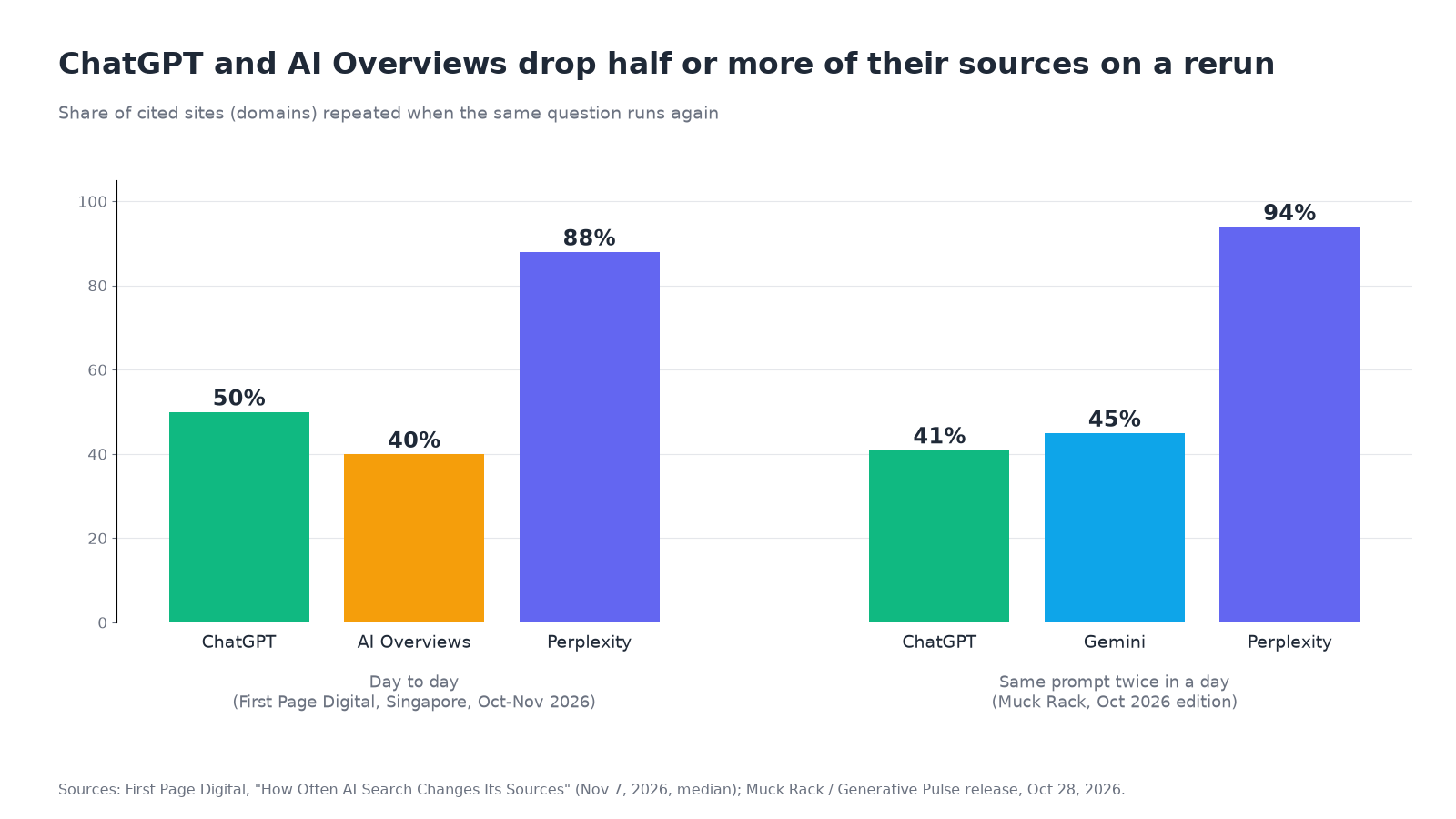
- In First Page Digital’s Singapore tracking study (164,540 answers, Oct 9 to Nov 7, 2026), ChatGPT cited only about 50% of the previous day’s sites for the same question, Google AI Overviews about 40% and Perplexity about 88%. Over 30 days a typical ChatGPT question cited 43 different sites, against about 6 on any one day.
- In the same study, news sites were “regulars” (cited on at least half the days) for only 2% of the ChatGPT questions that cited them, and 3% on AI Overviews. News citations are often one-offs.
- Muck Rack’s October 2026 What Is AI Reading? release found ChatGPT repeated just 41% of its cited domains when the same prompt ran twice in a day, Gemini 45% and Perplexity 94%. Only 212 domains were cited by all four major AI providers. Journalism was 22% of AI citations in September, down from 27% in May.
- Okara’s 230-answer B2B study (collected Nov 7, 2026) found two engines answering the same question shared only 6% of their cited domains on average.
- Over a longer span, PageSpeed Matters found that on 423 like-for-like searches, only 25.9% of pages cited in AI Overviews in Nov 2025 to Jan 2026 were cited again in Jul to Nov 2026.
The practical takeaway: log citations from several runs, keep the engines separate, and rank outlets by how often they come back, not by whether they showed up once. Cited pages also move, break or go stale over time, which we covered in why AI citations decay and how to plan for it, so open each one before you pitch.
How to build an AI media list in 7 steps
1. Write 10 unbranded buyer questions
Use the words customers actually use: sales calls, reviews, support tickets. Leave your brand name out so you see who the engines turn to when the buyer doesn’t know you yet. Mix question types: “best X in [city]”, “where to buy X”, “X for [situation]”. Our guide to finding buyer questions in support tickets covers this step in detail.
2. Run every question on each engine, at least three times
Run the set on ChatGPT, Perplexity and Google, on at least three different days over two weeks. Google won’t show an AI Overview for every question (in our Vancouver audit it appeared for 15 of the 25), so record “no overview” instead of a zero. Paste every cited URL into the Citations log tab, one row per URL per run, with the engine, question and date. Strip tracking parameters such as utm_source=chatgpt.com so the same page doesn’t show up twice.
3. Roll the URLs up to outlets, then to sections and authors
Group the log by domain to get outlets, then look inside each one. In the Vancouver sample, BC Living’s six links came from its shopping and home-decor sections, and Destination Vancouver’s from its holiday events and “inspirations” pages. Open each cited page and note the byline and the published or updated date. Section editors and the writers of cited guides are your actual contacts. The domain alone isn’t a contact.
4. Label each outlet by what you’d pitch
Not every cited site is “media” in the PR sense. Give each one a type and a pitch path:
| Outlet type | Example from our data | What you’d pitch |
|---|---|---|
| Magazine or news site | BC Living, Daily Hive, Vancouver Magazine | A story, data, an expert comment, or an addition to a guide |
| Tourism board or city guide | Destination Vancouver | Event listings and member or partner pages, through their own process |
| Local blog or guide | Family Fun Canada, Create a Stir | An update to an existing roundup, with facts the author can check |
| Event or listing site | gotcraft.com, Made in the 604 | Getting your event or business listed correctly |
5. Check the cited page before you pitch
For each cited page, fill in four columns: Are you named? Which competitors are named? When was it last updated? Does the outlet’s robots.txt let the engine’s search crawler in (OAI-SearchBot for ChatGPT search, PerplexityBot for Perplexity)? A cited page that names three competitors and not you is the most direct opportunity on the list. An old one is a refresh pitch.
6. Score and rank the outlets
Use a simple, visible scoring system so the ranking isn’t a gut call. This is our starting point, not a formula. Adjust the weights to your goals:
| Signal | Points |
|---|---|
| Each engine that cited the outlet | +2 |
| Each different question that cited it (up to 5) | +1 |
| Cited again on a later run | +2 |
| Cited page names competitors but not you | +3 |
| Cited page updated in the last 12 months | +1 |
| Outlet has a contact, tips or submissions page | +1 |
| Outlet blocks that engine’s search crawler | Don’t count that engine |
Using only our single-run sample, Destination Vancouver would score highest (two engines and three questions, 7 points before page checks) and BC Living second (one engine and four questions, 6 points). Repeat runs could change the order. That’s why you need them.
7. Pitch, then re-run and update the sheet
Pitch the top outlets with something that fits their cited pages: a new shop for a gift guide, local data for a trend piece, a correction for an outdated listing. Our digital PR for AI search guide covers what each source type tends to accept. Then re-run the same 10 questions every few weeks. Add new outlets, mark the ones that stopped being cited, and note whether your name now shows up on the cited pages and in the answers.
The free AI media list template
The template has two tabs. Download them as CSV files and import them into Google Sheets or Excel:
- Citations log (CSV): one row per cited URL per run.
- Outlets (CSV): one row per outlet, rolled up from the log, with three example rows from our Vancouver data.
| Tab | Columns |
|---|---|
| Citations log | run_date, engine, question_id, question, cited_url, domain, page_title, author, published_or_updated, brand_named, competitors_named |
| Outlets | outlet, domain, outlet_type, engines_citing, questions_citing, runs_cited, cited_urls, sections, contacts_from_bylines, brand_named_on_cited_pages, competitors_on_cited_pages, last_updated, crawler_access, pitch_path, score, status, next_check |
We left author names out of the example rows on purpose. Fill in bylines from the pages themselves, and use each outlet’s published contact or tips page instead of guessing at email addresses.
Mistakes that make an AI media list useless
- Pooling the engines. With so little domain overlap between engines, a combined list hides which outlet moves which engine. Keep an engine column on every row.
- Counting a single citation as a target. One link from one run might be one of the “one day only” sites. Wait for a second sighting before you spend a pitch on it.
- Stopping at the domain. “Daily Hive” isn’t a contact. The cited guide’s section and author are.
- Ignoring non-press sources. In our Vancouver sample, a tourism site and two craft-fair calendars sat next to the magazines. If the engines cite them, they belong on the list, even if your pitch is just a listing.
- Building it once. Citations churn month to month. A list that’s six months old is mostly a list of past citations.
Where Beket AI fits
Beket AI handles the measurement steps, 2 and 7: it runs unbranded buyer questions on ChatGPT, Perplexity and Google AI Overview and shows which businesses each engine names and which sources it cites. A free audit covers 25 prompts across those 3 engines. Pro, at $49 a month, re-audits daily starting at 50 prompts, which gives you the repeat runs this method needs. Agency, at $245 a month, covers 5 sites. Beket AI doesn’t pitch journalists or place coverage. The template above turns its cited sources into a list you can act on.
Run a free audit on beket.ai to see which outlets the engines cite for your buyers’ questions.
About the data
- Audit: Beket AI market audit of Vancouver holiday shopping, run October 29, 2026 (evening, Pacific time), 25 unbranded questions plus 4 the audit generated, on ChatGPT, Perplexity and Google AI Overview. Google showed an AI Overview for 15 of the 25 questions. The answers cited sources 654 times.
- Sample: two exports of 100 cited links each, combined into 147 unique links (53 ChatGPT, 94 Perplexity, 0 AI Overview). The sample doesn’t include every citation, so per-outlet counts are a floor, not a total. The top-10 domain rollup covers all 654 citations.
- Labels: outlet types are our editorial judgment. Robots.txt rules were checked for each outlet’s homepage on November 15, 2026, and can change.
- Caveats: this is one run, on one evening, before Google’s November 10 core update and its November 12 model switch in Search. AI answers change by day, wording and user, and this shows what the engines returned at that moment. Businesses and outlets named here can ask us to run the questions again.
Related posts
Digital PR vs Link Building: Which One Gets You Cited in AI Search?
Digital PR vs link building for AI search: what each does, what Ahrefs' mention studies show, where links still matter, and how to split the budget.
Best AI Tools for PR Agencies in 2026: Monitoring, AI Visibility and Reporting, Compared
The best AI tools for PR agencies in 2026: Muck Rack, Cision, Meltwater, Semrush, Ahrefs, Scrunch and Beket AI, compared on AI visibility and price.
Can AI Book Appointments With Your Business? ReserveAction Schema and the Booking Paths That Matter (2026)
Can AI book appointments with you? Google AI Mode and ChatGPT book through partners, your booking page or ReserveAction schema. How to set up all three.