
Digital PR vs Link Building: Which One Gets You Cited in AI Search?

Picture two proposals on a marketing lead’s desk with the same budget. One promises 40 backlinks from sites with high Domain Rating. The other promises a data story, pitched to trade press, local outlets and the review sites in your category, with links where editors allow them. Five years ago the first one was easier to defend in a report. When the buyer asks ChatGPT or Google’s AI Mode who to hire, the second one usually matters more.
This post compares the two head to head: what each one is, what the public data says about AI citations, where links still pull their weight, and how to split a budget between them. All the numbers below come from linked public studies or from Beket AI’s own audits, and each one comes with its limits.
The short answer
Link building aims at a URL. Digital PR aims at a story. Link building picks a page and gets other sites to link to it so it ranks higher. Digital PR creates something editors want to cover and counts a mention as a win even when there’s no link.
For AI search, the evidence points toward digital PR. Being talked about across many independent sites tracks AI visibility much more closely than raw link counts do. Links haven’t stopped mattering, though. They still help a page rank and get found, and the AI engines often search the web before they answer. Most brands need both, measured separately.
Side by side
| Link building | Digital PR | |
|---|---|---|
| What you’re after | Links pointing to a specific page | Coverage and mentions of your brand, link optional |
| What counts as success | A followed link from a relevant site | A mention in an outlet, list, review site or thread your buyers (and AI engines) read |
| Typical tactics | Guest posts, resource pages, broken-link outreach, digital assets | Original data, expert commentary, newsjacking, awards and rankings, review and directory profiles |
| Effect on classic SEO | Direct: links are still a ranking signal | Indirect: earned links come along when editors include them |
| Effect on AI answers | Indirect: helps pages rank and get retrieved | More direct: mentions build the brand-topic association engines repeat |
| Main risk | Paid or manipulative links break Google’s spam policies | A story no editor picks up, or coverage that gets your facts wrong |
| How to measure | Referring domains, rankings, organic traffic | Mentions, unbranded AI answers that name you, cited sources |
What the data says about AI citations
Mentions correlate far more strongly with AI visibility than backlinks
The study most people cite is Ahrefs’ analysis of 75,000 brands (published May 2025). It compared brand factors with how often each brand appeared in Google AI Overviews, using Spearman rank correlation. Branded web mentions scored 0.664. The number of backlinks scored 0.218, and referring domains 0.295.
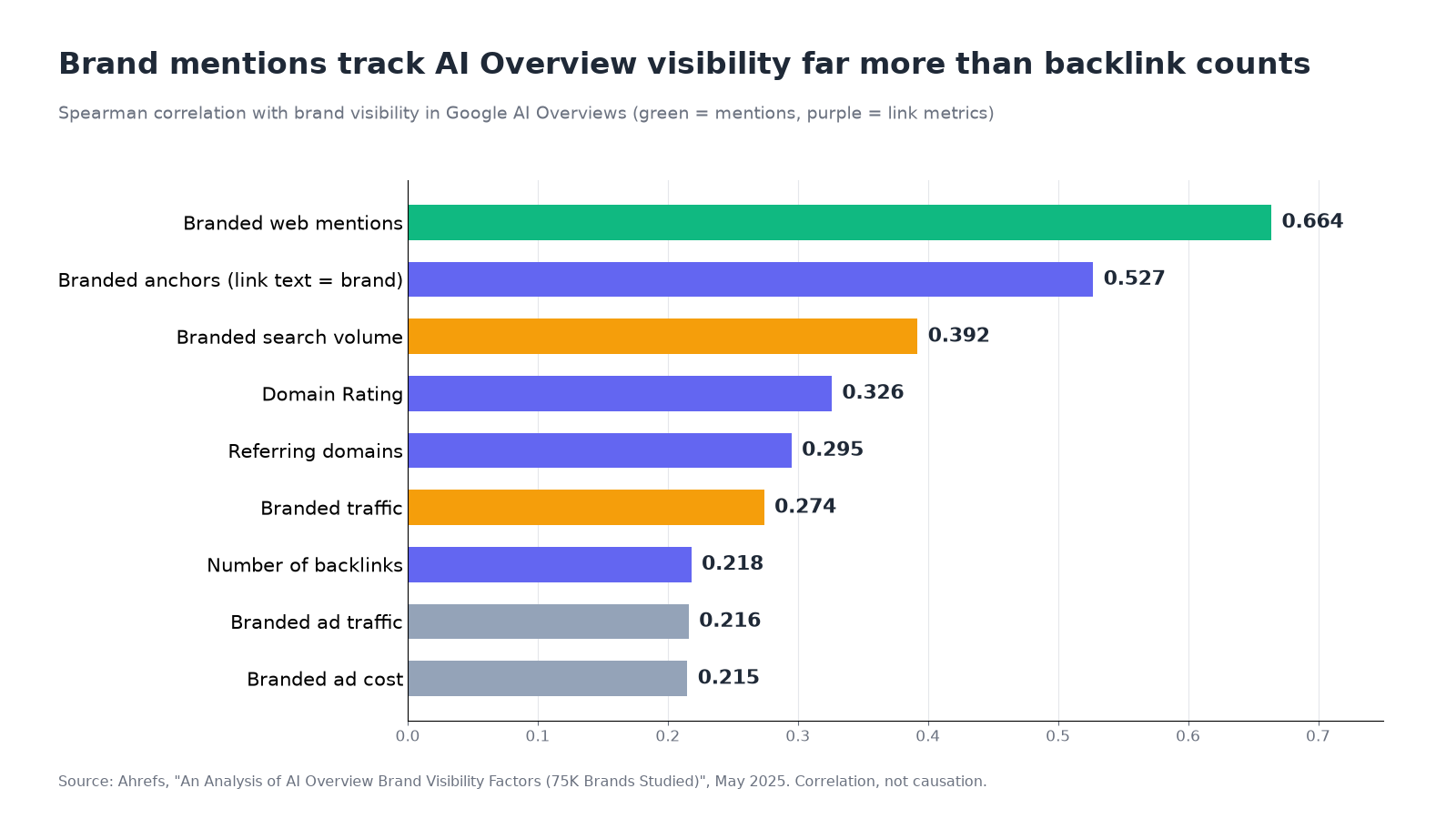
Two details are easy to miss. First, the second-strongest factor, branded anchors (0.527), is a link signal: links whose visible text is your brand name. So the result isn’t “links are dead.” It’s that raw link volume, the number most link-building reports lead with, sits near the bottom. Second, these are correlations. Ahrefs says plainly that they don’t prove cause, and big brands tend to have lots of everything.
Press coverage doesn’t beat ordinary web mentions
Ahrefs followed up on November 3, 2026 with a study of 10,000 US brands and 260 million unbranded prompts across ChatGPT, AI Mode and AI Overviews. This time it split mentions by type:
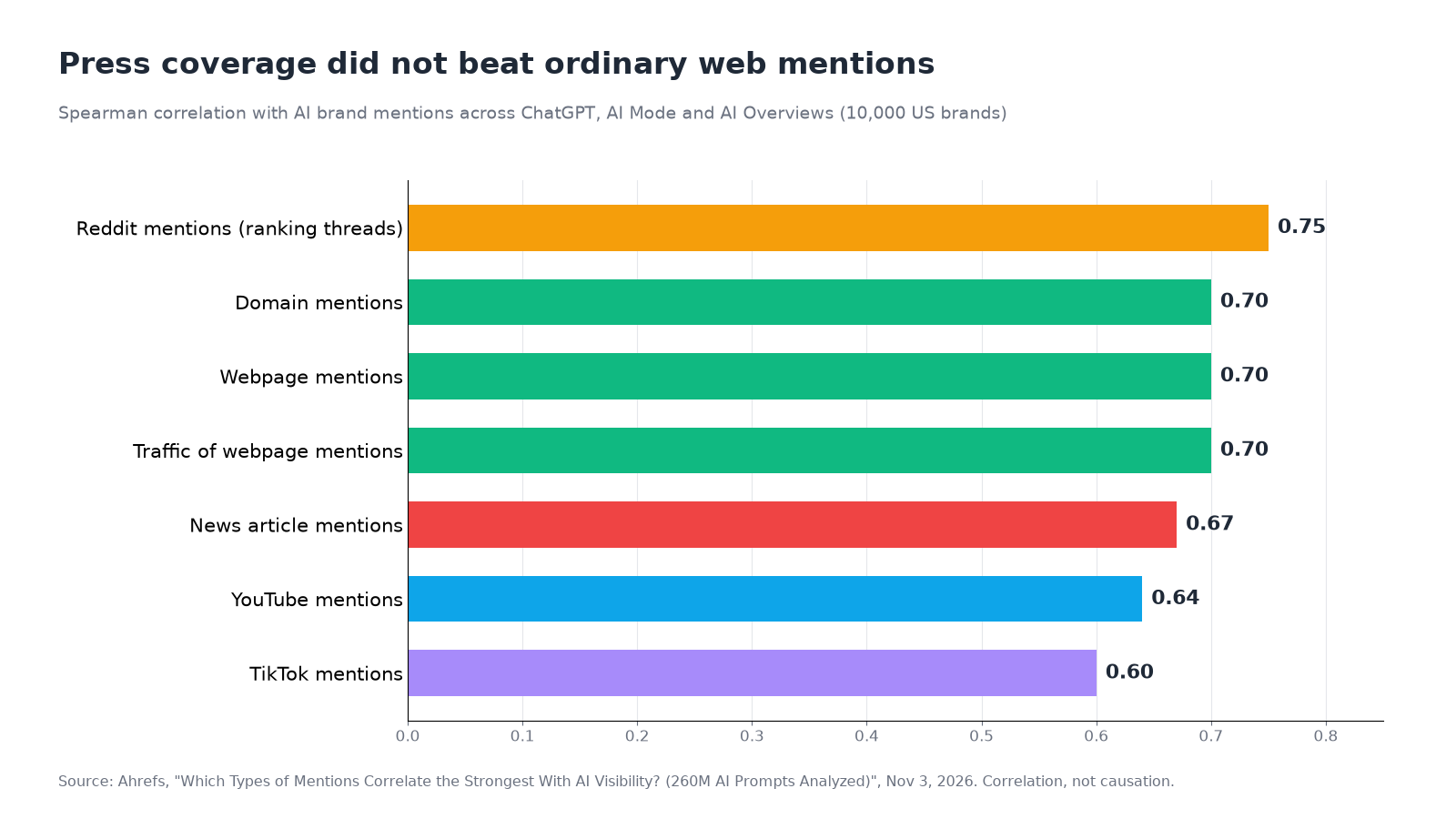
This changes how digital PR should be planned:
- News mentions (0.67) scored slightly below general webpage mentions (0.70). A wide spread of mentions mattered at least as much as big-name press.
- Traffic didn’t add anything. Weighting mentions by the traffic of the page that carries them scored the same 0.70 as raw mentions. A mention on a small niche site seemed to count about as much as one on a busy site.
- Returns diminish. A brand with 10 times more webpage mentions typically had about 3.7 times more AI mentions. Ahrefs’ own conclusion is that a visible change probably needs a large, sustained increase in coverage, tracked over months.
- Brand size explains part of it, not all. When Ahrefs compared brands with similar search demand, the link between webpage mentions and AI mentions got weaker (0.34 to 0.54 by band) but held in every band.
- ChatGPT was the least tied to off-site mentions of the three engines on 6 of 7 factors.
So the AI-search version of digital PR isn’t “land one big feature.” It’s “get named accurately, in context, on many independent pages your buyers read.”
Where link building still earns its place
Three findings explain why you shouldn’t drop links entirely.
AI engines retrieve before they answer. An October 2026 arXiv paper by Mahe Chen and Nick Koudas, What Drives AI Citations?, studied 158,099 answers with 468,037 citations. It found that every page ChatGPT cited was one its own search had retrieved, and that retrieval explained far more of the variation than page properties (32% against 2.8%). It also found that “pages are thus cited when searched; brands are also named when remembered.” Links help with the first half, getting pages found and ranked. Mentions help with the second, getting your brand remembered.
Ranking #1 still helps, but page one isn’t the finish line. PageSpeed Matters’ November 2026 study of 133,099 AI Overview citations on 19,757 US mobile results pages found the #1 organic page was cited on 43.1% of results pages. Yet only 30.1% of all citations pointed to a page in that search’s top 10. We looked at more of this rank-versus-citation data in Does SEO Still Matter for AI Search?
Branded anchors are a link signal. When a link uses your brand name as its text, it’s a link and a mention at once, which is exactly what good digital PR tends to produce.
In local search, “PR” mostly means lists and directories
Big studies skew toward large brands. For local service businesses, our own audit data points the same way, but the sources look different. Across five Beket AI market studies run November 7 to 12, 2026 (NYC lawyers, NYC mortgage brokers, NYC realtors, LA marketing agencies and SF marketing agencies), we grouped citation events for the top 10 cited domains in each study:
| Source type (Beket AI editorial grouping) | Citation events |
|---|---|
| Directories, rankings and portals | 497 |
| Business and vendor sites | 157 |
| Google (Maps, listings) | 120 |
| Regulators, courts and associations | 66 |
| Other third-party pages | 56 |
| News and publishers | 49 |
| Total (top 10 domains per study) | 945 of 2,304 |
Directories and rankings out-cited news about 10 to 1. Clutch alone took 69 citations in the LA agencies study and 64 in the SF one. For a local firm, the “digital PR” that shows up in AI answers is often a complete, accurate profile on the category’s ranking sites, bar association or licensing listings, and review platforms, not a newspaper feature. These were single runs of unbranded questions, and AI answers change over time, so treat the table as a snapshot. The full method is in our digital PR for AI search guide.
How each one goes wrong
Link building goes wrong when it turns into buying. Google’s spam policies list buying or selling links that pass ranking credit, excessive link exchanges, guest posts or press releases with optimized anchor links, and “low-quality directory or bookmark site links” as link spam. The same page now defines spam as including “attempting to manipulate generative AI responses in Google Search.” Paid links are allowed only when marked rel="sponsored" or rel="nofollow". A link-building vendor that guarantees DR numbers is selling the part of the playbook that carries the most risk and, per the data above, correlates least with AI visibility.
Digital PR goes wrong when the facts are wrong. An engine that reads a story with an old price, a wrong service area or a former CEO’s name will repeat it. Coverage only helps if it describes you the way you describe yourself: same name, category, location and one-line summary. Check that the outlet doesn’t block AI search crawlers such as OAI-SearchBot and PerplexityBot in its robots.txt. Our post on why brand mentions are the new backlinks covers why an accurate unlinked mention still counts and an inaccurate one counts against you.
How to split the budget
There’s no study that gives an ideal ratio, so treat this as our starting point, not a formula:
| Your situation | Lean toward | Why |
|---|---|---|
| Local service business (lawyer, plumber, realtor) | Digital PR, focused on directories, rankings, associations and reviews | That’s where our local audits found most AI citations |
| SaaS or B2B | Digital PR with original data, plus links to key comparison and pricing pages | Mentions build category association; linked pages still need to rank to be retrieved |
| Online store | Both, plus a product feed and review coverage | Shopping answers draw on product data as well as third-party reviews and roundups |
| New site with almost no links | Some link building first | Pages that can’t be found or ranked rarely get retrieved |
Whatever the split, keep the two reports separate. Links belong in your SEO dashboard (referring domains, rankings, organic traffic). Digital PR belongs in an AI visibility check: run the same unbranded buyer questions across ChatGPT, Perplexity and Google AI Overview before and after a campaign, and record which brands are named and which sources are cited. If you put out a release as part of a campaign, our guide on writing press releases for AI search covers the structure that tends to get picked up.
Where Beket AI fits
Beket AI shows the “after” picture. The free audit runs 25 unbranded prompts across ChatGPT, Perplexity and Google AI Overview and shows which businesses each engine names and which sources it cites. Pro ($49/month) re-runs the audit daily, starting at 50 prompts across the same three engines, so you can see whether a PR push changed the answers over the following weeks. Beket AI doesn’t place coverage or build links. It shows you where the engines are looking.
Run a free audit on beket.ai to see which sources AI engines cite for your buyers’ questions before you pick a side.
Related posts
Can AI Book Appointments With Your Business? ReserveAction Schema and the Booking Paths That Matter (2026)
Can AI book appointments with you? Google AI Mode and ChatGPT book through partners, your booking page or ReserveAction schema. How to set up all three.
How to Build a Media List From AI Citations (Free Template)
Build a media list from the outlets ChatGPT and Perplexity already cite: 7 steps, a scoring rubric, real Vancouver audit data and a free CSV template.
Should You Block AI Bots? Crawlers, Agents and Signed Agents Explained (2026)
Should you block AI bots? Training crawlers, search crawlers, user fetchers and signed agents differ. Web Bot Auth and Cloudflare change the answer.