
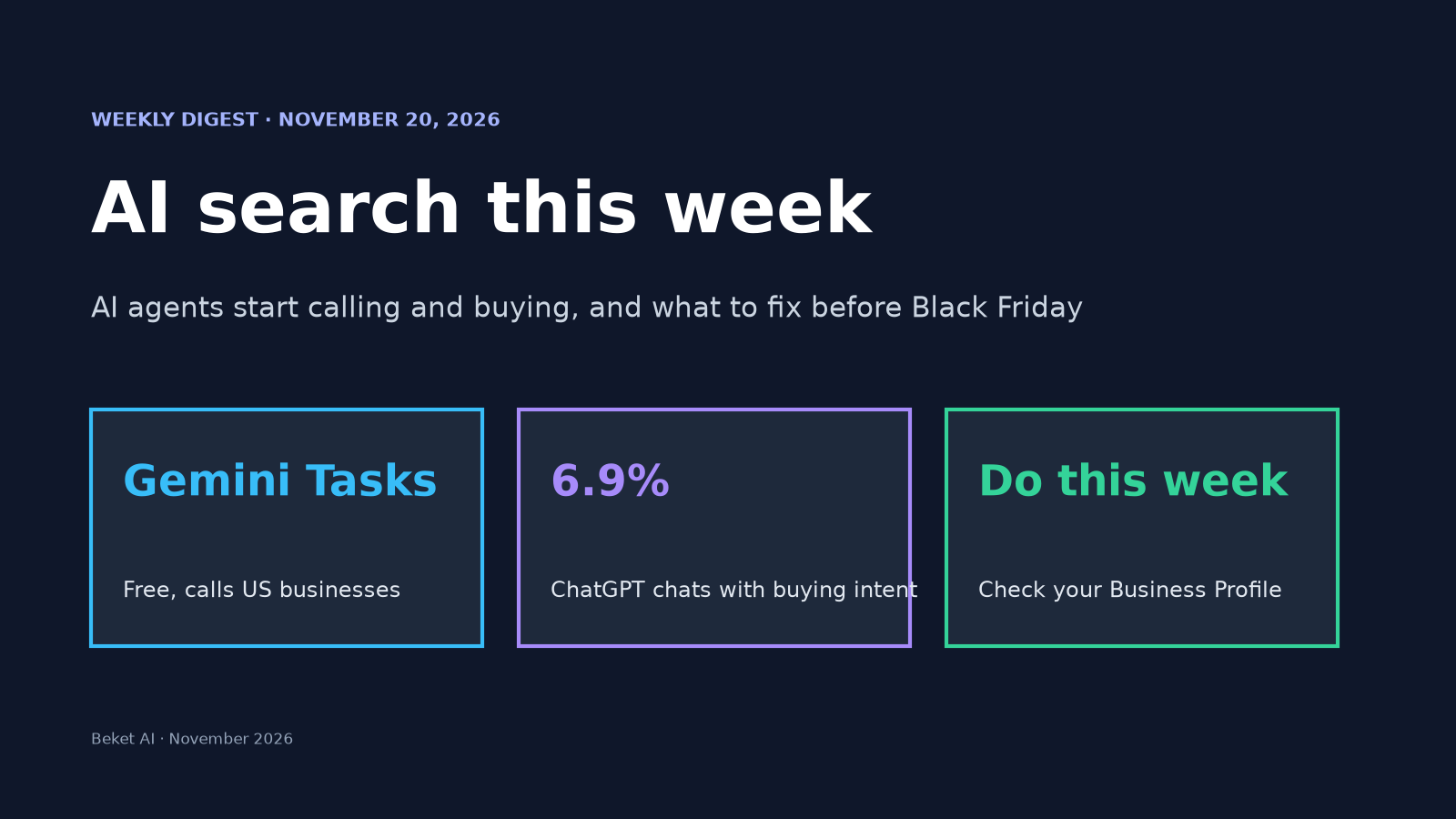
AI Search This Week: Gemini and ChatGPT Agents Start Booking and Buying (Nov 20, 2026)

A week before Black Friday, AI assistants stopped only recommending businesses and started contacting them. Google made Gemini's task agent free on November 17, and in the US it can phone a shop and book an appointment. ChatGPT got a wallet so its agents can check out. Google also published a guide that tells sites how to let its agent through their firewall. Then a new panel study landed with a reminder that keeps the hype in check: only a small share of ChatGPT conversations are about buying anything.
Our take: Two stories ran side by side this week, and they fit together better than they first appear. AI agents are being built to act on buying decisions, but buying questions are still a small slice of what people type into ChatGPT. Most local and shopping questions still go through Google. So the useful work for the next ten days isn't chasing every new AI surface. Make sure Google's AI surfaces have the right facts about you, make sure agents aren't blocked from your site, and measure across many runs instead of trusting one screenshot.
1. The big story: Gemini will now call businesses for you, for free
On November 17, Google made Tasks in Gemini free "for hundreds of millions of people" in the US, Japan, Korea, Canada, Australia and India, running on Gemini 4 Hydrogen. Google is starting a set of advanced features in the US. Gemini can phone businesses, buy through Google Pay using the Agent Payments Protocol (AP2) with a spending cap you set, and sign in to sites through Google Password Manager. In Google's own example, Gemini found the two nearest dealerships on Google Maps, called both at once, and booked "the shop that accepts appointments vs. walk-ins only." Google says Gemini tells the business it is an AI on the call, and that businesses "can opt out whenever they want." Calling isn't available yet in Indiana, Louisiana, Minnesota, Montana or Nebraska. Google says Universal Commerce Protocol (UCP) checkout is "up next," with no date.
The same day, Google published Allow Google-Agent traffic, a guide for CDNs, firewalls and bot-detection tools. It explains how to verify Google-Agent requests (user agent, IP list, and an experimental Web Bot Auth signature) and lists six troubleshooting checks. Your allow rule has to come before "category-level AI agent block policies." It has to skip CAPTCHAs. And it has to cover on-site search, add-to-cart, booking and API calls, not just the homepage.
Four days earlier, on November 13, OpenAI launched ChatGPT Wallet, which lets its "dots" agents complete purchases. At launch it's limited to some US ChatGPT Pro subscribers, and each purchase is approved with Face ID or a fingerprint. OpenAI also published a Commerce Partner Playbook for stores (TechCrunch).
Our take: Gemini Tasks is the bigger change of the two, because it's free, it's live in Canada and the US, and in Google's own example it starts from Google Maps. When an agent picks which plumber or dealership to call, it reads the same Business Profile details a person would skim: your hours, whether you take appointments, your phone number, and whether you have the item in stock. A wrong field used to cost you a click. Now it can cost you the booking, and you'll never know it happened. ChatGPT Wallet matters less this week because so few people can use it yet, but OpenAI's playbook and Google's guide make the same point: if your firewall blocks AI agents by default, you might be unbuyable to them without realizing it. Our Gemini Tasks readiness checklist and Google-Agent firewall guide walk through both.
Source: Google
2. Quick hits
- Microsoft confirms ads in Bing's AI Overviews. On November 19, Microsoft said ads can now appear "next to AI-powered answers on Bing" through existing campaigns, including Performance Max and AI Max, in all markets except China. It gave no details on labels or where ads sit relative to cited sources (Search Engine Roundtable). Our take: Organic citations now compete with ads on Bing too, as they already do in AI Mode and ChatGPT. We covered what changes in our news take.
- Google's homepage now saves your AI Mode chats. A collapsible sidebar lists recent AI Mode searches so people can pick a thread back up. It's rolling out globally on desktop. Google's Robby Stein says people "are coming to Search with more questions that aren't just one and done" (The Verge). Google also launched temporary AI Mode threads that aren't saved or personalized. Our take: More follow-up questions mean you need to show up across a whole conversation, not just in the first answer.
- AI Overview citations got easier to see, at least for now. AI Overviews now show three citation cards with no fade, reversing last month's removal of desktop citations. Google hasn't announced this. It was spotted by one SEO and reported by Search Engine Roundtable. Our take: If it sticks, landing in the top three cited sources matters more than being somewhere in the list. Google has changed this display several times, so treat it as a sighting.
- Most pages ChatGPT reads never get cited. In an AirOps dataset of 15,000 prompts and 548,534 pages that ChatGPT retrieved, 85% of retrieved pages were never cited. Among cited pages that appeared in a top-20 search result, 32.9% showed up only for a follow-up ("fan-out") query, not the original prompt (Search Engine Land, Kevin Indig's Q4 meta-analysis). Our take: Tracking only your headline prompt misses part of how brands get picked. Add the pricing, "vs" and reviews questions buyers ask next.
- ChatGPT model launches act like unannounced core updates. Using Generative Pulse data, Search Engine Land reported that ChatGPT's citations of AP, TIME, TechCrunch, the LA Times and The Atlantic fell 50% to 90% within a week of the July 9 model launch, while their Google rankings held. On the same 102 questions, brands' own sites went from 14% to 20% of ChatGPT citations between April and September (Search Engine Land). The data comes through APIs, not the ChatGPT app, and the author works at the company behind it. Our take: Put OpenAI's launch dates on your dashboard next to Google's updates. Here's how to catch it.
- AI answers change from one day to the next, though the headline number has been corrected. Supercite, which sells an AI visibility tracker, asked 210 buying questions on four engines on November 17 and 18. It first reported that 84% of 839 answers named a different set of brands the next day. On November 19 it corrected that to 75% after recounting with its published brand list. Brand overlap was 68%, and a brand ranked #1 was still named the next day 90% of the time (Supercite). The study is preliminary (2 of 7 days) and comes from a single vendor. Our take: Whichever number holds up, one check of "does ChatGPT recommend us?" doesn't tell you much. Our own daily audits point the same way (what Beket AI's daily audits show).
3. What people are asking
These are the questions that came up most this week in the X, Reddit and LinkedIn threads we follow, put in our own words.
"Is SEO dead now that buyers ask AI?" Salesforce launched an AI visibility product with a "Goodbye SEO" pitch, and practitioners pushed back fast. Their point was that AI answers are still built from pages that can be found, crawled and trusted (one widely shared reply). The data backs them up, with limits. A performance.io and Semrush pharma study found that 84% of AI Overview citations came from pages in Google's organic top 10, and 69% of #1-ranked pages were cited. But brand sites held 9.2% of #1 rankings and only 4.2% of AI Overview citations (Search Engine Land). Our take: SEO is the entry ticket, not the finish line. Rankings get you into the pool AI picks from, but they don't guarantee you get named.
"ChatGPT mentions us thousands of times, so where are the customers?" Now that ChatGPT's Business Hub shows numbers, people are sharing screenshots. One affiliate site owner on Reddit reported 139,356 mentions and 543 clicks in 28 days, a click rate under 0.4% and about 4% of their total traffic (Reddit). That's one self-reported account. On the other side, a SaaS founder said 12 of 22 ChatGPT visitors signed up, compared with 5 of 16 from Google. That's a tiny sample, but it shows the pattern people keep describing: few clicks, high intent. Others pointed out that clicks from AI Overviews show up as plain Google organic traffic in GA4, so part of AI's effect is hidden. Our take: Report AI visibility next to leads and sign-ups, not as a vanity count, and don't expect ChatGPT clicks to look like Google clicks.
"My AI traffic disappeared. What changed?" This week had more failure stories than wins: - Failure: A replacement-parts store owner said ChatGPT had sent about one order a day until November 4, then parts sessions stopped completely. In October they'd used an AI coding tool to rework the store's business schema around their main product and leave parts out. Now ChatGPT recommends the main product more and the parts not at all (Reddit). The cause isn't confirmed, but the timing is a warning about sweeping structured-data changes. - Failure, then a fix: A SaaS founder found ChatGPT telling people their free tier wasn't really free. The cause was their own page copy, which made the free site sound temporary. They rewrote it in plain words (Reddit). - Failure: Several news and recipe publishers reported Google Discover and Search traffic falling sharply as the November core update rolled out. One gaming news site said it went from about 94,000 to 16,000 daily pageviews in three days (Reddit). These are self-reported and the update is still rolling out. - Success: One team said its static site was never cited in a 16-query Perplexity test until they changed robots.txt and response headers, and citations appeared "within hours" (X). That's a single unverified claim, but it's a cheap thing to check.
Our take: Most of these stories come back to the same cause: what AI says comes from the pages and data you control. Check your own changelog (schema edits, copy changes, robots.txt) before you blame an update. And keep a baseline so you can tell which change did what.
4. Number of the week: 6.9%
Only 6.9% of ChatGPT conversations in a SparkToro and Verso panel showed purchase intent, meaning research into what to buy or questions about a specific brand. The panel covered 118,163 prompts in 41,961 conversations from 12,321 opt-in US users between January 1 and October 29, 2026. Only 12.1% of ChatGPT's responses named any brand, product or company, so about 88% named none. "Shopping, brands & local services" made up 5.7% of per-user activity, while images and visual design were the top use at 16.1%. SparkToro compares that 6.9% with 15%+ of Google queries meeting the same definition in its earlier study (SparkToro). The panel skews toward phones and consumers and doesn't include API use.
Our take: Don't read this as "ignore AI search." Read it as "know where the buying questions are." Buying-intent prompts are a small slice of ChatGPT, but they're the slice that turns into revenue. SparkToro's own conclusion is that AI visibility matters most because of Google's AI Overviews and AI Mode, which is where most shopping and local questions happen. Track the buying questions that matter to you, on Google's AI surfaces as well as ChatGPT. We went deeper in Only 6.9% of ChatGPT chats are about buying.
5. What to do this week
- Check your Google Business Profile as if an agent were reading it. Gemini Tasks finds businesses on Google Maps and, in the US, can call them. Make sure your hours, holiday hours, phone number, and whether you take appointments or walk-ins are all correct before Black Friday. If you'd rather not get AI calls, Google says businesses can opt out (Google; our Gemini Tasks checklist).
- Make sure your firewall isn't blocking the agents you want. Go through Google's six troubleshooting checks. Your allow rule should come before AI-agent block categories, skip CAPTCHAs on search and booking, and cover add-to-cart and API calls. If you use Cloudflare, check its AI agent settings too (Google's guide; our step-by-step version and ChatGPT Wallet checklist).
- Measure share on your buying questions, not one screenshot. Pick 10 to 25 unbranded buying questions, including the follow-ups buyers ask next. Run them more than once on Google AI Overviews and AI Mode as well as ChatGPT, and write down how often you're named and which pages get cited. Daily churn (Supercite) and fan-out citations (Search Engine Land) both mean a single check misleads.
6. From the Beket AI blog
Beket AI studies this week - How Often Do AI Answers Change? What Beket AI's Daily Audits Show: between two consecutive daily runs of the same prompt on the same engine, the list of brands named was identical only 30.1% of the time. - Which Publications Does AI Cite Most?: 252 citations on 10 US buying questions across ChatGPT, Perplexity and AI Overviews, with only 3 domains cited by all three engines. - Which Seattle Plumbers Does AI Name for Booking?: 10 "can you come Thursday" questions on Gemini, AI Mode and AI Overview, run the day Gemini Tasks went free. - Does AI Recommend Different Apps to a Founder, a CFO and a Parent?: the CFO and parent got the same first app in only 2 of 19 matched answers.
Guides and news takes - Only 6.9% of ChatGPT Chats Are About Buying. Here's Where AI Visibility Still Matters - Ads Now Sit Next to Bing's AI Overviews: What Changes for Organic Citations - Is Your Business Ready for Gemini Tasks? - How to Let Google-Agent Into Your Store Without Letting Scrapers In - ChatGPT Wallet: Is Your Store Ready for AI Agents That Buy? - ChatGPT Has Core Updates Too - GEO Checklist for Ecommerce: 20 Checks Before AI Shopping Answers Pick Your Products - How to Get Your Black Friday Offer Into Google AI Overviews and AI Mode - Service Area Pages vs Doorway Pages
Want to know what AI engines say about your business before Black Friday? Start with the free Beket AI audit, which checks 25 unbranded prompts. For ongoing tracking, Pro is $49/mo, and the Agency plan is $245/mo for 5 sites.
Related posts
YouTube in AI Overviews vs ChatGPT: Which AI Engines Cite Videos (2026 Data)
YouTube is the most-cited site in Google AI Overviews, yet ChatGPT almost never cites it. Six engines compared with Beket AI audit data and what to do for each.
Gemini 4 Hydrogen in Google Search: What Changed in AI Overviews After One Week (Beket AI Data)
After Google's Gemini 4 Hydrogen switch, AI Overviews kept just 14% of earlier citations on the same questions vs 40% on ChatGPT. Week-one data and what to do.
AI Search This Week: Gemini 4 Hydrogen Takes Over Google Search (Nov 13, 2026)
Gemini 4 Hydrogen now powers Google Search, the November core update is rolling out, and ChatGPT opened business profiles. The week in AEO, GEO and SEO.