
ChatGPT Has Core Updates Too: How Model Launches Rewrite Who Gets Cited (and How to Catch It)

Google tells you when it ships a core update. OpenAI doesn’t. But a Search Engine Land analysis published November 16, 2026 makes a strong case that ChatGPT model launches work like one anyway: the day a new model rolls out, the list of sites ChatGPT cites can change, and nobody sends a changelog.
This post covers what the article reports, why it matters if your brand’s AI visibility depends on other people’s websites, what our own Beket AI audit data shows about how often ChatGPT’s sources change, and how to catch the next shift before it shows up in your pipeline.
What Search Engine Land reported
The article, by Anna Crowe, draws on research from Generative Pulse, presented at the Generative Pulse Summit in New York on October 28. Its October report, “What Is AI Reading?”, covers more than 40 million AI responses, and Generative Pulse runs the same prompts every day. Two disclosures come with it: Generative Pulse queries AI models through their APIs, not the consumer apps (the author says to “read it as direction, not gospel”), and the author works at Muck Rack, which produces the research. Her Semrush ranking analysis is her own.
The main findings, as reported:
- Five newsrooms fell off a ledge on one day. Starting July 9, the day OpenAI rolled out the GPT-5.6 family in ChatGPT, ChatGPT’s citations of AP, TIME, TechCrunch, the Los Angeles Times and The Atlantic fell by 50% to 90% within a week.
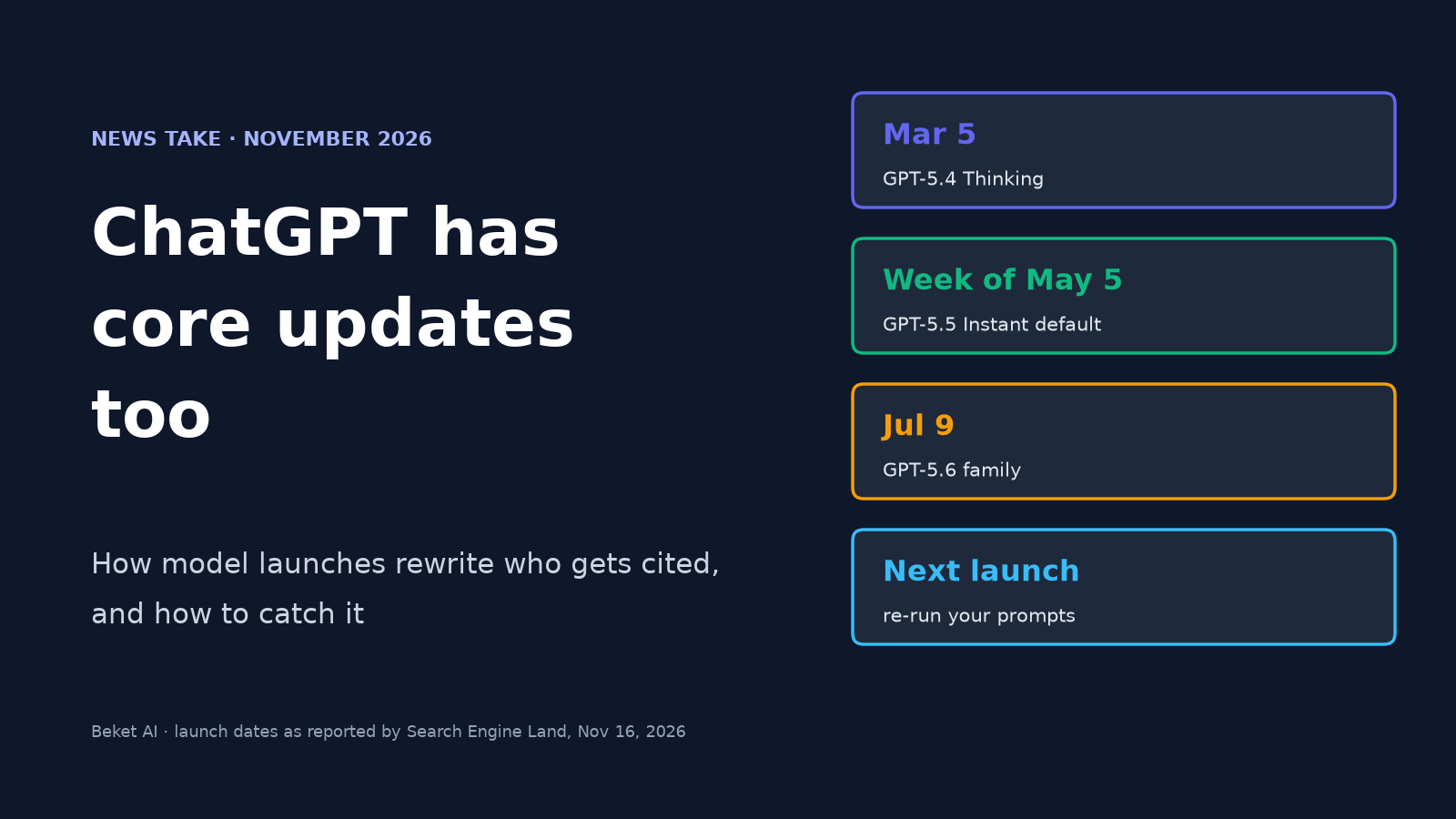
- It wasn’t a one-off. Earlier drops lined up with launches too. GPT-5.4 Thinking launched in ChatGPT on March 5, and by March 9 the Financial Times had vanished. GPT-5.5 Instant became the default the week of May 5, six days before a wave that hit The Verge, Business Insider, The Wall Street Journal, Investopedia, People, Barron’s and Politico. The January (Reuters) and June (CNBC) drops matched no launch the author could find.
- Google rankings didn’t explain it. Comparing keywords in Google’s top three from June 15 to July 15, AP gained 17%, TIME 1% and TechCrunch 3%, while the LA Times lost 2% and The Atlantic 8%. Google’s hit to those sites came around the May core update, and their ChatGPT citations held flat through June.
- ChatGPT’s reading list got rewritten. Journalism’s share of ChatGPT’s citations slid from roughly 33% in January to 22% by September. On the same 102 questions asked in April and again in September, government and NGO sources went from 10% to 35%, brands’ own websites from 14% to 20%, and journalism from 28% to 22%. The article notes that the September panel ran on a newer ChatGPT model, so the change reflects the model update as much as the calendar.
- Other models barely moved. Claude and Gemini “mostly sat still,” and Gemini’s citations of the dropped outlets barely changed.
Some outlets came partway back. AP has recovered about half its old level since August 13, according to the article.
Why “core update” is the right frame
A Google core update has a name, a rollout window and a public statement. What the article describes has the effect without any of that: a launch day, a citation cliff and, in the author’s words, “zero comment from OpenAI.”
The article’s explanation for why news lost out is that ChatGPT’s search now goes more directly to original sources. It cites Seer Interactive’s finding that GPT-5.6 Luna, the fastest model in the family, used site: searches in 76% of its fan-out queries and retrieved 43% fewer sources than GPT-5.5, and an Ahrefs finding that 75.9% of Luna’s site: searches against the most-searched domains targeted brand sites. When ChatGPT cites a press release, the article says, it links to the company’s own site about 85% of the time and to a wire about 14%.
The author is careful about cause: from the outside, you can’t tell whether it’s the new model or the search plumbing OpenAI ships with it. Either way, the practical point holds. If a model stops reading an outlet, every brand mentioned in that outlet loses that path into ChatGPT’s answers. As Generative Pulse’s Matt Dzugan put it in the keynote the article quotes: “Your placement is only as visible as the link between that publisher and that model.”
What our own data shows
We looked at the ChatGPT answers collected in Beket AI audits to see how stable ChatGPT’s sources are from one check to the next. All numbers below are aggregates. Demo audits are excluded, daily re-runs are collapsed so each prompt counts once per day (or once per month), and averages weight each audit equally so a few heavily monitored audits can’t dominate. Our data covers August to November 2026, so it does not include the July 9 launch.
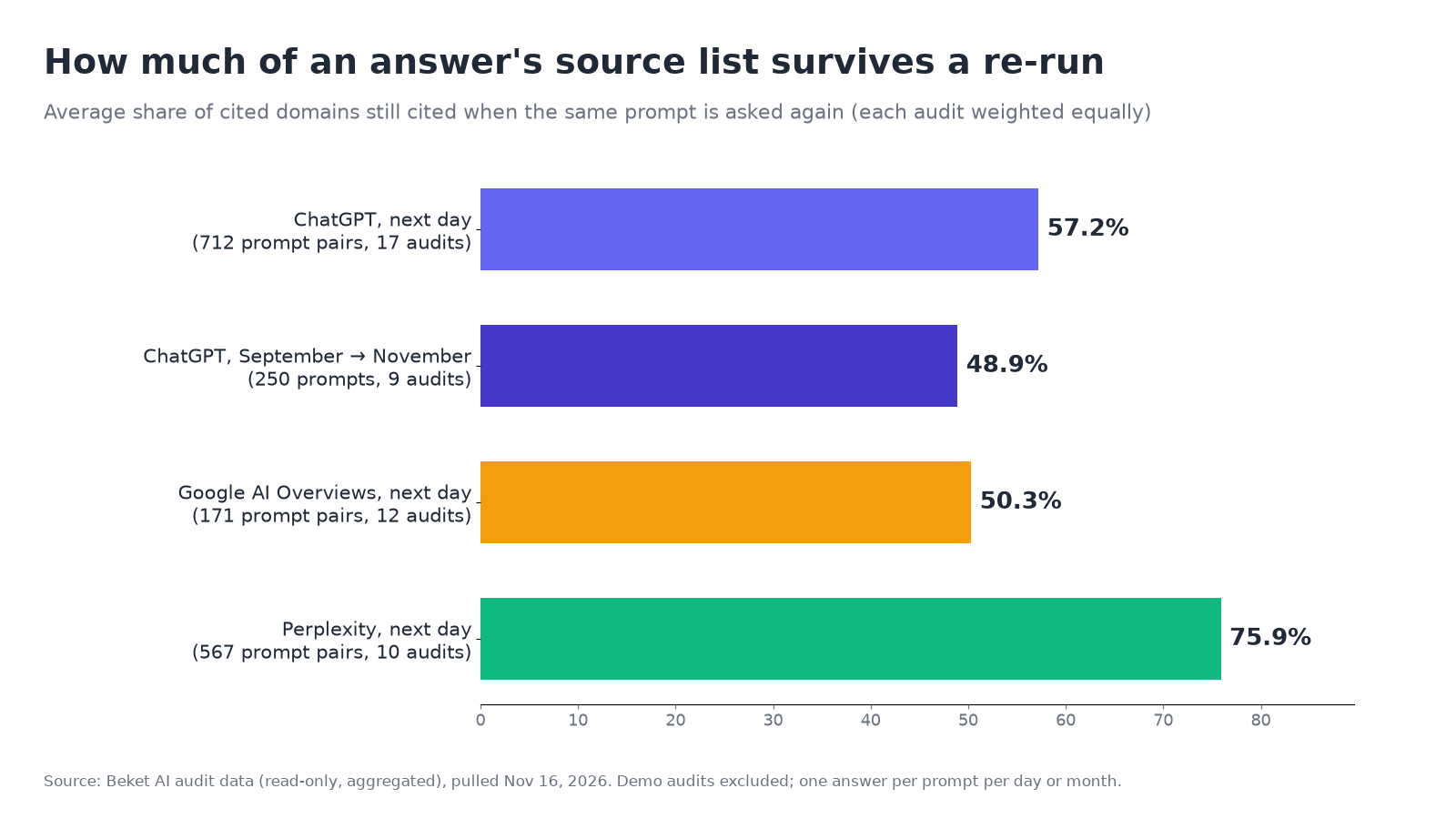
ChatGPT keeps only about half its sources from one day to the next. When the same prompt was asked on two consecutive days, ChatGPT still cited 57.2% of the previous day’s domains, on average across 712 such prompt pairs in 17 audits. Only 17.7% of pairs came back with exactly the same set of domains, and 15.1% kept none of them.
Over two months, the overlap drops further. For 250 prompts that were asked in both September and November, in 9 audits, the latest November answer kept 48.9% of the domains from the latest September answer. 18.9% of those prompts kept none.
Engines differ. On the same next-day comparison, Perplexity kept 75.9% of its domains (it also cites more domains per answer: about 11 on average, against about 4 for ChatGPT), while Google AI Overviews kept 50.3%. A drop in ChatGPT alone, with Perplexity and AI Overviews steady, is the pattern the article tells you to look for.
That baseline matters. If ChatGPT already replaces close to half its sources overnight, a single before-and-after check can’t tell a launch-day shift from ordinary churn. You need the same prompts measured on a schedule, so a real break stands out against the normal noise.
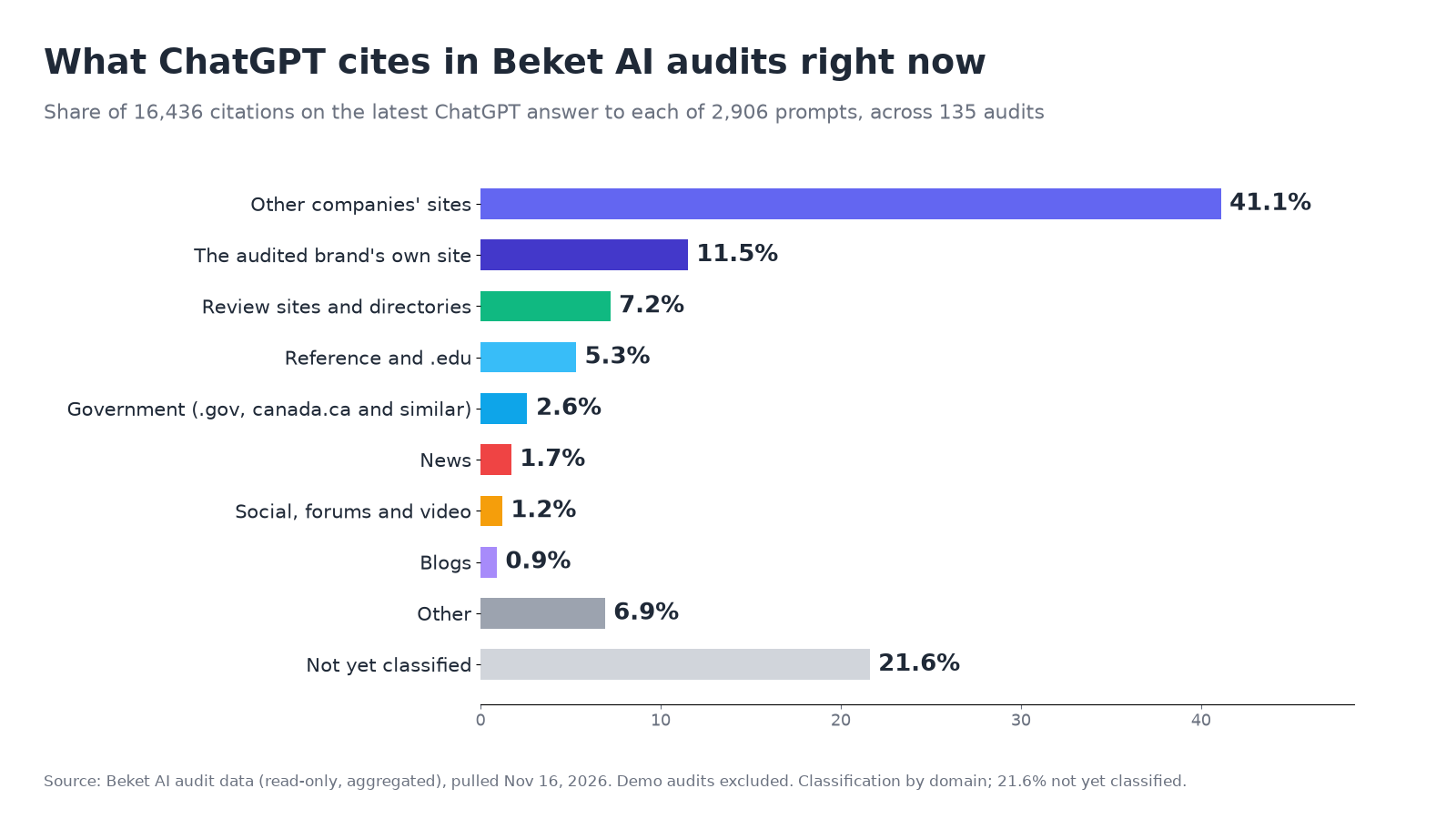
On commercial questions, ChatGPT mostly cites companies. On the latest ChatGPT answer to each of 2,906 prompts across 135 audits, company websites made up 52.6% of 16,436 citations: 41.1% other companies’ sites and 11.5% the audited brand’s own site. Review sites and directories were 7.2%, reference and .edu sites 5.3%, government sites 2.6% and news only 1.7%. 21.6% of citations are on domains we haven’t classified yet.
Those shares look nothing like the article’s 22% journalism figure, and they shouldn’t. Beket AI audits ask the kinds of questions buyers ask about a category, mostly for software and service businesses, not the general questions in the Generative Pulse panel. Our September-to-November set is also too small and too concentrated to confirm the government shift: in those 250 prompts, government sites went from 5.6% to 3.5% of ChatGPT’s citations, not up. What our data does say is that for commercial prompts, the sites ChatGPT leans on are mostly company sites, review platforms and directories, and that list changes a lot from run to run. For a ranked list of the specific domains, see our study of the most-cited domains in ChatGPT and AI search.
How to catch the next ChatGPT update
The article’s checklist for July 9 is a good template for any launch. Here it is, adapted into a routine you can keep running:
- Fix a prompt set and keep it. Pick the questions your buyers ask about your category and run them on a schedule, unchanged. Changing prompts and models at the same time makes any shift impossible to read.
- Track each engine separately. The article’s test is simple: if the line breaks in ChatGPT and not in Gemini, it’s probably OpenAI’s change, not yours. An “AI visibility score” averaged across engines hides exactly that.
- Put OpenAI’s launch calendar next to your data. Mark each model launch and compare the week after it with the weeks before. Given how much ChatGPT churns day to day, look for a sustained change, not one bad day.
- Check Google before you blame your content. Pull the same pages in Search Console and your rank tracker. Flat rankings with falling ChatGPT citations point away from Google.
- Check whether ChatGPT is still fetching your pages. Search your server logs for ChatGPT-User and OAI-SearchBot. If they still fetch your pages but the citations stopped, that’s a selection change, not a crawl problem. Our guide to checking ChatGPT-User and OAI-SearchBot in your server logs walks through it.
- Know which source types you depend on. If most of your ChatGPT visibility comes through one kind of site, such as news coverage or one review platform, one launch can take it away. Spread it across your own site, review platforms, directories and the publications each engine actually cites. Building a media list from AI citations turns that into a pitch list.
One more caveat from the article applies to every tracker, including ours: results gathered through an API may not match what people see in the ChatGPT app. Our explainer on why ChatGPT API checks don’t match ChatGPT covers what to ask any vendor.
Where Beket AI fits
Beket AI re-runs the same prompts on a schedule, which is the only way we know to catch an unannounced shift like this one: the next run re-asks the same questions, so a launch-day change shows up in your trend, engine by engine. Pro is $49 a month per website and checks 50 prompts every day on any 3 of 6 engines: ChatGPT, Gemini, Perplexity, Microsoft Copilot, Google AI Overviews and Google AI Mode. You can add the other engines for $19 each a month to cover all 6. Pro includes change detection alerts and shows the sites AI cites in its answers, including source gaps where rival sites get cited instead of yours. A separate change signal for new citation sources is in beta and readable through the MCP server or the API. The free audit runs 25 prompts once on any 3 of the 6 engines. Details are on Beket AI pricing.
How we measured our numbers
The numbers come from Beket AI’s production audit data, read through a read-only connection on November 16, 2026, and reported only as aggregates. No customer names, brands or prompts appear here. Demo and agency-demo audits are excluded. A citation’s domain is the cited site with “www.” removed.
- Next-day overlap: for each engine, we kept the latest completed answer per audit, prompt and Pacific Time day, paired each answer with the same prompt’s answer from the day before, and computed the share of the earlier answer’s domains that the later answer also cited. We averaged within each audit, then across audits.
- September to November: the latest ChatGPT answer per prompt in September 2026 and in November 2026 (through November 16), for the 250 prompts with an answer in both months.
- Source mix: the latest ChatGPT answer per prompt across all 135 audits with ChatGPT citations. “The audited brand’s own site” means the domains registered for the audited brand. Other types come from Beket AI’s domain classification; government means .gov-style domains (including canada.ca and .gc.ca). Search engines and other uncommon types fall under “other.” Weighting each audit equally instead of each citation moves these shares by 2.6 points or less.
Our audits skew toward software and service businesses, the ChatGPT history covers August to November 2026, and AI answers change over time, which is the point of this post. Treat these figures as a baseline for how much ChatGPT churns, not as a measure of any one launch.
Related posts
Ahrefs Brand Radar Review (2026): An Honest Look at Ahrefs' AI Visibility Features
An honest review of Ahrefs' AI visibility tools: Brand Radar's index, Custom Prompts, Bot Analytics and Web Analytics. Pros, cons, real costs and who it suits.
What Semrush Can't Track in AI Search (and How to Fill the Gaps)
Semrush's AI Visibility Toolkit limitations, from its own docs: no Perplexity or Claude in Prompt Tracking, Copilot dropped, one engine per campaign, desktop only, and more.
How to Get Your Black Friday Offer Into Google AI Overviews and AI Mode (2026)
Before Black Friday 2026, set Business Profile offers, local inventory and product schema, then check whether Google AI Overviews and AI Mode show them.