
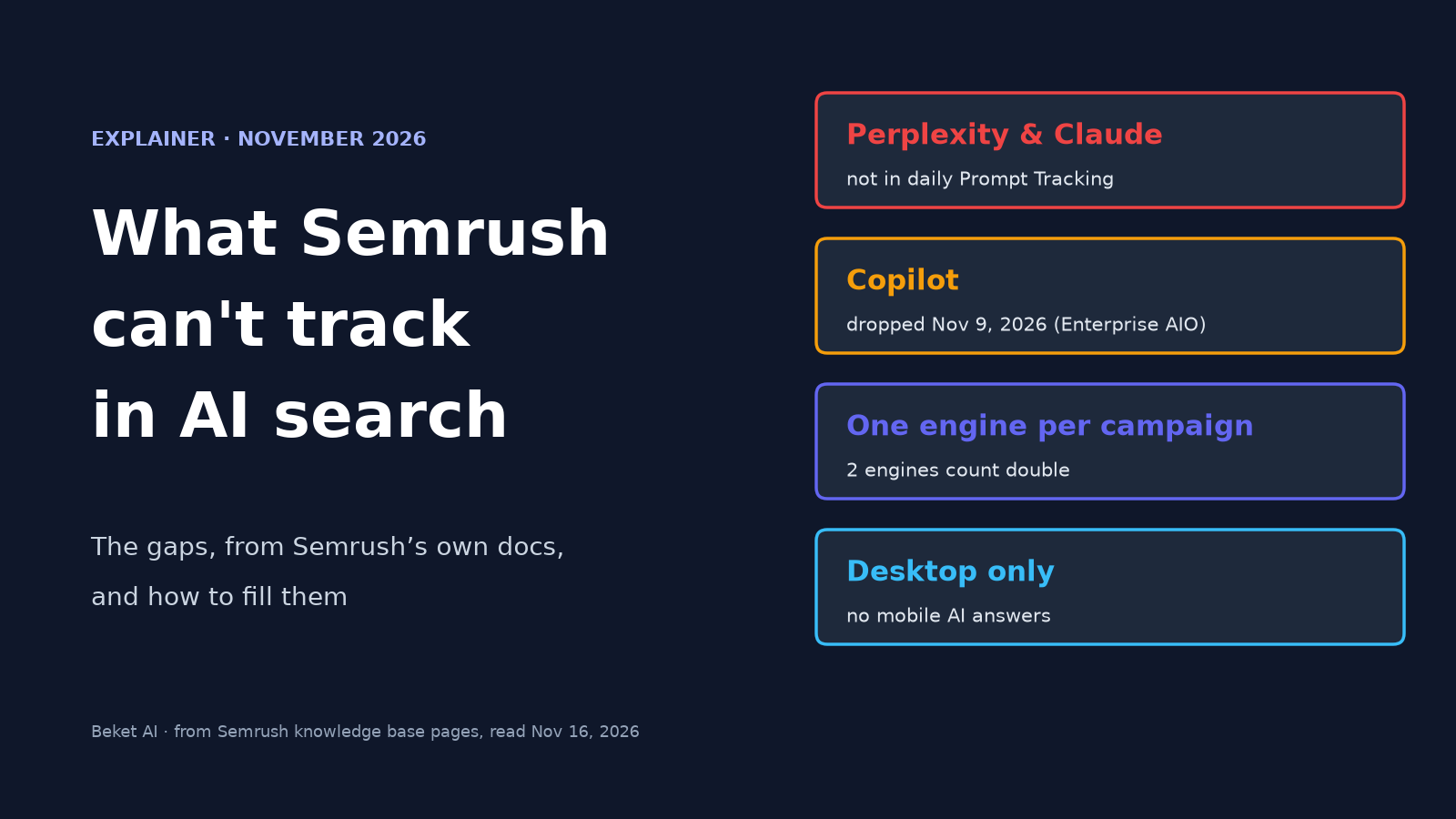
What Semrush Can't Track in AI Search (and How to Fill the Gaps)

Semrush is one of the most complete SEO suites you can buy, and its AI Visibility Toolkit covers more of AI search than most people expect. It also has limits. Some are deliberate product choices, some come from how AI engines let outside tools in, and a few are just the current state of the docs.
This explainer lists those limits, using Semrush’s own knowledge base and blog as the source for each one, read on November 16, 2026. We make Beket AI, which competes with part of this toolkit, so we’ve stuck to what Semrush documents and linked every claim. If you want the head-to-head on price and features, that’s in our Beket AI vs Semrush comparison. This post is about the gaps, and how to cover them whatever tool you use.
First, what Semrush does track
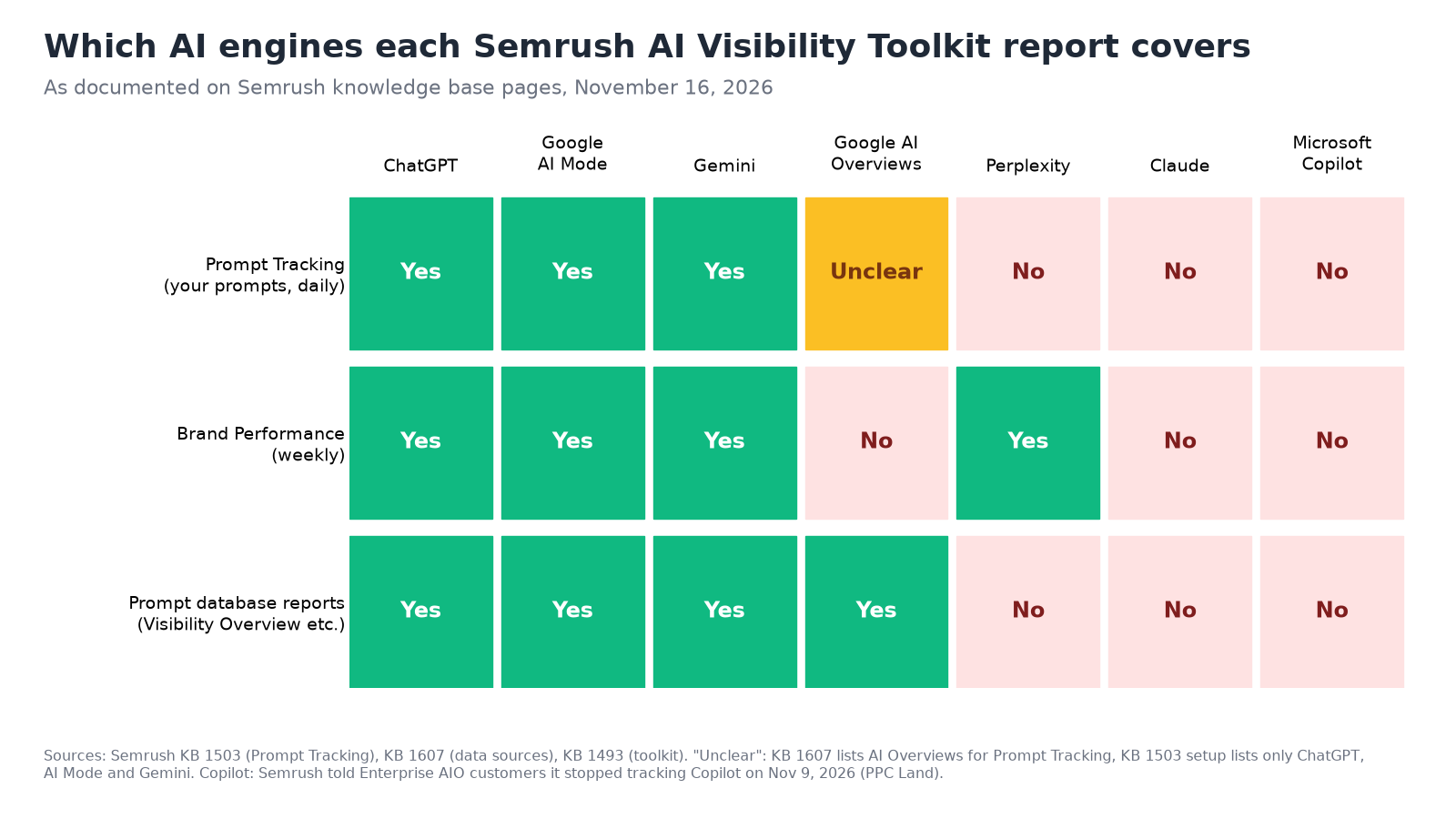
It’s worth being clear about the scope before talking about gaps. The AI Visibility Toolkit costs $99 a month and bundles three kinds of data, each with its own engines and refresh rate (KB 1607):
- Prompt database reports (Visibility Overview, Competitor Research, Prompt Research). These come from a collection of more than 317 million prompts and responses on ChatGPT, Gemini, Google AI Overviews and AI Mode, across 117 regional databases.
- Brand Performance. Share of voice, sentiment and narratives for one domain, updated weekly, covering Google AI Mode, ChatGPT, Perplexity and Gemini.
- Prompt Tracking. Your own prompts, checked daily on ChatGPT Search, Google AI Mode or Gemini (KB 1503). It shows visibility, mentions, average position and the sources each engine cites.
That’s a lot of coverage. The limits below are about what falls between those three pieces.
The limits, one by one
1. Perplexity and Claude aren’t in daily Prompt Tracking
Semrush’s own guide to building an AI visibility dashboard says it plainly: “Claude and Perplexity aren’t currently supported” in Prompt Tracking (Semrush blog, Oct 12, 2026). Perplexity does appear in Brand Performance, but that report updates weekly and runs on Semrush’s own query set, not your prompt list.
Why it matters: if your buyers use Perplexity, you can’t see day-to-day changes on the exact questions you care about. Perplexity also shows its sources openly, which makes it one of the easier engines to check by hand. Our guide to checking whether Perplexity mentions your brand covers the manual method.
2. Microsoft Copilot tracking ended on November 9, 2026
Semrush told its Enterprise AIO customers that “recent changes to Microsoft Copilot’s access requirements prevent AI visibility platforms, including Semrush Enterprise AIO, from collecting the data needed to track Copilot performance,” and that Copilot tracking would be discontinued on November 9 (PPC Land, Oct 29, 2026). Customers could either return their Copilot prompts to their balance or keep the historical data while the prompts kept counting against it. The standard toolkit’s Prompt Tracking doesn’t list Copilot at all.
Semrush didn’t name the Microsoft change. PPC Land points to Microsoft’s consumer Copilot terms, effective August 18, 2026, which require a Microsoft account and bar bots and scrapers. That’s a constraint on every outside tracker, not only Semrush, so treat any third-party Copilot line as something to sanity-check against Microsoft’s own data.
Why it matters: Copilot answers are grounded in Bing search. We explain the connection in one of your engines runs on Bing. The first-party fix is Bing Webmaster Tools’ AI Performance report, which shows how often your pages are cited across Copilot, Bing’s AI summaries and select partners. It reports citations, not placement, and Microsoft says its grounding queries are a sample.
3. One engine per campaign, and multi-engine tracking counts double
Each Prompt Tracking campaign follows one AI platform. In Semrush’s words: “Tracking two platforms means two campaigns with the same prompts, which also counts double against your plan’s prompt limit” (Semrush blog). The toolkit alone includes 25 prompts; Semrush One plans raise that to 50, 100 or 200, and extra blocks of 50 cost $60 a month (KB 1493).
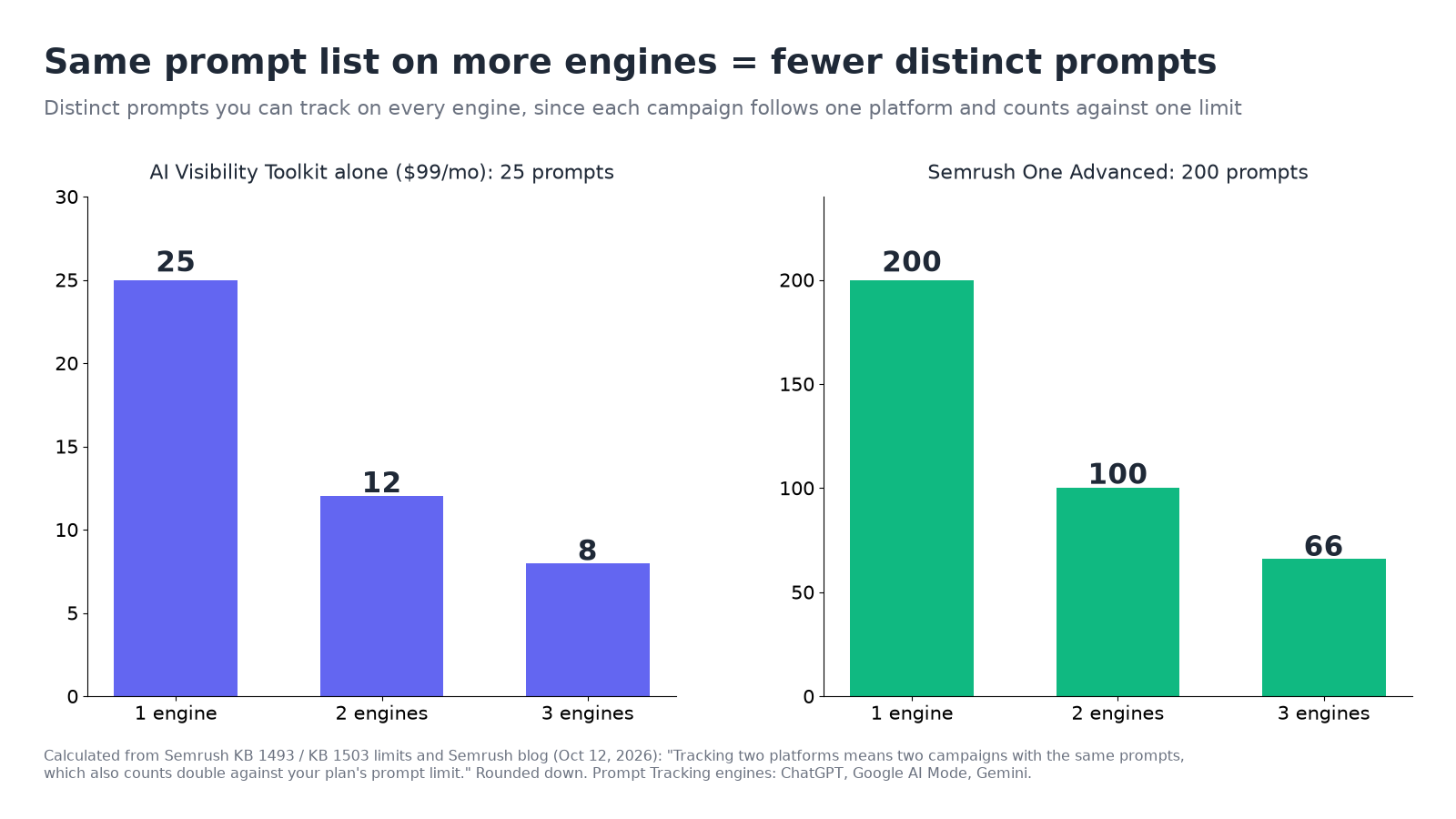
Calculated from the limits above, rounded down. This only covers Prompt Tracking, not the database reports.
Why it matters: AI engines often disagree on the same question. If you only track one, you can miss a drop on the others. If you track all three, a 25-prompt plan leaves you about 8 questions.
4. Desktop answers only
The Prompt Tracking limits section says: “Only desktop searches are supported at this time for all available AI search engines” (KB 1503). Mobile AI Mode and app answers aren’t measured.
5. No traffic or share of voice in Prompt Tracking
Semrush notes that “Estimated Traffic and Share of Voice metrics are not available” for AI engines in Prompt Tracking (KB 1503). Share of voice lives in Brand Performance instead, on the weekly schedule and Semrush’s own query set.
Clicks are a separate gap. No visibility tracker sees what happens after an AI answer. Semrush’s own dashboard tutorial pairs its data with Google Search Console to answer that question, and on its test site found a guide that AI answers cited for 50 prompts that earned zero Google clicks (Semrush blog). Our walkthrough of the Search Console Generative AI report explains what that report counts (impressions, not clicks).
6. Topic volumes in 15 countries, and no exact prompts
Prompt Tracking runs in more than 220 countries and territories, but volumes and topics are only available in 15 of them, including the US, Canada and the UK (KB 1503). And the prompt database isn’t a list of exact questions: Semrush groups prompts into topics, “with duplicates removed and phrasing simplified” (KB 1607). That’s sensible for research, but it means the database reports describe a market, not the wording your buyers use.
7. Sentiment isn’t the same as accuracy
Brand Performance covers share of voice, sentiment and “the key narratives driving your reputation” (KB 1493). The docs don’t describe checking whether an answer gets your facts right, such as prices, hours, locations or features. A glowing answer with last year’s pricing still scores as positive.
8. Access is per person
Every teammate who needs the toolkit needs their own $99 license, and the toolkit “cannot be shared via shared limits” (KB 1493). Brand Performance campaigns are shared automatically with licensed users, but other reports aren’t.
The limits at a glance
| Limit | What Semrush documents | How to cover it |
|---|---|---|
| Perplexity, Claude | Not in Prompt Tracking; Perplexity weekly in Brand Performance | Manual checks or a tracker that covers them |
| Microsoft Copilot | Enterprise AIO tracking ended Nov 9, 2026 | Bing Webmaster Tools AI Performance report |
| Multi-engine tracking | One platform per campaign; counts double | Budget prompts per engine, or use a per-prompt multi-engine tool |
| Mobile | Desktop only | Spot-check mobile AI Mode by hand |
| Clicks | No traffic estimate in Prompt Tracking | Search Console, plus AI referrals in your analytics |
| Exact buyer wording | Database prompts are grouped and simplified | Track your own prompt list |
| Factual accuracy | Sentiment and narratives, not fact checks | Read the answers for your key facts |
| Team access | $99 per user | Exports, PDF reports or My Reports |
Sources: KB 1493, KB 1503, KB 1607, Semrush blog, PPC Land, Bing Webmaster Tools help.
One thing even Semrush says no tool can do
Semrush’s data page closes with a line that’s true of every tracker: “AI search and LLM responses are fast-changing and highly personalized, which means no platform can provide exact numbers on visibility” (KB 1607). Logged-in users, memory, location and model updates all change what a given person sees. Any tool gives you a consistent sample, not the full picture. Use it for trends and comparisons, not as an exact count.
A simple plan to fill the gaps
- Keep Semrush for what it’s good at. Prompt and topic research, market-level benchmarks, the AI crawler checks in Site Audit, and your existing SEO work.
- Add Microsoft’s own data. Verify your site in Bing Webmaster Tools and watch the AI Performance report for Copilot and Bing citations.
- Add Google’s own data. Read the Search Console Generative AI report for AI Overviews and AI Mode impressions, and compare it with clicks.
- Cover the missing engines. Check Perplexity and Claude by hand on your top 10 buyer questions, or use a tracker that runs each prompt on several engines. Beket AI tracks ChatGPT, Gemini, Perplexity, Microsoft Copilot, Google AI Overviews and Google AI Mode, with Claude as an add-on, and the free audit runs 25 prompts on any 3 of those 6 engines.
- Read the answers, not only the scores. Once a month, open the actual answers for your most valuable questions and check prices, locations and claims.
Semrush features and limits are as documented on the linked Semrush pages on November 16, 2026. Semrush updates the toolkit often, so check its knowledge base before you decide.
Related posts
ChatGPT Has Core Updates Too: How Model Launches Rewrite Who Gets Cited (and How to Catch It)
ChatGPT model launches can rewrite which sites it cites, with no announcement. What Search Engine Land reported, what Beket AI data shows, and how to catch it.
Do XML Sitemaps Matter for AI Search? What Each Engine Documents (2026)
The role of XML sitemaps in AI optimization: what Google, Bing, OpenAI and Perplexity document, what sitemaps can't do for AI answers, and an 8-step check.
Ahrefs Brand Radar Review (2026): An Honest Look at Ahrefs' AI Visibility Features
An honest review of Ahrefs' AI visibility tools: Brand Radar's index, Custom Prompts, Bot Analytics and Web Analytics. Pros, cons, real costs and who it suits.