
Do XML Sitemaps Matter for AI Search? What Each Engine Documents (2026)

Short answer: yes, but only for the first step. An XML sitemap helps AI search engines find your pages and notice when they change. It does nothing to make an AI answer pick, quote or recommend a page. Most of the confusion about sitemaps and AI comes from mixing up those two jobs.
Below is what each major engine actually documents about sitemaps as of November 16, 2026, followed by a short checklist you can run on your own site. We've linked every claim to the vendor's own pages.
The role of XML sitemaps in AI optimization
AI search engines get web content the way classic search does: a crawler finds a URL, fetches it, and an index stores it. Only then can an answer engine retrieve the page for a question and decide whether to cite it. Bing's search product manager Fabrice Canel put it bluntly when asked whether optimizing for AI search is just normal SEO: "Absolutely at 💯. Optimize for AI Search by following SEO guidelines" (Search Engine Roundtable).
A sitemap works at the very start of that chain. It's an inventory of the canonical URLs you want found, with a date telling crawlers which ones changed.
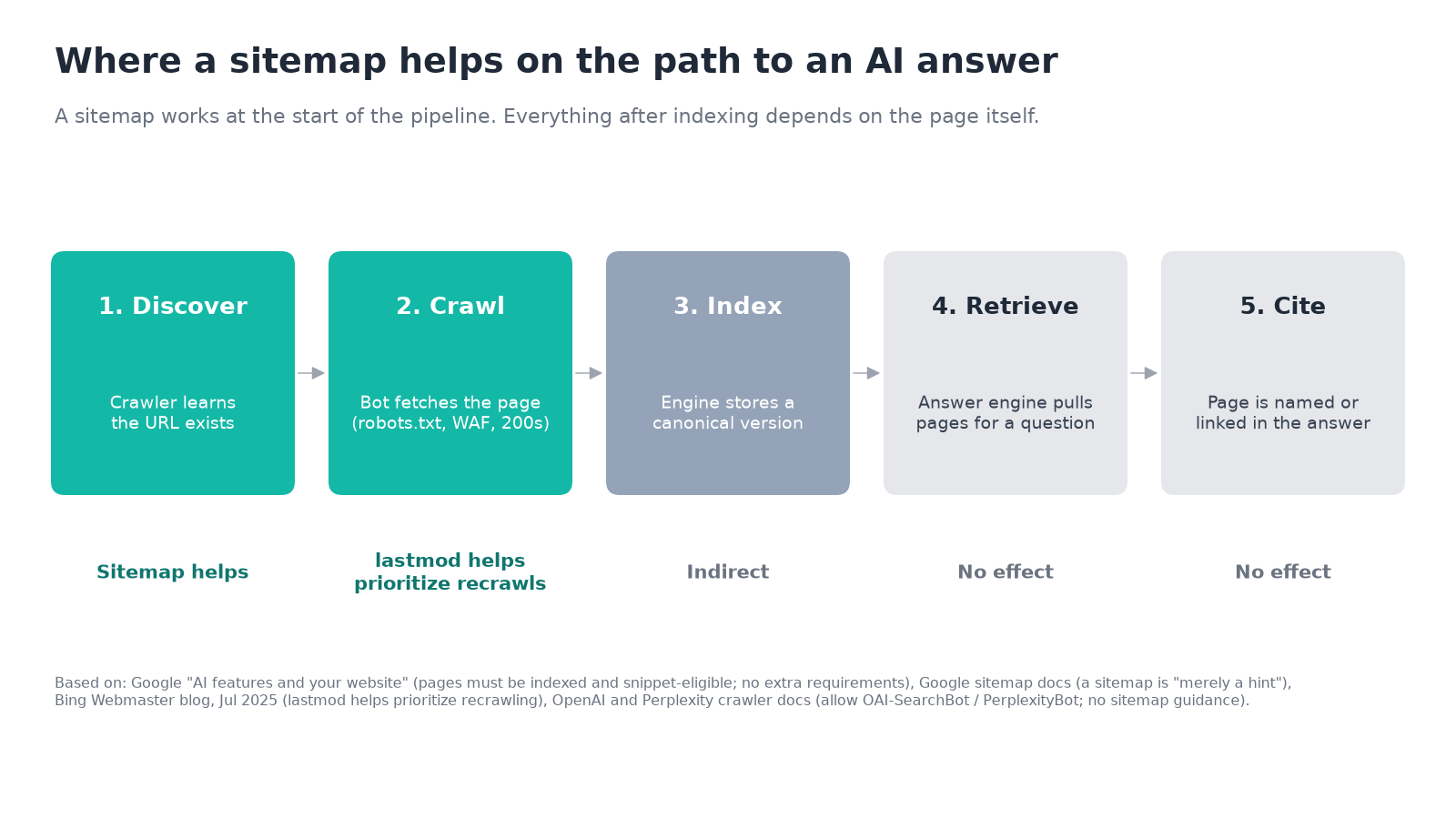
That's the honest scope. A sitemap can get a new pricing page crawled sooner, and it can get an updated page recrawled so AI answers stop quoting the old version. It can't fix a page that doesn't answer the question.
What each engine documents
| Engine | What it says about sitemaps | What it says matters instead |
|---|---|---|
| Google AI Overviews and AI Mode | A sitemap is "merely a hint." lastmod is used if it's "consistently and verifiably" accurate; changefreq and priority are ignored |
Pages must be indexed and eligible for a snippet. "There are no additional technical requirements" for AI features |
| Bing and Microsoft Copilot | Sitemaps "remain a foundational signal." lastmod is "a key signal" for recrawling; changefreq and priority are ignored. Bing rereads sitemaps "typically at least once per day" |
Pair sitemaps with IndexNow for fast change notices |
| ChatGPT search | No sitemap guidance in OpenAI's crawler docs | Allow OAI-SearchBot in robots.txt and its published IP ranges |
| Perplexity | No sitemap guidance in its crawler docs | Allow PerplexityBot and its published IP ranges, including in your WAF |
Sources: Google's AI features guide and sitemap docs; Bing's sitemaps in AI-powered search post (July 2025) and Webmaster Guidelines; OpenAI crawler overview; Perplexity crawler docs. All read November 16, 2026.
Two details stand out.
Bing is the engine that talks about sitemaps for AI the most. Its guidelines say proper sitemap use "helps Bing maintain accurate, up-to-date indexing and reliable grounding eligibility," and that IndexNow notices "reduce outdated or incorrect URL references in Copilot responses." Bing's index matters beyond Copilot too, which we cover in one of your engines runs on Bing.
OpenAI doesn't need your sitemap to find you. Its publisher FAQ notes that it may surface a page's link and title if it gets the URL "from a third-party search provider or by crawling other pages" (OpenAI Help Center, archived Oct 4, 2026). In practice, being well indexed in classic search engines and linked from other pages does the discovery work. What OpenAI does require for full snippets is crawler access, which our guide to AI crawlers and robots.txt explains.
What sitemaps don't do for AI
- They don't rank or select pages. Google says "indexing and serving isn't guaranteed," even when a page meets every requirement (Google). Bing says sitemaps "do not guarantee visibility."
- There's no special AI sitemap. Google says you don't need "new machine readable files, AI text files, or markup" for AI Overviews or AI Mode (Google). An llms.txt file is a different thing again; see llms.txt vs robots.txt vs schema markup.
priorityandchangefreqdo nothing at Google or Bing. Setting your blog topriority 1.0won't move it.- They can't fix content crawlers can't read. If your key text only appears after JavaScript runs, a perfect sitemap still points to an empty page for some AI crawlers. Our test of whether ChatGPT can read JavaScript shows what to serve instead.
A sitemap check for AI search
Run these in order.
- Find your sitemap from robots.txt. Open
yoursite.com/robots.txtand look for aSitemap:line. Google and Bing both read it there. If it's missing, add it. - Open every child sitemap. A sitemap index should list each file, and each file should load with a 200 status. Google's limit is 50,000 URLs or 50MB uncompressed per file.
- Check that you list only canonical, live URLs. No redirects, no 404s, no
noindexpages, no staging or parameter URLs. Bing asks you to "remove deleted or redirected URLs promptly." - Check that
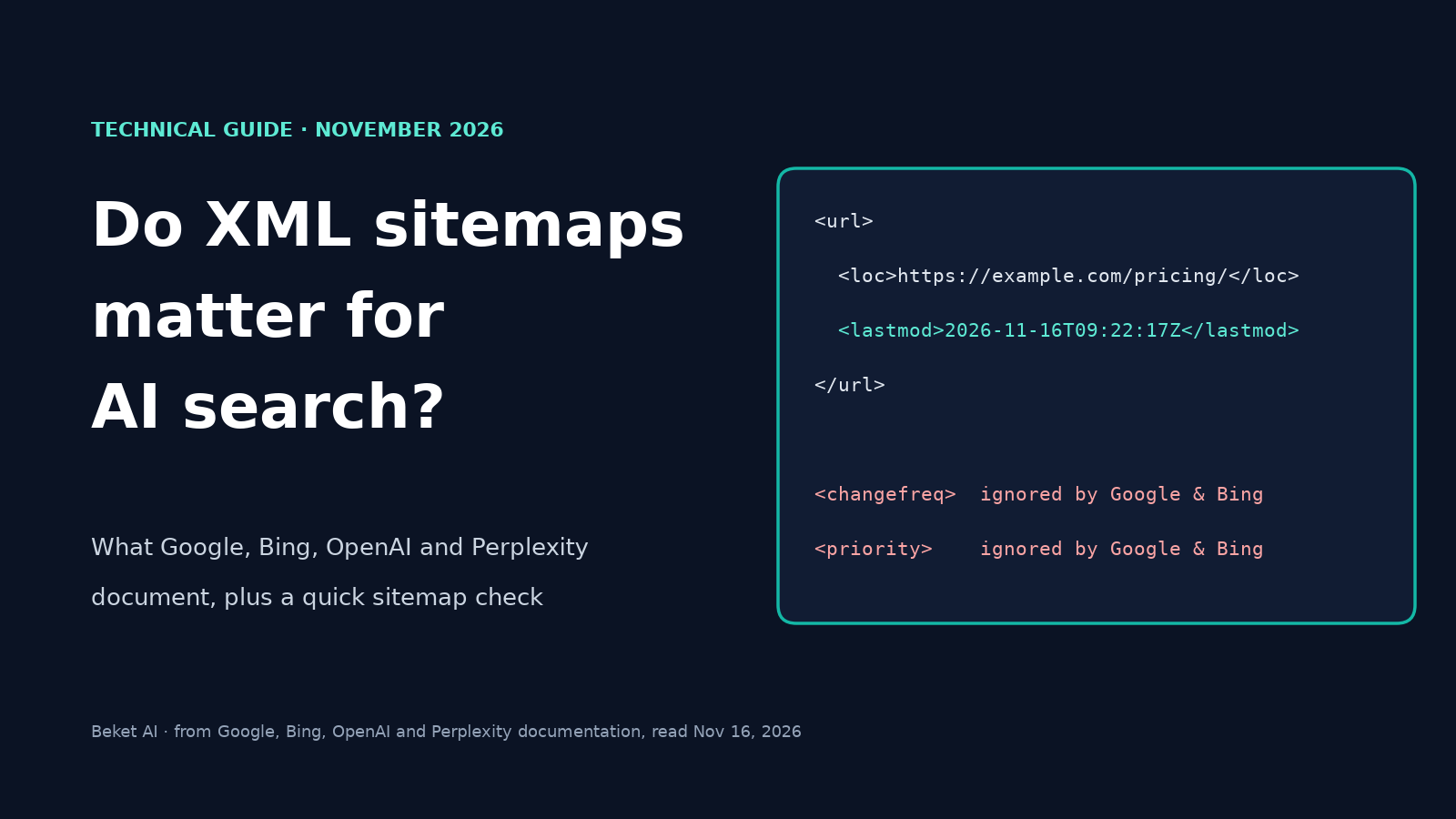
lastmodis real. It should change only when the page's main content, structured data or links change, not every time the sitemap is rebuilt. Bing recommends the full ISO 8601 date and time, for example2026-11-16T09:22:17Z. - Make sure your money pages are in it. Pricing, product, service, location and comparison pages are usually what buyers' questions are about. Check that each is listed under its final URL.
- Submit it in Search Console and Bing Webmaster Tools. Then check each tool's sitemap report for errors and the last read date.
- Add IndexNow if you update often. It tells Bing about added, changed or removed URLs right away. Bing says it doesn't guarantee indexing (IndexNow FAQ).
- Confirm the AI crawlers can reach the pages. Check robots.txt rules for OAI-SearchBot, PerplexityBot, Claude-SearchBot and Bingbot, and check your CDN or firewall, which can block bots that robots.txt allows.
For reference, here's how our own site handles it. beket.ai's robots.txt points to a single sitemap-index.xml, which lists six child sitemaps (pages, blog, guides, comparisons, glossary and our AI shortlist pages). When we checked on November 16, 2026, every one of the 322 URLs carried a lastmod with a full timestamp, and a post published that afternoon was already listed with its publish time.
How to tell whether it's working
A clean sitemap shows up first in crawl data, not in AI answers. Watch three things:
- Crawler visits. Your server logs or CDN show whether OAI-SearchBot, PerplexityBot and others fetch new and updated pages. Beket AI's Cloudflare integration reports AI crawler activity per site if you'd rather not read raw logs.
- Index status. Search Console's page indexing report and Bing's URL inspection show whether listed URLs actually got indexed.
- Answers. Ask AI engines the questions your updated pages answer and see whether the answers change. AI answers vary between runs and over time, so check the same questions over several days rather than once. You can run a free Beket AI audit on 25 prompts across any 3 of 6 engines to get a baseline.
If crawlers are visiting, pages are indexed and answers still don't mention you, the sitemap has done its job. The remaining gap is the content and the sources that cite it.
Related posts
What Semrush Can't Track in AI Search (and How to Fill the Gaps)
Semrush's AI Visibility Toolkit limitations, from its own docs: no Perplexity or Claude in Prompt Tracking, Copilot dropped, one engine per campaign, desktop only, and more.
SE Ranking vs Surfer SEO: An AI Visibility Review Roundup (2026)
SE Ranking reviews vs Surfer SEO reviews for AI visibility: which engines each tracks, price per prompt, and what independent testers found when they checked the numbers.
ChatGPT Has Core Updates Too: How Model Launches Rewrite Who Gets Cited (and How to Catch It)
ChatGPT model launches can rewrite which sites it cites, with no announcement. What Search Engine Land reported, what Beket AI data shows, and how to catch it.