
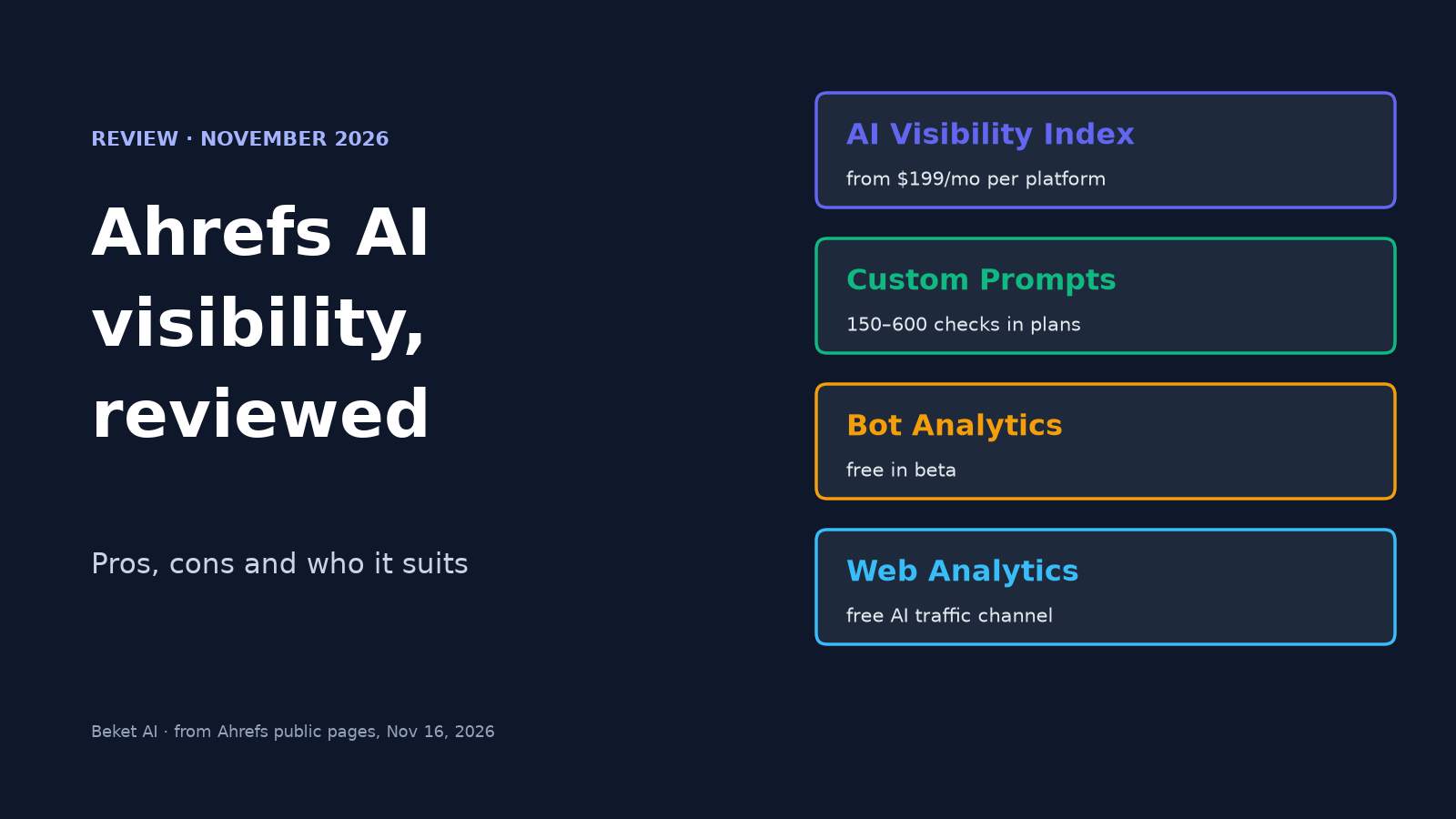
Ahrefs Brand Radar Review (2026): An Honest Look at Ahrefs' AI Visibility Features

Ahrefs didn’t add one AI visibility feature. It added five, sold three different ways, and the page you land on decides which one you think you’re buying. This review sorts them out, then goes through what works, what doesn’t and who should pay for it.
A note on how we did this. We make Beket AI, which competes with part of what Ahrefs sells, so weigh our view accordingly. Every Ahrefs fact below comes from Ahrefs’ own pricing pages, product pages and Help Center, read on November 16, 2026, and is linked. For hands-on findings we lean on TechRadar’s review of Brand Radar (published October 19, 2026), and we say so when we do. If you want the head-to-head on price, that’s in our Beket AI vs Ahrefs comparison. This post is about Ahrefs on its own terms.
Verdict
Ahrefs’ AI visibility tools are best as a research layer for teams that already run on Ahrefs. The AI Visibility Index is the most useful thing here: you can look up any brand or category across stored AI answers, with history, without setting anything up. The free pieces (Web Analytics’ AI channel and Bot Analytics) are genuinely good value.
The weak spots are cost stacking, an index that leans heavily toward Google’s own AI surfaces, monthly refreshes for the index, and a check-based meter that runs out quickly once you track several engines or countries. If your question is “do the 20 buyer questions in my category name us this week?”, the index is the wrong tool and the included prompt allowance is too small.
What “Ahrefs AI visibility” actually includes
| Piece | What it does | Price (Nov 16, 2026) |
|---|---|---|
| AI Visibility Index (Brand Radar) | Searches stored AI answers to search-backed prompts for any brand, topic or competitor | From $199/mo per platform; $699/mo for all platforms |
| Custom Prompts (Brand Radar) | Runs the questions you choose, daily, weekly or monthly | 150 / 300 / 600 checks a month on Lite / Standard / Advanced; packages from $50/mo |
| Free AI Visibility Checker | One-time snapshot for a brand name: mentions by platform, top 5 topics, cited domains and pages | Free, no signup |
| Web Analytics | Breaks out AI search as its own traffic channel and shows landing pages | Free |
| Bot Analytics | Reads CDN logs to show which bots, including AI assistants and crawlers, hit which pages | Free during beta |
Ahrefs’ paid SEO plans start at $129/mo (Lite), $249/mo (Standard) and $449/mo (Advanced), each with one user included (Ahrefs pricing). Ahrefs says Brand Radar is a standalone product that can be added to any plan or used on its own (Ahrefs AEO page).
The pros
1. Instant answers about any brand, with history
This is the reason to buy Brand Radar. Type in a brand, a product or a whole category and the index returns mentions, citations, AI Share of Voice and estimated impressions, with stored answers going back to 2025 and no domain cap (Brand Radar). TechRadar found the real value was in drilling down: from a three-brand comparison, to the ChatGPT answers that named the competitors but not the brand being reviewed, to the individual stored answer and the pages behind it.
That makes it strong for pitch research, competitor teardowns and finding topics where AI already discusses your category but not you.
2. It separates “found” from “cited”
Brand Radar’s cited pages report distinguishes pages retrieved while an answer was produced (“Found in”) from pages the answer actually cited (“Cited in”), according to TechRadar. That’s an honest distinction many dashboards blur, and it matters: a page can be read often and credited rarely. For ChatGPT and Perplexity, Brand Radar also shows the fan-out queries returned with a response, which hint at the supporting topics an assistant searched for.
3. Custom Prompts cover more engines than the index
Custom Prompts run on Google AI Overviews, AI Mode, ChatGPT, Perplexity, Gemini and Copilot, plus Claude. You can tag prompts, pick locations, choose a cadence per platform and generate prompt ideas with AI (Brand Radar; Ahrefs Help Center). Pulling custom prompt data through the API doesn’t use API units, per the same page.
4. The free tools are better than they need to be
Bot Analytics sorts bot traffic into 12 categories (AI Assistant, AI Search and AI Crawler among them), flags bots that fake their user agent by checking published IP ranges and Cloudflare’s verified bots, and exports to CSV or Google Sheets. It works with Cloudflare (including a Worker method on any Cloudflare plan), Vercel, Amazon CloudFront and Fastly (Ahrefs Help Center). Add the free AI search channel in Web Analytics and a small team can see crawler visits and human AI referrals without paying anything.
5. It sits next to everything else in Ahrefs
If your reporting already runs on Ahrefs, AI mentions sit beside backlinks, keywords, rank tracking and site audits. Every prompt in the index maps back to search demand and keyword topics, so you can tie AI visibility to the SEO plan you already have (Brand Radar). TechRadar also found a native sentiment report and entity matching, which helps when a brand name has other meanings.
The cons
1. The costs stack
The full index is $699 a month for all platforms, or $199 per platform. Custom prompts beyond your plan’s allowance are a separate package. Extra users cost $40 to $80 a month each, depending on plan (Ahrefs pricing). TechRadar’s verdict lists “full AI index access costs a hefty $699/month” as its first reason to avoid it. Inside an Ahrefs plan, Lite ($129) plus the all-platform index ($699) plus two extra users ($80) comes to $908 a month.
2. The index leans heavily toward Google
The index is built from Ahrefs’ keyword database: real queries expanded into natural questions through People Also Ask and semantic fan-out (Brand Radar). That’s a sensible design, but it shows in the mix. Ahrefs’ own free checker page lists the monthly prompts per platform:
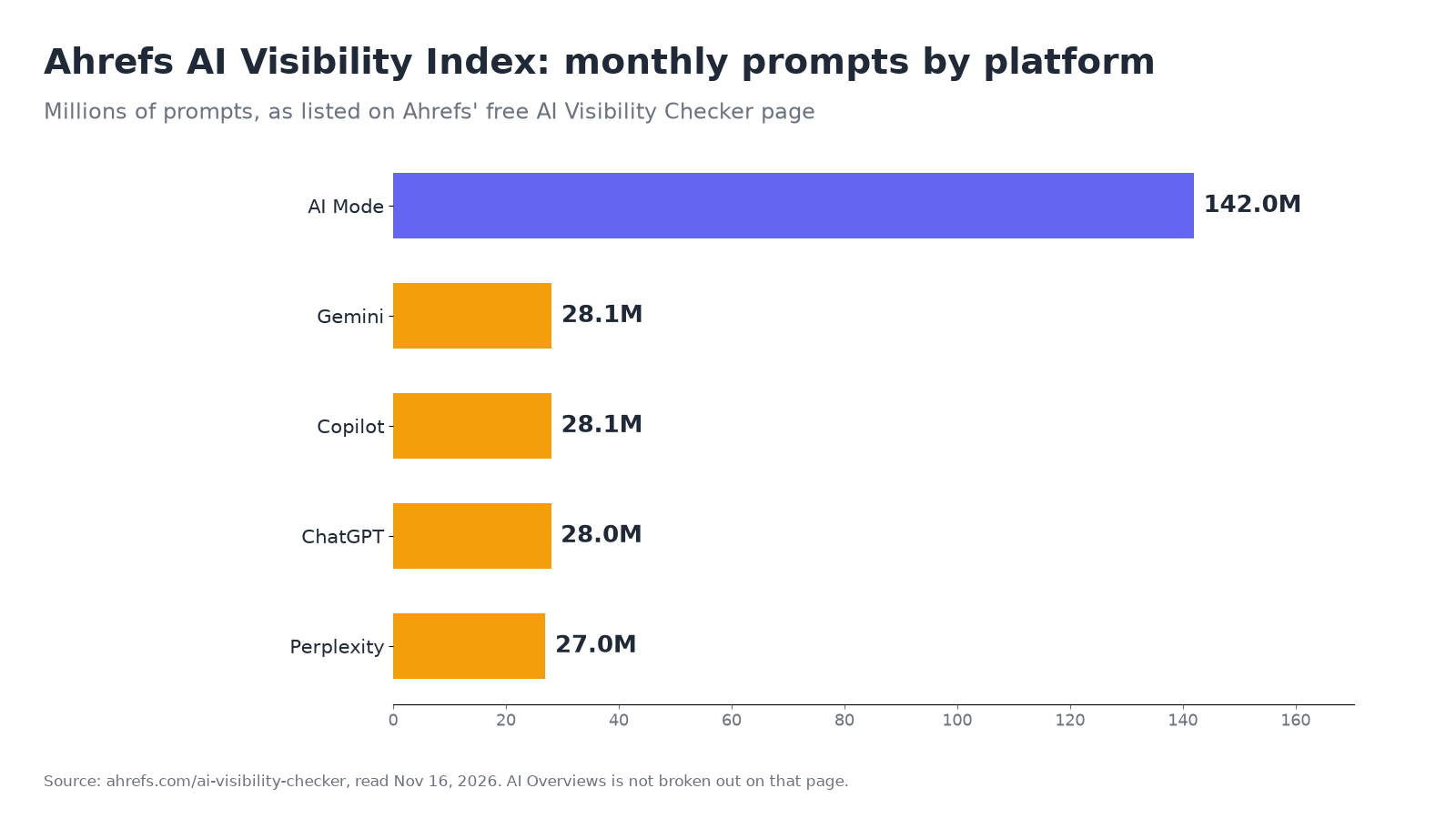
Source: Ahrefs Free AI Visibility Checker, November 16, 2026.
AI Mode alone has about five times the prompts of ChatGPT. Brand Radar also keeps a separate search-query index that exists only for AI Overviews and AI Mode. If ChatGPT or Perplexity is where your buyers ask, you’re working from a smaller sample there.
3. The index size depends on which page you read
Ahrefs’ pages quote different figures for the same index: 572 million prompts on the Brand Radar page, 376 million across 7 engines on the AEO page, 350 million-plus in the Help Center and 319,271,137 monthly index prompts on the free checker. They may count different things, but none of the pages explains the difference. If you’ll quote the index in a client report, ask Ahrefs which number applies.
4. Monthly refreshes, modeled reach
The index’s question sets are re-tested monthly on a 90-day reporting window (Brand Radar). That’s fine for quarterly benchmarking and slow for a launch, a rebrand or a pricing change. Estimated impressions are weighted by search volume behind each prompt, and TechRadar notes they “don’t measure real audience reach.” AI Share of Voice also shifts with the brands and filters you pick.
Ahrefs itself says the index “may have limited coverage for brands with little or no search volume.” For a local firm or a new product, that’s the main catch: the index may simply not contain your questions.
5. The check meter runs out fast
Custom Prompts are billed in checks: 1 prompt × 1 engine × 1 location = 1 check, and Claude uses 8 checks per update. If pay-as-you-go is off and you run out, tracking stops until the next billing month (Ahrefs Help Center). Here’s how quickly common setups use the allowances:
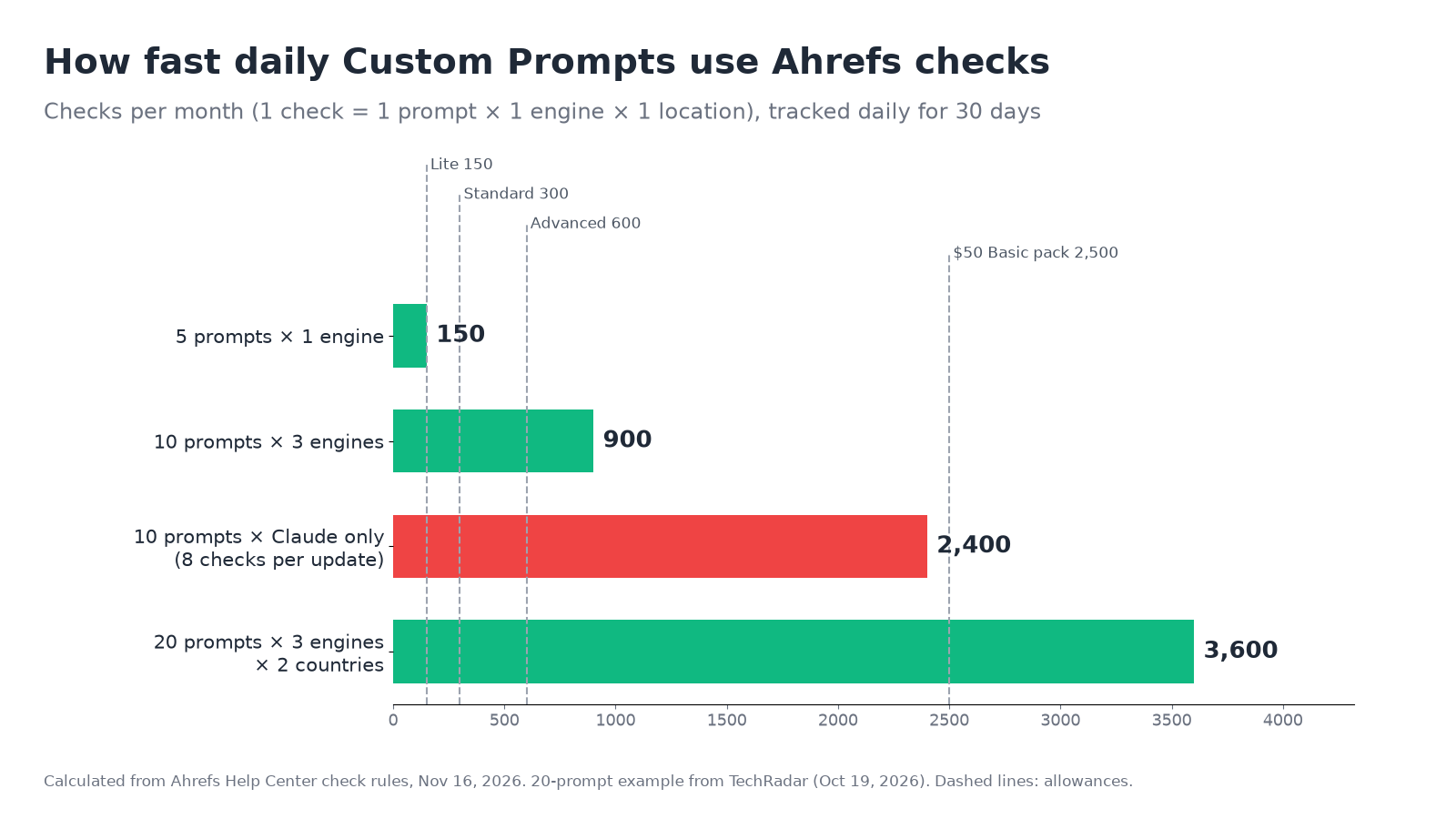
Calculated from Ahrefs’ published check rules over 30 days. The 20-prompt example is TechRadar’s.
Ahrefs calls the included allowance “a built-in trial.” That’s a fair description: Advanced’s 600 checks cover 20 prompts on one engine, daily.
6. Some reports need checking by hand
TechRadar saw raw markup in some stored answers, a sidebar that reported no citations while listing pages as “found but not cited,” and an “Other” sources group that included pages owned by a competitor it was tracking. None of these is fatal, but it means the reports are a starting point for an analyst, not something to forward to a client unread. Grok data collection is also paused for now because of changes in Grok’s policy, Ahrefs says; TechRadar reports older Grok data is kept.
Who it suits
Good fit:
- SEO teams and agencies already paying for Ahrefs who want AI visibility in the same place as links and keywords.
- Agencies doing pitch research or competitor audits across many brands, where instant lookups beat setting up tracking.
- Established brands with real search demand, especially those focused on AI Overviews and AI Mode.
- Anyone who wants free bot analytics from Cloudflare, Vercel, CloudFront or Fastly logs.
Poor fit:
- Local businesses and young products with little search volume, where the index may hold few relevant questions.
- Teams that need daily answers to a fixed list of buyer questions across several engines and countries. The meter makes that expensive.
- Teams that need to know whether AI answers get their facts right, such as prices, hours or features. Brand Radar’s published metrics are mentions, citations, share of voice, estimated impressions and sentiment; none of them checks whether the facts are right.
If you need something else
Start with what’s free. Run Ahrefs’ free checker on your brand, connect Bot Analytics, and use your plan’s included checks on your five most important buyer questions. That alone tells you whether you need more.
If you outgrow it, there are two directions. For the research side, Semrush is the other suite option; see our Beket AI vs Semrush comparison for its AI Visibility Toolkit. For daily tracking of your own questions, a prompt-first tracker fits better. That’s what we built Beket AI for: Pro is $49 a month per site for 50 prompts run daily on 3 of 6 engines (ChatGPT, Gemini, Perplexity, Microsoft Copilot, Google AI Overviews and Google AI Mode), with an accuracy audit of what the answers say about you (Beket AI pricing). Our roundup of GEO and AI visibility tracking tools covers the wider market, and how to check by hand whether ChatGPT recommends your business shows what to test before paying anyone.
Ahrefs features, limits and prices are as of November 16, 2026, from the linked Ahrefs pages, which don’t always agree with each other. Brand Radar changes often, so check Ahrefs’ Help Center before you buy.
Related posts
How to Get Your Black Friday Offer Into Google AI Overviews and AI Mode (2026)
Before Black Friday 2026, set Business Profile offers, local inventory and product schema, then check whether Google AI Overviews and AI Mode show them.
ChatGPT Has Core Updates Too: How Model Launches Rewrite Who Gets Cited (and How to Catch It)
ChatGPT model launches can rewrite which sites it cites, with no announcement. What Search Engine Land reported, what Beket AI data shows, and how to catch it.
Beket AI vs Ahrefs: AI Visibility and Agent Analytics Compared (2026)
Beket AI vs Ahrefs Brand Radar for AI visibility: prompt tracking prices, engines, bot analytics and AI traffic, from published pages (Nov 2026).