
Gemini 4 Hydrogen in Google Search: What Changed in AI Overviews After One Week (Beket AI Data)

On November 12, Google put Gemini 4 Hydrogen into Search for everyone and called it "the biggest model upgrade to Search yet." The line that matters most for brands is the second one: Hydrogen "supercharges our query fan-out technique in Search, connecting you to a broader range of helpful links than before."
Google gave no numbers. So we looked at our own. Beket AI re-checks the same buyer questions on Google AI Overviews, ChatGPT and Perplexity every day for the brands it tracks, which gives us a before-and-after view of the same questions across the switch.
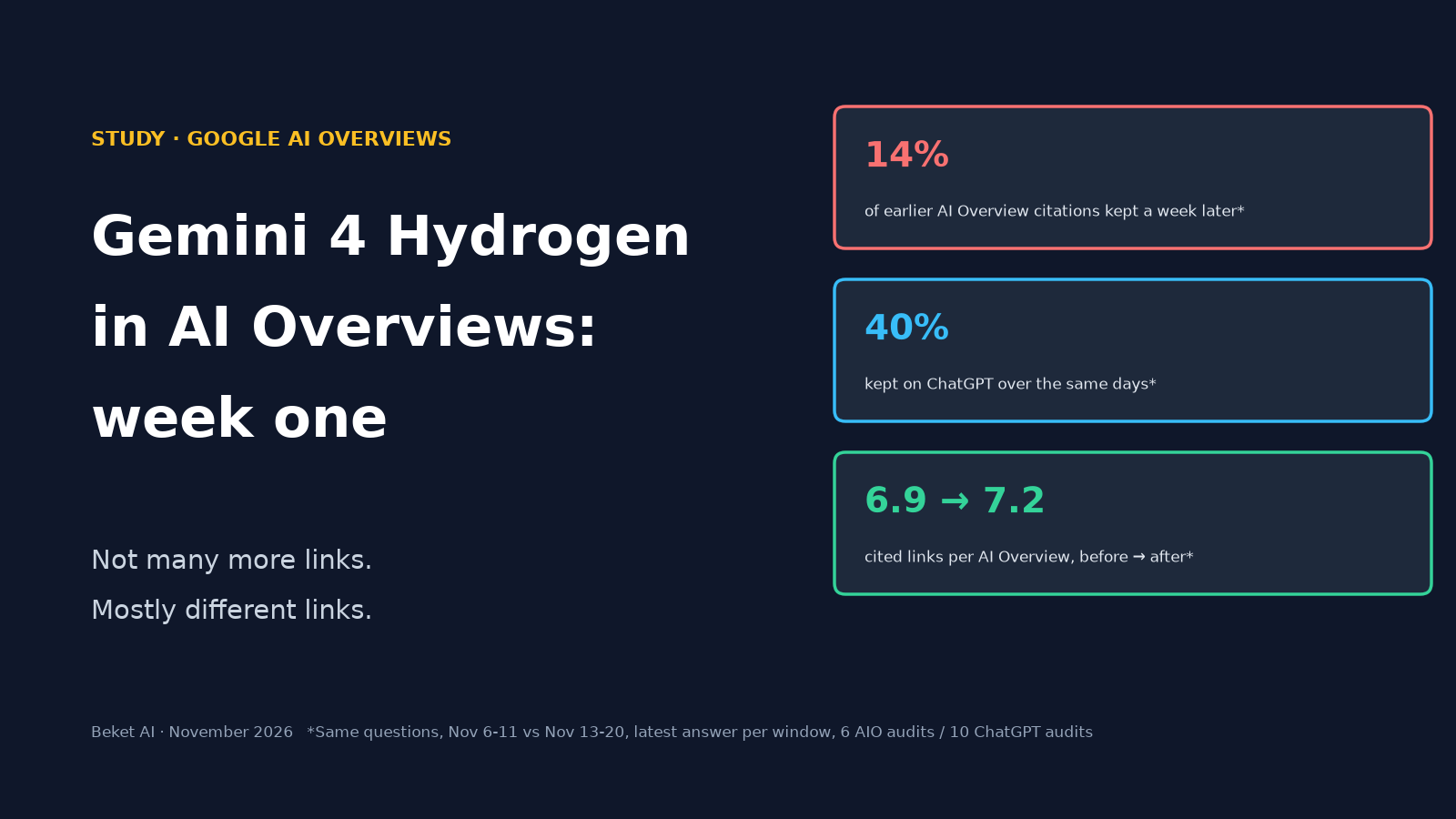
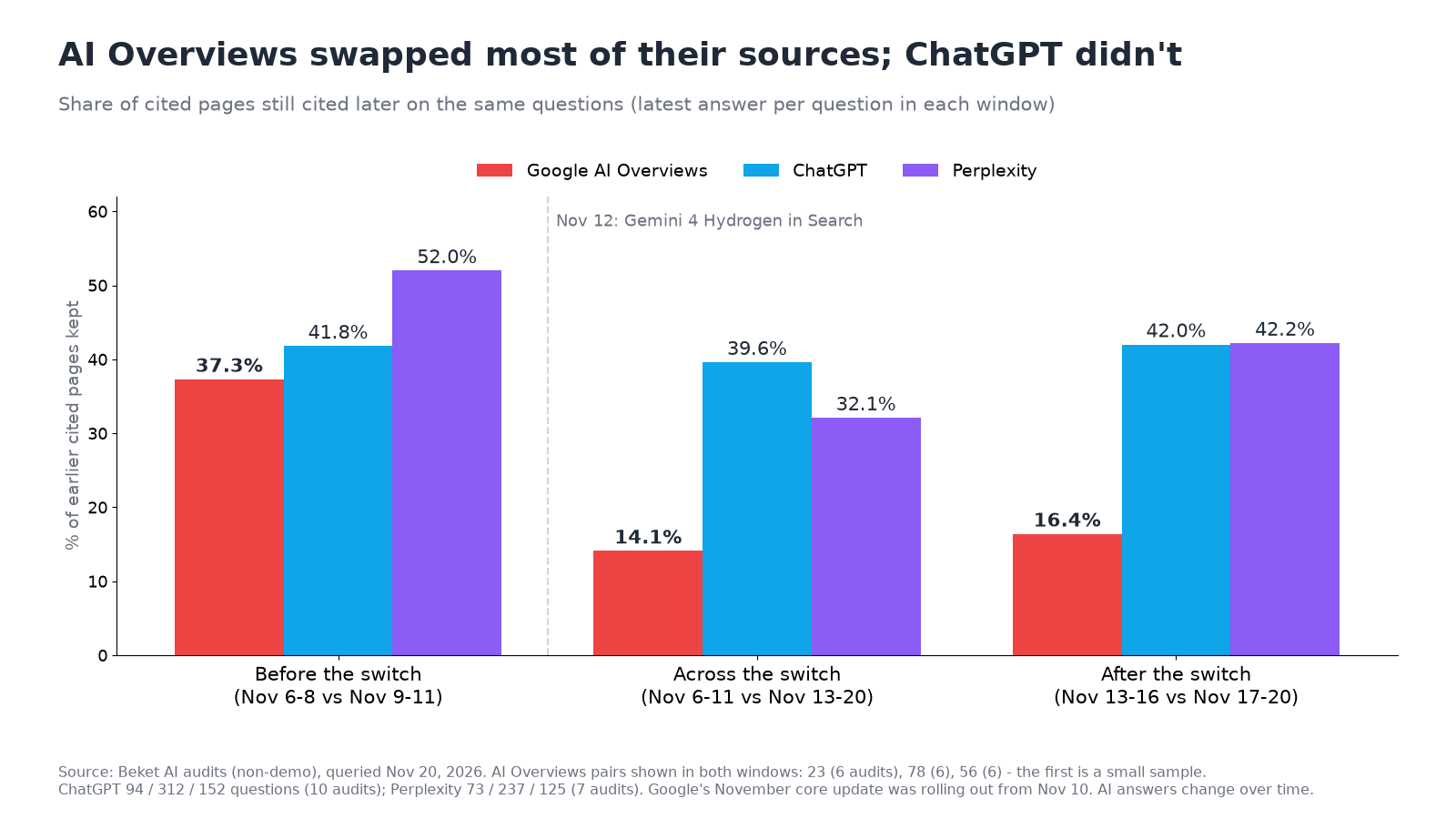
The short answer after one week: AI Overviews did not get noticeably more links per answer. They got different links. Only 14% of the pages AI Overviews cited before November 12 were still cited on the same questions a week later. On ChatGPT, over the same days, it was 40%.
What Google actually said, and what it didn't
Here is what is on the record:
| Source | What it says |
|---|---|
| Google's Search post (Robby Stein, Nov 12) | Hydrogen is "available globally in Google Search for all users." Four claims: better handling of multi-part questions and typos, improved query fan-out and linking, more visual answers (images, comparison tables, custom tools) and better answers in all AI Mode languages. |
| Search Engine Journal's SEO Pulse (Nov 14) | Hydrogen became AI Mode's default model. Stein said on X it is "being used for your hardest questions in AI Overviews." Neither source gives link numbers or says which AI Overview questions count as "hardest." |
| Ars Technica | Hydrogen replaced Gemini 3.8 Flash across Google's products. Answers in AI Overviews and AI Mode should get more visual elements. On the fan-out claim: "we've heard that from Google before." |
| PPC Land | Google's Search post doesn't mention AI Overviews at all, and gives "no count of links." The November core update began two days earlier, so separating the two effects "will be difficult." |
So two things changed in Google Search in the same week. The November 2026 core update started on November 10 and "may take up to 2 weeks to complete." As of November 20, Google's Search Status Dashboard still shows it without an end date. Hydrogen arrived on November 12, and Google says it handles at least some AI Overview questions.
If you're a brand, you don't need to know which change moved your citations. You need to know that they moved, and by how much.
What changed in AI Overviews: Beket AI data
We pulled an aggregate from Beket AI's audit database on November 20, 2026. Only aggregates were used: no brand names, questions or customer details.
How we built it. We took the questions that were checked both before and after the switch: November 6 to 11 (before) and November 13 to 20 (after). We left out November 12, the rollout day. For each question we kept only the latest answer in each window, so a question checked every day counts once per window, not seven times. We started on November 6 because that's when our AI Overview collection moved to its current method. Comparing across two collection methods would have mixed up a tool change with a Google change.
That gave us 205 questions from 6 daily-tracked audits for AI Overviews, plus the same kind of pairs for ChatGPT (312 questions, 10 audits) and Perplexity (237 questions, 7 audits) as a reference.
| Measure (same questions, before vs after Nov 12) | Before (Nov 6-11) | After (Nov 13-20) |
|---|---|---|
| Questions where an AI Overview appeared | 122 of 205 (59.5%) | 130 of 205 (63.4%) |
| Average cited links per AI Overview* | 6.9 | 7.2 |
| Average cited domains per AI Overview* | 6.1 | 6.1 |
| Average answer length* | 1,891 characters | 1,953 characters |
| Earlier cited pages still cited a week later* | – | 14.1% |
| Earlier cited domains still cited a week later* | – | 27.4% |
| AI Overviews sharing no cited page with the earlier one* | – | 35 of 78 (45%) |
*On the 78 questions where an AI Overview appeared in both windows.
Four things stand out.
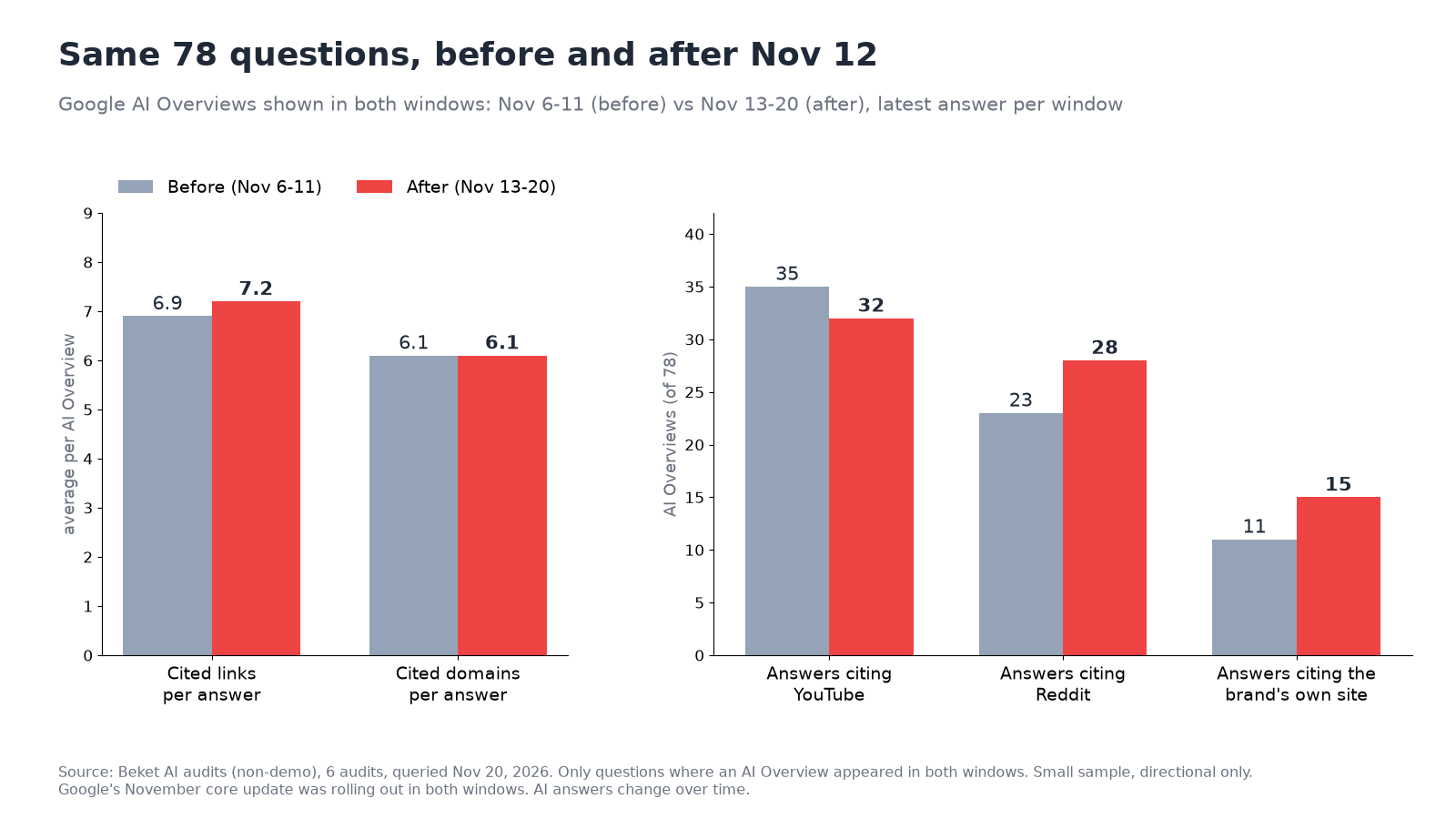
1. Not many more links, at least not yet. Links per AI Overview went from 6.9 to 7.2, about 4%, and the number of different domains didn't move at all. Our week-after-the-switch comparison (November 13 to 16 vs 17 to 20) saw a similar small rise, 7.0 to 7.4. If "a broader range of helpful links" means more links in each answer, it barely shows up in our data. If it means a wider spread of sites across many answers over time, that is what the next point looks like.
2. Far more turnover in which pages get cited. Only 14.1% of the pages AI Overviews cited before November 12 were cited again on the same question after it. Even at the domain level, only 27.4% of sites stayed. In 45% of answers, the new AI Overview shared not one cited page with the old one. All six audits showed it: their retention ranged from 5% to 26%.
3. The change looks specific to Google. On ChatGPT, over exactly the same days, 39.6% of cited pages were still cited a week later. In both of our control comparisons it was about 42%. ChatGPT's churn was steady. AI Overviews' wasn't: in the two pre-switch windows (November 6 to 8 vs 9 to 11), 37.3% of cited pages carried over. After the switch it fell to 14 to 16% and stayed there. Perplexity dipped too, from 52.0% to 32.1%, and recovered to 42.2% after, so its dip may be ordinary week-to-week noise. The pre-switch AI Overview sample is small (23 answers shown in both windows), so treat the 37% as a rough baseline, not a precise figure.
4. Whether an AI Overview shows up at all is unstable, and always was. On 47% of questions, an AI Overview appeared in one window but not the other: 44 disappeared and 52 appeared. That isn't new with Hydrogen. In the pre-switch control, 44% of questions flipped. If your report says "we lost the AI Overview," check again a few days later before you act.
On source types, the changes were small: YouTube was cited in 35 of the 78 AI Overviews before and 32 after, Reddit in 23 and then 28. The tracked brand's own website was cited in 11 answers before and 15 after. That's a small sample, but at least our data gives no sign of brands' own sites being pushed out.
Why AI Overviews might churn more now
Google hasn't explained it, so this part is our reading, not a confirmed mechanism. A stronger fan-out means each question gets split into more or different sub-searches before the answer is written. Different sub-searches retrieve different pages, and a model picks citations from what it retrieves. Change the model and the sub-searches, and the cited pages change even when the question doesn't. We wrote about how one question turns into many searches in One Question Becomes Twenty Searches Before AI Answers.
The core update adds a second push. AI Overviews draw on pages in Google's index, and Google's rankings are being reshuffled at the same time. Our data can't separate the two, and nor can anyone else's yet.
We've seen this pattern before on the ChatGPT side. When OpenAI ships a new model, the sites it cites can be rewritten overnight with no announcement. We covered that in ChatGPT Has Core Updates Too. Hydrogen looks like Google's version: a model swap that works like an unannounced citation update.
What to do this week
- Write down both dates. Mark November 10 (core update start) and November 12 (Hydrogen) in your reporting. SEJ's advice is the same: log both so you can compare before and after each one.
- Don't read Search Console's November 9 to 11 dip as lost visibility. Google confirmed a "logging error" that lowered impressions in the Generative AI performance report for those three days. It affects data only.
- Re-check your most important questions now. If you last checked what AI Overviews cite for your top buyer questions before November 12, that snapshot is likely out of date. In our data, most cited pages changed.
- Check more than once before reacting. AI Overviews appear and disappear on almost half of questions from one check to the next. Look at the same question over several days before you decide you've gained or lost a spot.
- Track engines separately. ChatGPT and Perplexity didn't change the way AI Overviews did. A single blended "AI visibility" number would hide a big Google-only move like this one.
- Wait for the core update to finish before judging the result. Then compare a full week after it with a full week before November 10, as Google suggests for core updates.
Our guide on how to track Google AI Overviews for your business walks through a manual setup if you want to do this by hand.
Beket AI does it automatically. It re-checks your questions daily across six engines (ChatGPT, Gemini, Perplexity, Microsoft Copilot, Google AI Overviews and Google AI Mode), records which pages each one cites, and includes change detection alerts on Pro. The free audit runs 25 prompts on any 3 of those engines, and Pro re-checks them daily from $49 a month per website.
Limits of this study
- Early and small. This covers one week after the switch and 6 audits for AI Overviews (205 questions, 78 with an AI Overview in both windows). The pre-switch control is smaller still. Read the numbers as direction, not precise size.
- Two changes at once. The November core update was rolling out across all of our windows, including the earliest one (it began November 10). We can't say how much of the change comes from Hydrogen and how much from the core update.
- Not every AI Overview uses Hydrogen. Google says it's used for the "hardest" AI Overview questions and doesn't define them. Some of our questions may never have touched it.
- Different time gaps. The main comparison spans about a week, the controls three to four days. ChatGPT's retention stayed near 40% across all three, which suggests the gap alone doesn't explain the AI Overview drop, but it may play a part.
- Sample mix. Beket AI audits skew toward software, services, local and B2B brands. AI Mode had too few audits on both sides of the switch to analyse.
- What we counted. Cited links as captured from each answer. Links shown only as images or carousels may be missed.
These figures are the data the engines returned for those questions between November 6 and 20, 2026, pulled on November 20. AI answers change over time. Businesses that track their category with Beket AI can request another run at any time to see whether the picture has changed.
Related posts
AI Search This Week: Gemini and ChatGPT Agents Start Booking and Buying (Nov 20, 2026)
Gemini can now call and book businesses for free, ChatGPT got a wallet, and only 6.9% of ChatGPT chats show buying intent. The week in AEO, GEO and SEO.
Does GEO Actually Work? What 2026 Research Says Moves a Brand in AI Answers
Does GEO actually work? Three 2026 studies find honest rewrites barely move AI rankings, brand familiarity does, and fake evidence works. What it means for you.
YouTube in AI Overviews vs ChatGPT: Which AI Engines Cite Videos (2026 Data)
YouTube is the most-cited site in Google AI Overviews, yet ChatGPT almost never cites it. Six engines compared with Beket AI audit data and what to do for each.