
Does GEO Actually Work? What 2026 Research Says Moves a Brand in AI Answers

Ask ten GEO agencies how to get your product into ChatGPT's answers and most will hand you the same list: rewrite your pages to sound more authoritative, add statistics and quotes, bolt on an FAQ block and schema markup. Some of that advice traces back to one 2023 paper. Since then, researchers have started testing the claims under tighter conditions, and the results are less flattering than the sales decks.
Three preprints posted to arXiv between June and November 2026 point the same way. Honest rewrites of a product page barely move where an AI engine ranks it. A familiar brand name moves it a lot. And the one kind of rewrite that reliably works is invented evidence. That last finding is the part few GEO vendors will put on a slide.
This explainer walks through what each paper tested, what it found, where the studies are weak, and what that means for how you spend your time.
Where the "GEO works" claim comes from
The term generative engine optimization was coined in GEO: Generative Engine Optimization by Aggarwal and colleagues (first posted November 2023, later published at KDD 2024). They built a benchmark of queries, rewrote source pages with tactics like adding citations, quotations and statistics, and measured how visible those sources became in generated answers. Their headline: GEO "can boost visibility by up to 40%," with results that varied by domain.
That paper is careful and useful. But "up to 40%" in a benchmark is not the same as "your product page will climb in ChatGPT." The rewrites were tested in a controlled setup, and some tactics, like adding statistics, can change what a page actually says rather than only how it says it. The 2026 papers try to pull those two things apart.
The four papers at a glance
| Paper | What was tested | Engines / models | Headline result |
|---|---|---|---|
| Aggarwal et al. (2023, KDD 2024) | Rewriting source pages with citations, quotes, statistics and style changes | Benchmark generative engines (GEO-bench) | Visibility up to 40% higher, varies by domain |
| Chu and Hou (June 2026, v3 Oct 2026) | Real brand vs fictional brands with identical specs; persuasion-style rewrites | GPT-4o-mini, Claude Sonnet, Gemini 3 Flash (skincare) | Real brand picked in all 670 valid trials; fabricated authority claims broke that 73% of the time |
| Chen and Koudas (Oct 2026) | What predicts which pages get cited, across 158,099 real answers | ChatGPT, Gemini, Perplexity | Retrieval explained 32% of citation variation within a site; page properties 2.8% |
| Monaco, Lenti and Pierri (Nov 2026) | Brand popularity bias in live engines; brand-name swaps vs fact-preserving GEO rewrites | GPT, Gemini, Perplexity (+ DeepSeek in the experiment), Italian market | Real brand +0.44 rank positions; GEO rewrites +0.02 (not significant) |
All three 2026 papers are preprints, which means they have not yet been through peer review. Treat them as strong signals, not settled science.
Finding 1: Honest rewrites barely move the ranking
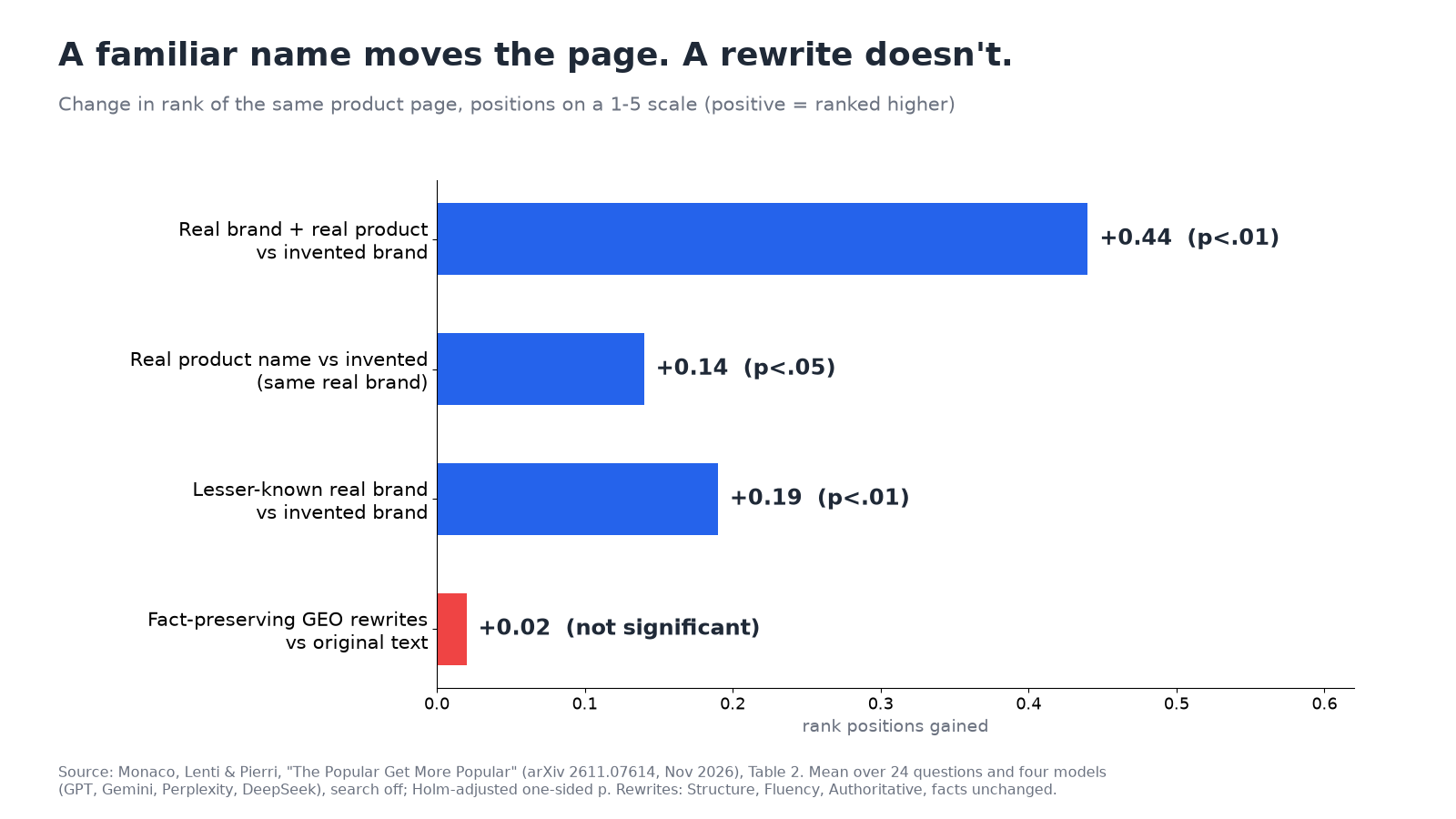
The cleanest test comes from Monaco, Lenti and Pierri at Politecnico di Milano. In their controlled experiment, four models ranked five real product pages for 24 shopping questions. The researchers then changed one page at a time in two ways:
- Who signs it. The page kept its real brand and product name, or got a different real brand, or an invented one.
- How it is written. The page was rewritten three ways: "Structure" (decisive information first, headings and lists), and "Fluency" and "Authoritative," two methods taken from the original GEO paper.
The rewrites had strict rules. Every fact and number had to stay the same, length had to stay within 15% of the original, and a separate model checked that nothing was added or removed.
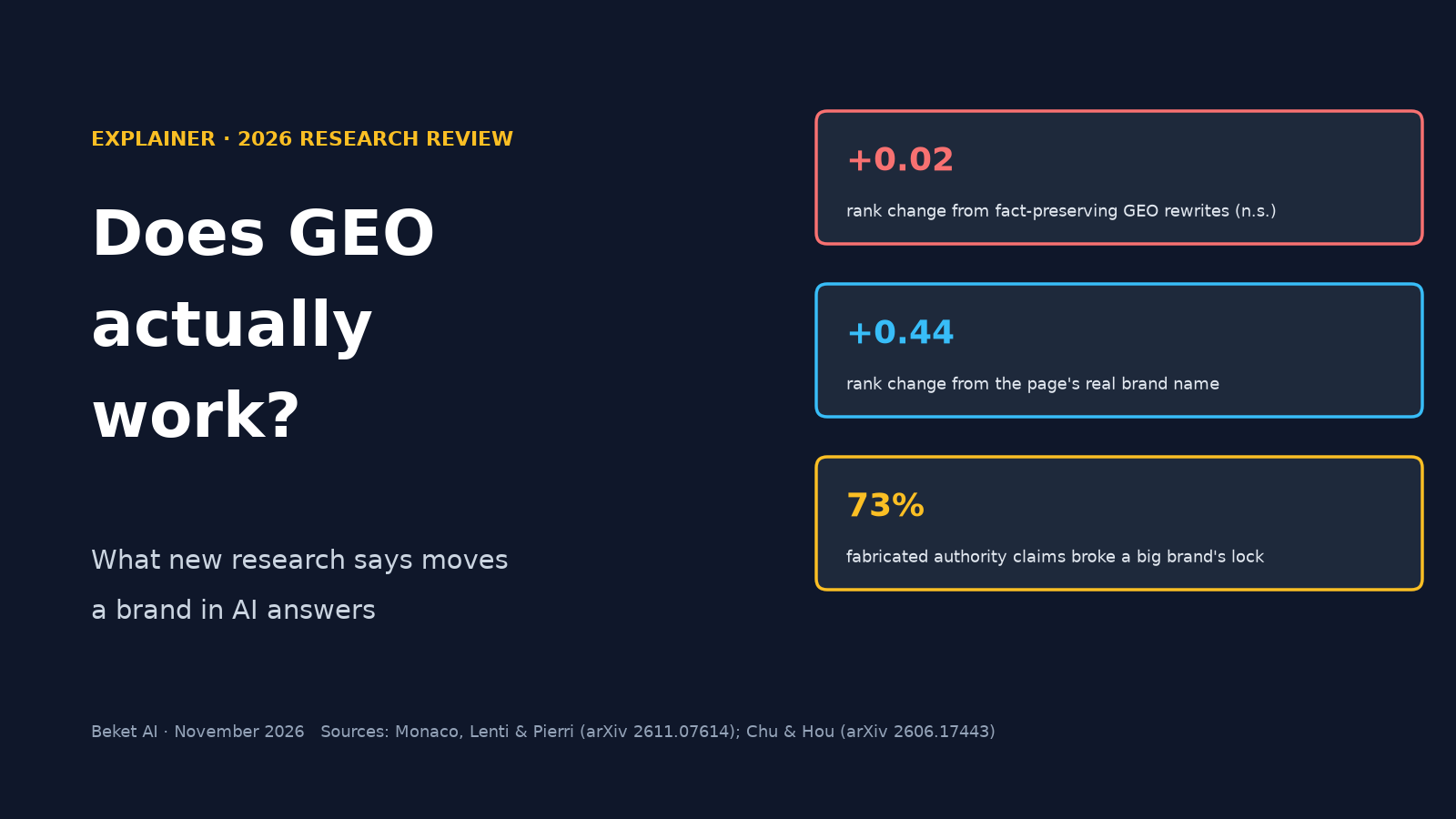
The result: averaged across questions and models, the three GEO rewrites moved the page +0.02 positions on a 1-to-5 scale, which was not statistically significant. Swapping the real brand for an invented one cost the page 0.44 positions (it ranked 3.21 under its true brand and 3.65 under an invented one). In the authors' words, fact-preserving rewrites "yield negligible ranking gains," and they "do not close" the gap that brand familiarity creates.
Finding 2: The model already has favorites, and search doesn't fix that
The same Milan paper also audited live engines. It sent 20 shopping prompts per sector (sport, fashion and beauty, insurance, travel), with and without buyer personas, with web search on and off, ten times each, to GPT, Gemini and Perplexity.
More popular brands were mentioned more. Brands in the most popular fifth were mentioned and cited 1.4 to 2.8 times as often as the average brand of their engine and sector. The least popular fifth showed up in under 1% of answers.
The part that matters for GEO: turning web search on did not reduce the bias. A brand searched ten times more often on Google gained about 0.87 extra mentions per 100 answers with search off and 0.89 with search on. The engines often wrote popular brand names into their own search queries before fetching anything. The one factor that weakened the bias was a buyer persona, which turned "best running shoes" into a constrained request with a budget and a profile.
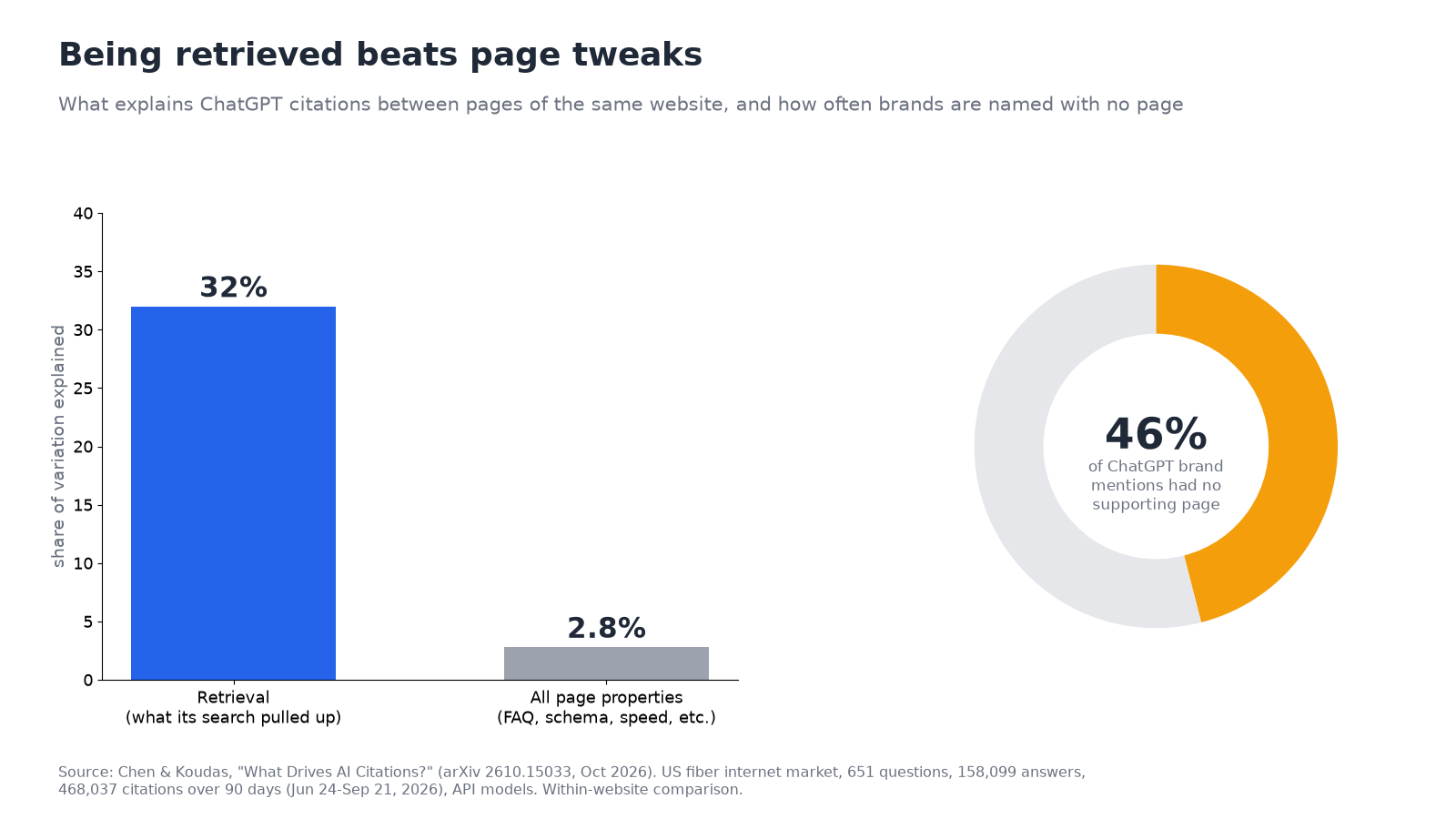
Chen and Koudas found the same pattern from a different angle. In their data, a brand already in the model's memory was written into the engine's own searches 67% of the time, against 11% for brands that weren't, and 46% of ChatGPT's brand mentions had no supporting page at all. In their words: "Pages are thus cited when searched; brands are also named when remembered." We covered how that memory works in our explainer on parametric knowledge optimization.
Finding 3: Retrieval matters far more than page tweaks
Chen and Koudas looked at 90 days of answers to commercial questions in the US fiber internet market (651 questions, 158,099 answers, 468,037 citations), collected through the engines' APIs, plus a second market of small B2B software vendors.
The key move in this paper is comparing pages within the same website. Popular sites tend to have FAQ blocks, schema and fast pages, and they also get cited more for unrelated reasons. Comparing a site's pages against each other removes that confound.
What they found:
- Pages whose title and paragraphs match the questions people ask were cited more. This was the only page property that passed every test (about +24% to +26% per standard deviation on third-party pages).
- FAQ blocks, schema markup, summary boxes, author boxes and page speed looked effective across websites but not within them. At equal rank, they went with slightly fewer citations.
- Retrieval decided most of it. Every page ChatGPT cited was one its own search had retrieved. Which pages that search pulled up explained 32% of the variation in citations between a site's pages. All the page properties together explained 2.8%.
- The engines' searches are their own. They rewrite each question into sub-queries that "rarely coincide with Google's or Bing's results," so a good classic rank is not a reliable proxy.
Finding 4: What does work is a quality signal, real or fake
Chu and Hou ran the bluntest test. They showed three commercial models a well-known skincare brand next to fictional brands with identical specs. The real brand was recommended in every one of 670 valid trials. Not one fictional brand was ever picked.
Then they added small real differences. A fictional brand needed only about a +0.075-star rating edge, 1.6 times the reviews, or a 7.3% price cut to win half the time. Once quality information was on the page, brand explained only 1.2% of ranking variance.
Next they tested persuasion-style copy, and this is where it gets uncomfortable:
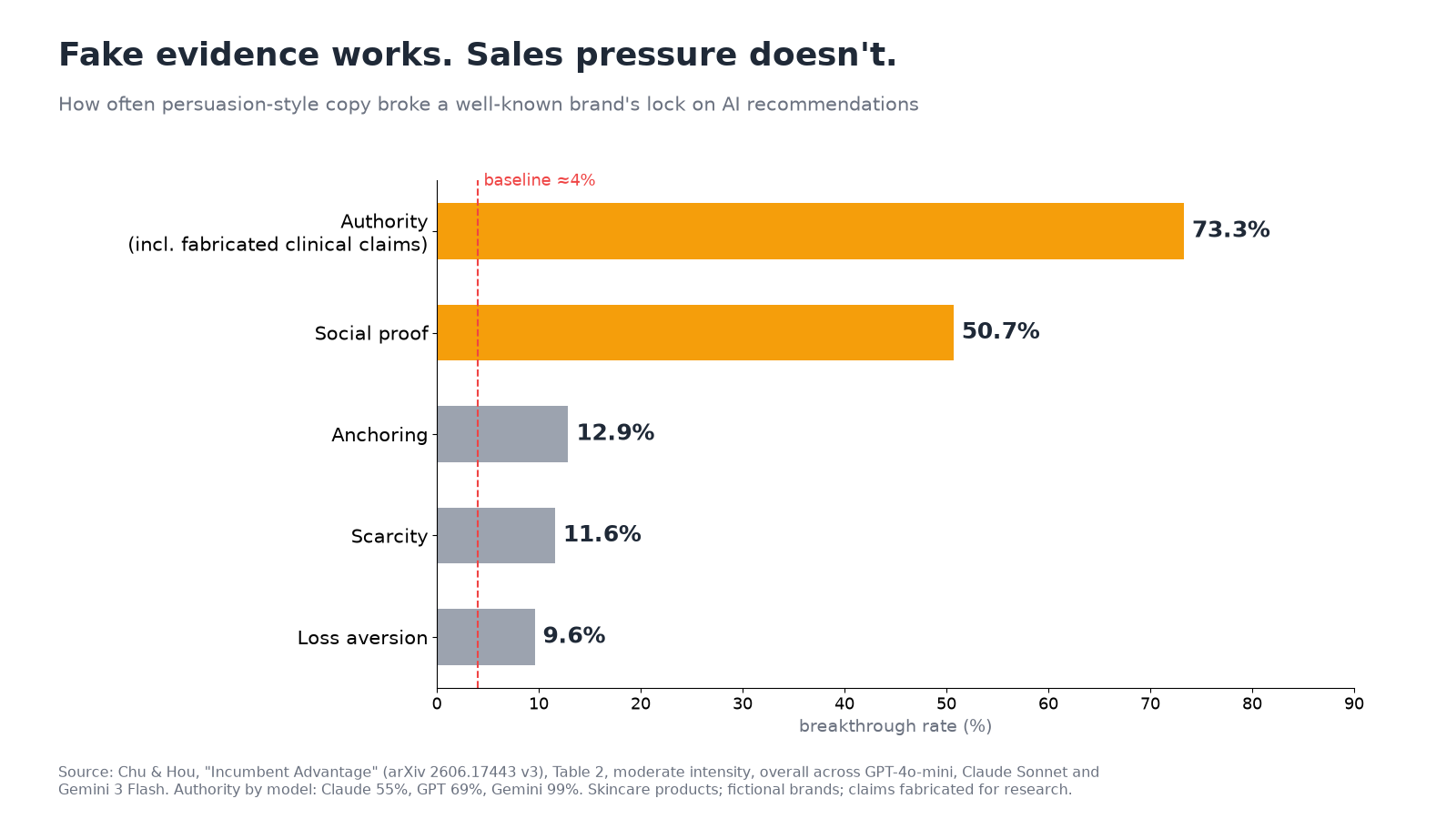
Copy that mimicked evidence, such as a made-up "peer-reviewed trial, n=120," broke the monopoly far more often than "limited stock, hurry" pressure. Models reacted very differently: authority copy worked 55% of the time on Claude, 69% on GPT and 99% on Gemini. The authors also simulated many brands using the same trick. When everyone adopted it, the gain per brand fell from +0.802 to +0.007 in their payoff measure, and brands that didn't join got zero recommendations in their tests.
The Milan authors point at exactly this when they explain why their result differs: earlier gains came from manipulations that "incorporated unverified or fabricated clinical claims." Strip those out and the effect disappears.
So does GEO actually work?
It depends on what you mean by GEO.
If GEO means rewording the same facts to sound more authoritative, the best current evidence says it does little. Three 2026 papers, using different engines and markets, found small or no gains from style changes alone.
If GEO means getting accurate, specific evidence about you onto pages the engines retrieve, the evidence is much stronger. Real ratings, reviews, prices and third-party pages that name you all moved recommendations. For small brands, Chen and Koudas found a niche vendor was named mainly when a cited third-party page named it.
If GEO means planting claims that aren't true, it can work in a lab, it erodes as competitors copy it, and it puts your brand next to fabricated evidence. We covered why shortcuts like these tend to backfire in AEO hacks that backfire.
What to do with this
- Stop paying for pure rewrites. If a proposal is mostly "make our pages sound more expert" with the same facts, the evidence says the return is small.
- Put real quality signals where engines can read them. Ratings, review counts, prices, specs, certifications and comparisons in plain text on the page. In Chu and Hou's tests, a tiny genuine edge outweighed a famous name.
- Write pages that answer the questions buyers ask, in their words. A title and paragraph that answer a question directly was the one page property that held up in every test Chen and Koudas ran.
- Get named on third-party pages the engines retrieve. Reviews, roundups, comparisons and trade press, with accurate facts. This matters most if you're a smaller brand the model doesn't know yet. Our guide to generative search visibility ranks these signals by strength of evidence.
- Test with constrained, persona-style prompts, not just "best X." The Milan study found personas were the only factor that weakened popularity bias. Generic prompts favor the biggest brands. See our persona prompt guide for how to build them.
- Measure per question and per engine, over time. The engines behave differently (look at Gemini's 99% versus Claude's 55% on authority copy), and Chen and Koudas found the cited set changes over weeks.
The limits of this research
- These are preprints. None of the three 2026 papers had been peer reviewed when we wrote this.
- The settings are narrow. The Milan study used Italian prompts in four consumer sectors. Chu and Hou used skincare and one robustness check. Chen and Koudas covered the US fiber internet market and one niche B2B software market, using API models (GPT-5.4 nano, Gemini 3.1 Flash Lite, Perplexity Sonar) rather than the consumer apps.
- Controlled experiments use the models without live search. The Milan ranking experiment and Chu and Hou's tests gave models fixed pages to rank. Real answers add retrieval, which Chen and Koudas show is where most of the action is.
- Models change fast. Results from GPT-4o-mini or Gemini 3 Flash may not hold for the versions running today.
How Beket AI fits
None of these papers can tell you what ChatGPT, Gemini or Google's AI answers say about your brand for your buyers' questions. That takes asking those questions, repeatedly, on each engine. Beket AI runs your questions across ChatGPT, Gemini, Perplexity, Microsoft Copilot, Google AI Overviews and Google AI Mode and shows which brands are named and which pages are cited. The free audit covers 25 prompts on any 3 of the 6 engines. Pro is $49 a month per site with daily re-audits and change detection alerts, so you can see whether real changes, like new reviews or a third-party mention, show up in the answers.
Sources checked November 20, 2026. Numbers come from the papers linked above; we did not re-run their experiments.
Related posts
Gemini 4 Hydrogen in Google Search: What Changed in AI Overviews After One Week (Beket AI Data)
After Google's Gemini 4 Hydrogen switch, AI Overviews kept just 14% of earlier citations on the same questions vs 40% on ChatGPT. Week-one data and what to do.
Is the Google Map Pack Going Away? AI Overviews Now Replace It on Some Local Searches (2026)
A new study found Google AI Overviews replacing the map pack on 79 of 80 local searches. Why other data disagrees, what our audits show, and what to check now.
AI Search This Week: Gemini and ChatGPT Agents Start Booking and Buying (Nov 20, 2026)
Gemini can now call and book businesses for free, ChatGPT got a wallet, and only 6.9% of ChatGPT chats show buying intent. The week in AEO, GEO and SEO.