
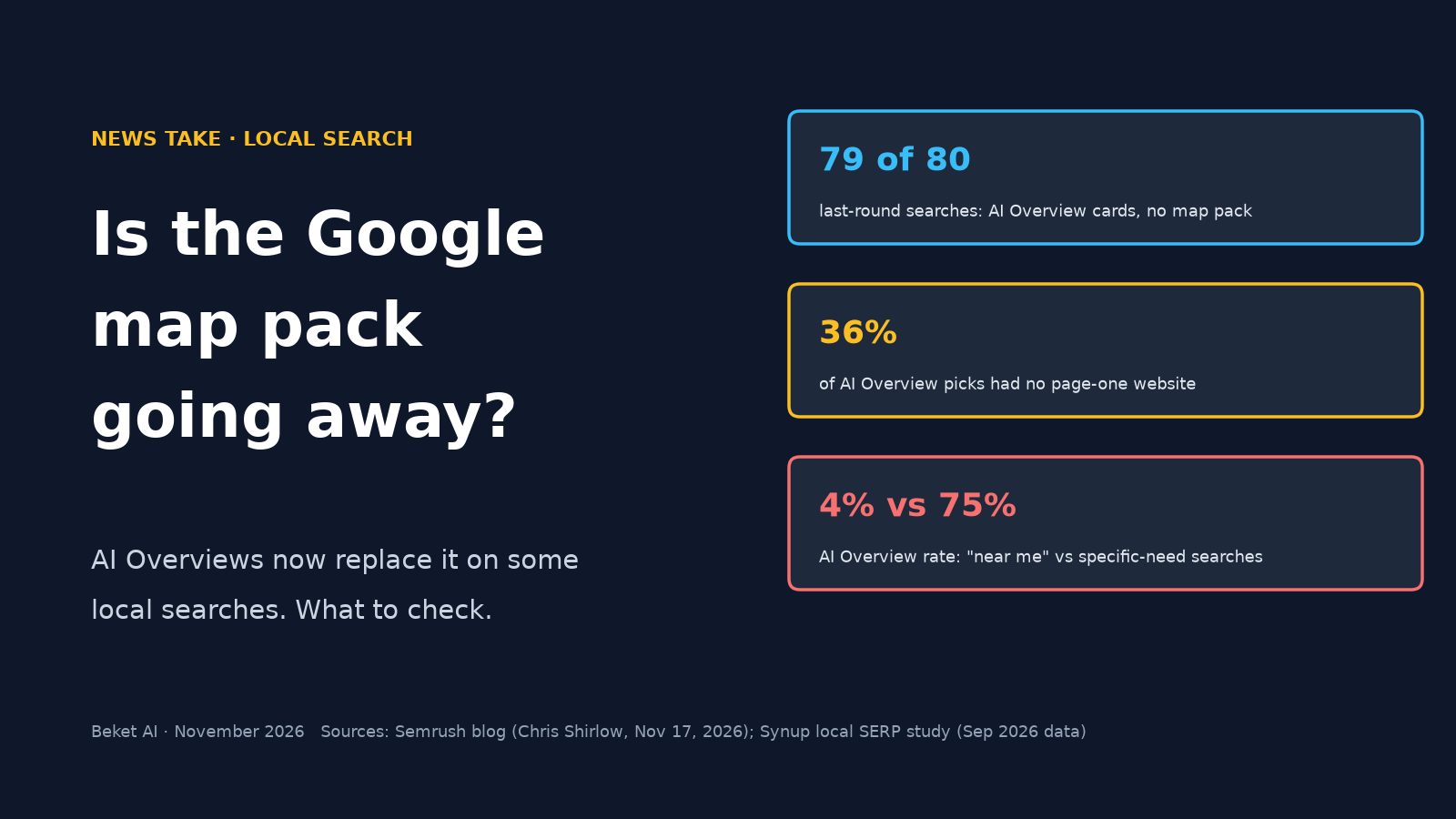
Is the Google Map Pack Going Away? AI Overviews Now Replace It on Some Local Searches (2026)

A local SEO agency owner searched his electrician client's main service and found the client exactly where the agency had worked to put it: in Google's map pack. Sitting above the pack, Google's AI Overview recommended four other electricians. His client wasn't one of them.
That moment kicked off a two-month study, which Semrush published on November 17, 2026. Its headline finding is hard for any local business to ignore. In the last round of searches, Google's AI Overview didn't sit above the map pack anymore. On 79 of 80 searches, it replaced the pack, showing local businesses as cards inside the AI answer.
So is the Google map pack going away? Not everywhere, and not yet. Two other large local studies, from Synup and BrightEdge, still find a map pack on more than 9 in 10 local results pages. The difference comes down to how people phrase the search. This news take covers what the Semrush study found, why the three studies disagree, what Beket AI's own local audits add, and what to check this week.
What happened
Chris Shirlow, who runs a local SEO agency, ran 480 Google searches by hand between September and November 2026. He was signed out, used an incognito window, and expanded every AI Overview. The searches covered 12 US markets (from Phoenix and Philadelphia down to Marshall, Missouri), 10 local services (emergency plumbers and electricians, HVAC repair, roofing, bathroom remodeling, personal injury and estate planning lawyers, dentists, chiropractors and Italian restaurants), and two phrasings of each search: a bare keyword like "emergency plumber [city]" and a conversational one like "need an emergency plumber [city]". Every market was searched twice.
Here are the numbers that matter most, all from the Semrush write-up:
| Finding | Number |
|---|---|
| Searches with an AI Overview, first round | 38% |
| Searches with an AI Overview, last round | 99% (79 of 80) |
| Searches with an AI Overview, all 480 | 292 (61%) |
| First-pass AI Overviews still there on the second pass | 106 of 108 |
| Last-round searches where the AI Overview replaced the map pack | 79 of 80 |
| Businesses named per AI Overview (last round) vs the pack's 3 | about 5 |
| Searches where the AI Overview sat above the pack but named none of the pack's businesses | 32 of 145 (22%) |
| AI Overview picks whose own website wasn't on page one | 373 of 1,023 (36%) |
| Conversational vs bare searches with an AI Overview, first pass | 66% vs 24% |
The layout change is the part to focus on. In the last four markets, the first pass found 48 AI Overviews sitting above a normal map pack. About four weeks later, none did. 76 searches showed an AI Overview with business cards and no map pack, 3 showed an AI Overview with a text list and no pack, and only 1 still showed a classic pack.
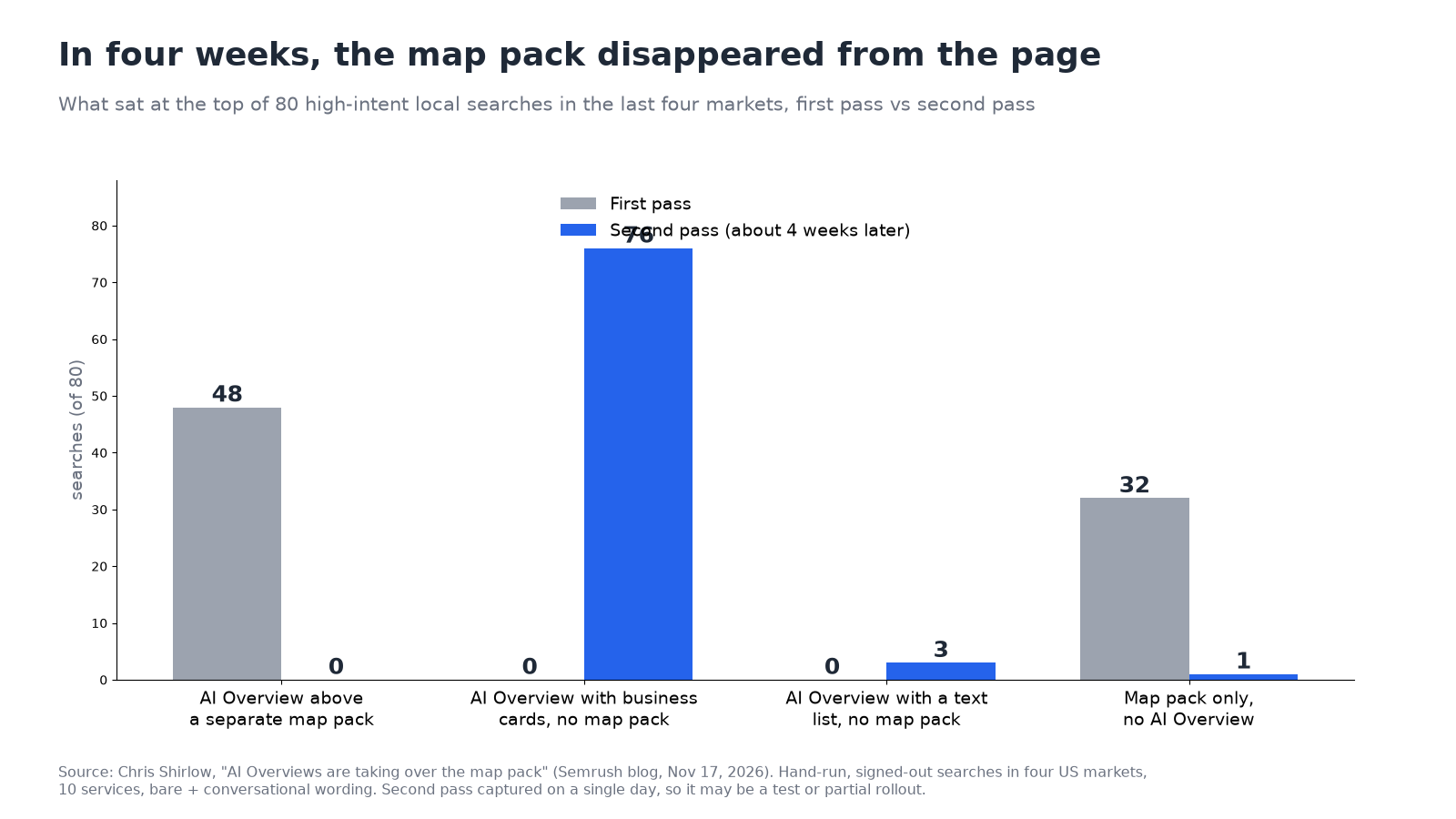
The cards look like map pack listings: name, rating, review count, and buttons to call, get directions, or visit the website. But they aren't the old pack moved up the page. In that last round, only 154 of the 236 businesses from the first-pass map packs (65%) made it into the AI Overview cards. On 9 of the 79 searches, none of them did.
Our take: big signal, small sample
We think this study matters, and we also think it's easy to over-read. Before you rebuild your local strategy around "the map pack is dead," keep four limits in mind:
- The 99% comes from one day in four markets. Shirlow notes that he captured the last round on a single day, "so it could be a test or a rollout that hasn't reached everyone yet."
- It's one person's hand-run study. That gives it the realism of what a signed-out searcher sees, but it isn't a large automated sample.
- The query set is high-intent by design. Every search was a money search ("need a personal injury lawyer [city]"), which is exactly where AI Overviews are now spreading fastest.
- Google keeps changing this layout. On November 10, Search Engine Roundtable reported a test where the AI Overview version of the local pack dropped the action buttons, reviews and photos, and Joy Hawkins said that on mobile "the traditional local pack is gone" whenever she got that version. By November 18 she was seeing the old version again.
What we don't think you should take from those limits is "nothing to see here." AI Overviews grew in every service category Shirlow tested, and once an AI Overview appeared, it almost never went away. The direction is clear even if the 99% figure isn't a national rate.
Why other studies still find the map pack on 9 in 10 local searches
Two other recent studies look, at first glance, like they contradict Semrush's. They mostly don't. They measured different searches.
Synup's 2026 local SERP study pulled 53,900 Google results pages for 49 business categories across 250 US cities in September 2026. Across the four phrasings in its main chart, the local pack showed on 91% to 97% of desktop pages. But the AI Overview rate swung wildly with phrasing, from 4% of "near me" searches to 75% of searches that added a specific need:
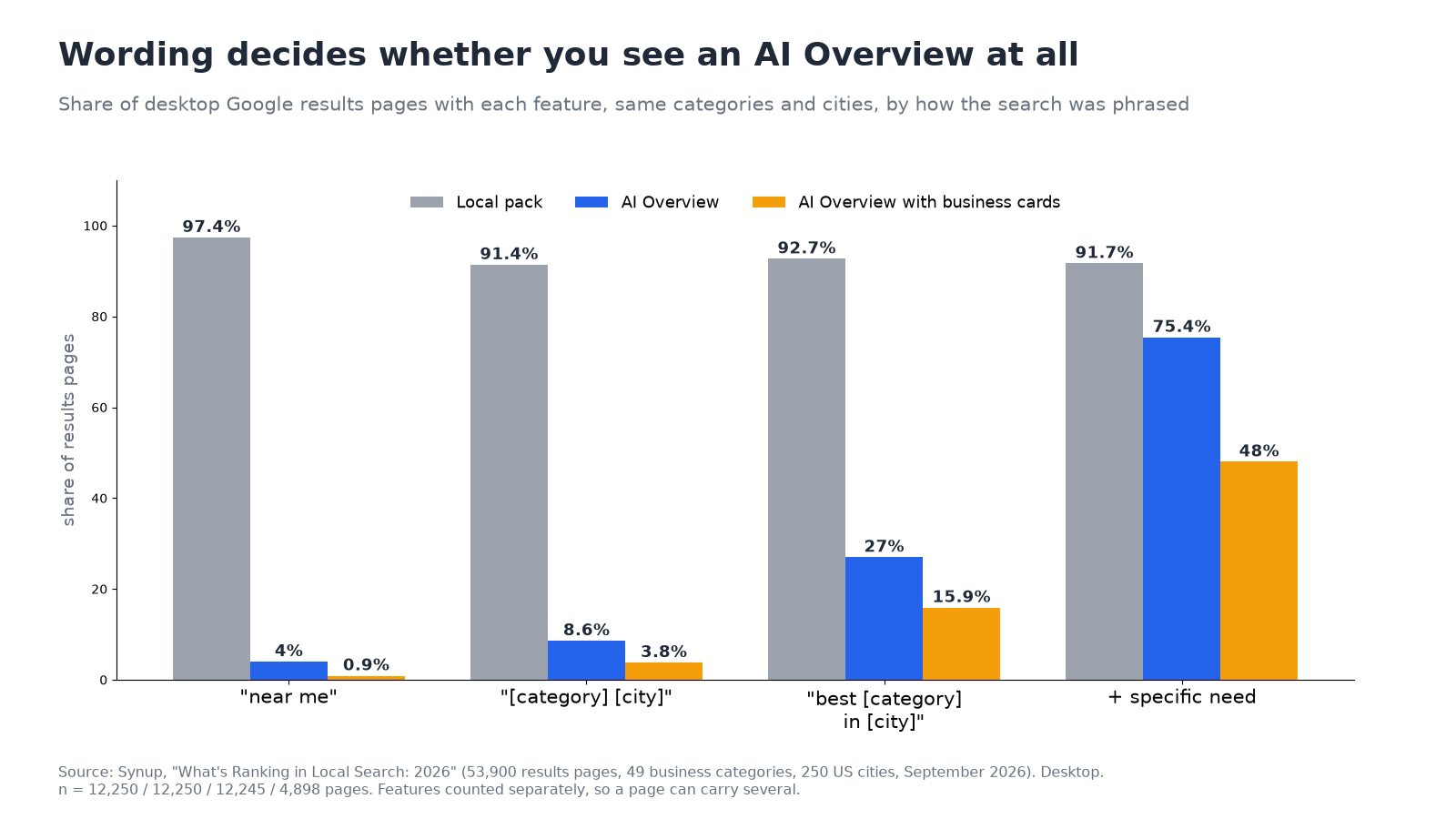
On specific-need searches, nearly half of the pages (48%) had an AI Overview with business cards inside it. Synup describes those as "a Local Pack wrapped in generated text" that, on the pages Synup spot-checked, didn't always list the same businesses as the map pack below it.
BrightEdge's November 20 analysis of its own tracked keywords (October 2026, US desktop, one fixed location) found the Local 3-Pack on 94.6% of "near me" keywords, 99.3% of hotel keywords and 93.0% of local-service keywords. AI Overviews appeared on only 13.9% to 16.6% of them. BrightEdge's conclusion: when the wording signals someone wants a nearby provider, "the pack is what came back."
Put the three studies side by side and the picture is consistent:
| Study | Data | What it measured | AI Overview rate | Map pack |
|---|---|---|---|---|
| Semrush / Shirlow | Sep–Nov 2026, 480 hand-run searches | High-intent local, bare + conversational | 38% → 99% | Replaced on 79 of 80 in the last round |
| Synup | Sep 2026, 53,900 pages | 5 phrasings, 250 cities | 4% ("near me") to 75% (specific need) | 91%–97% of pages |
| BrightEdge | Oct 2026, tracked keywords | Near me, hotels, local-service words | 13.9%–16.6% | 93%–99% of keywords |
Short, proximity-style searches ("plumber near me") still mostly get a classic map pack. Longer searches that describe a need ("need an emergency plumber in Spokane tonight") increasingly get an AI Overview, and that AI Overview increasingly carries its own business list. As more people type the way they'd talk to an AI assistant, that second kind of search could become a bigger share of local demand.
What Beket AI's own local audits show
We checked the same question against our own data: Beket AI's local study audits, which ask buyer questions about a specific city across AI engines. We used 34 audits (Seattle 15, Vancouver 13, New York 4, Los Angeles 1, San Francisco 1), run between October 16 and November 20, 2026. We counted only the latest run of each question on each engine, and we ranked domains by how many audits cited them, not by raw citation counts. These are aggregate numbers from what the engines returned on those dates. AI answers change from day to day.
AI Overviews showed up on most of our city questions. From November 7 to 20, Google showed an AI Overview on 104 of 162 city-specific questions (64%) across 9 audits. That's lower than Semrush's last round, which makes sense: our question sets mix "who should I hire" questions with cost and how-to questions, while every Semrush search was a money search.
AI Overviews name a short list, and it's a different list from ChatGPT's. Google's AI Overview named 5.8 businesses per answer on average, close to the "about five" Shirlow counted in his cards. ChatGPT named 7.1 and Perplexity 4.4. When ChatGPT and the AI Overview answered the same question, only 16.6% of the businesses the AI Overview named (265 of 1,592) were also named by ChatGPT. Ranking in one AI engine tells you little about the next one, the same way ranking in the pack told Shirlow little about the AI Overview.
Google's AI Overviews lean on Google's own pages and on social and review sites. On our local questions, the AI Overview linked to google.com (Google Search and Google Maps pages) in 49% of its answers, across 32 of 34 audits. ChatGPT cited google.com in just 4.2% of its answers on the same audits. After Google itself, the AI Overview cited Reddit, Facebook, Yelp, YouTube, Thumbtack and Instagram most often:
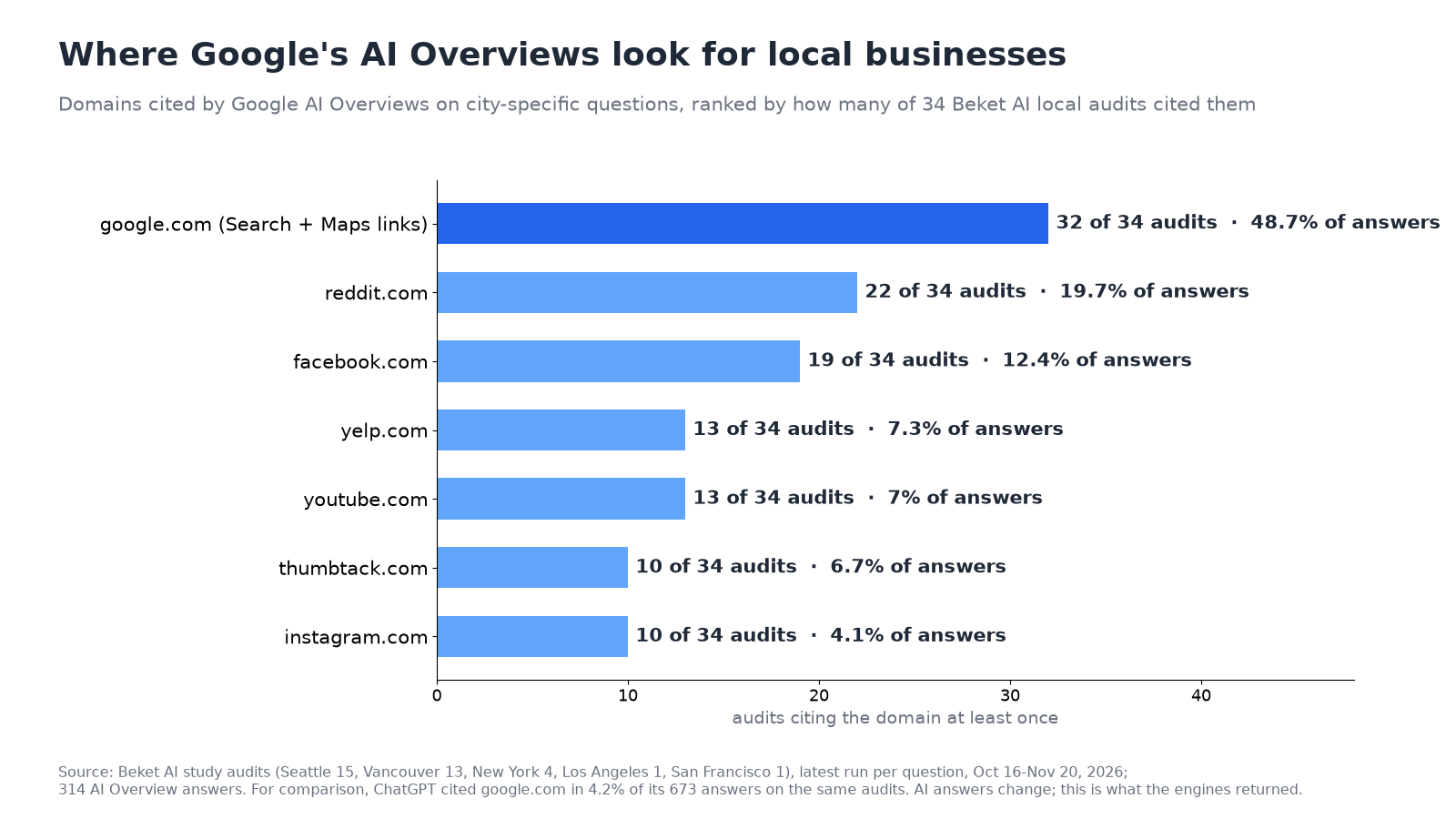
That matches what Shirlow saw: the cards in his AI Overviews used the same names, ratings and addresses as Google Business Profile listings, and after business websites, the AI Overviews he checked cited Yelp most often, then industry directories like Justia and Zocdoc, then Facebook and Reddit. Your Google Business Profile still matters. It now also feeds the AI answer, not just the pack. We saw the same gap in our earlier test of whether Vancouver's top realtors on Google Maps get named by ChatGPT: of the 50 businesses in the Maps top 3 for 25 searches, the AI engines named 7.
Update, November 21: we checked 40 local searches ourselves
After this post went live, we ran a check of our own. We typed 40 local searches into Google from a cloud browser, 20 for Vancouver and 20 for Seattle, with the location set to each city. They covered 10 services (an emergency plumber, an electrician, furnace repair, roof repair, a locksmith, a family lawyer, a personal injury lawyer, an emergency dentist, a bathroom renovation contractor and an immigration lawyer), each typed as a bare search and as a long question.
| What we looked at | Result |
|---|---|
| AI Overview in the browser | 40 of 40 searches |
| Separate map pack in the browser | about 35 of 40 (Seattle 18 of 20, checked with screenshots; Vancouver 17 of 20, read from page text, so approximate) |
| Seattle: pack below the AI Overview | 12 of 20 |
| Seattle: pack above the AI Overview | 6 of 20 |
| AI Overview logged by Beket AI's collector, same 40 searches | 27 of 40 |
An AI Overview showed on every search, but the separate map pack mostly stayed. In Seattle the pack sat below the AI Overview on 12 searches and above it on 6. Of the 5 searches with no separate pack across both cities, 3 were long conversational questions. That fits the pattern above: the longer and more specific the question, the more the AI Overview takes over. It also sits between the Semrush result (the pack replaced on 79 of 80 searches in the last round) and the Synup and BrightEdge results (a pack on more than 9 in 10 pages). We counted whether a separate pack block was on the page at all, which isn't the same as Semrush counting the pack being replaced by business cards, and ours is one day, two cities and a cloud browser.
Our own collector missed AI Overviews the browser showed. Beket AI's audit collector logged an AI Overview on 27 of the same 40 searches, against 40 of 40 in the browser. We don't know why, so treat any tool's "AI Overview rate" as what it saw in one fetch, and spot-check a few searches by hand.
In those audits, Google AI Mode named about 7 businesses per answer, Google AI Overviews about 5 and ChatGPT 3 to 5. Only 14% to 21% of the businesses one engine named were also named by another engine on the same search. Of the 142 links cited by AI Overviews, 27 (19%) were google.com, and 25 of those looked like Google Maps or place links. That supports the Google Business Profile advice in the steps below.
We wrote up the full check, with charts and a screenshot, in our local pack news take.
What to check this week
You don't need to wait and see whether the 79-of-80 layout sticks. Everything below helps whether Google shows a pack, an AI Overview with cards, or both.
- Search your top services both ways. Run "[service] [city]" and a conversational version ("need a [service] in [city]", "who's the best [service] in [city]") signed out, in a private window. Note whether you appear in the map pack, the AI Overview, both or neither. If the bare search shows no AI Overview, the conversational one is where it shows up first.
- Treat your Google Business Profile as AI input. Check categories, name, address, phone, hours and service area. Make sure they match your site and major directories. If you have more than one location, complete every listing. Shirlow saw the same business shown from two different locations depending only on wording.
- Give every city you serve a real page. Some AI Overview picks in the Semrush study were businesses based elsewhere, even 100 miles away, that had a page for the searched city. Our guide to service area pages vs doorway pages covers what Google allows and what AI engines actually cite.
- Open the sources the AI Overview cites. If a "best [service] in [city]" list, a directory or a Reddit thread names your competitors and not you, that's your outreach list. In one Semrush example, every roofer in the AI Overview appears to have come from a single "5 best roofing companies" blog post.
- Don't rely on review count alone. On 46 of 144 Semrush searches (32%), the AI Overview named a business with fewer than 50 reviews that wasn't in the pack, while the pack showed a business with 200 or more. Reviews still help. They no longer guarantee the top slot.
- Write the details down on your pages. Services, neighborhoods, typical prices, credentials and same-day availability, in plain language, backed by LocalBusiness schema that matches the page. Our step-by-step guide on how to show up in Google AI Overviews walks through each part.
- Track the AI answer, not just the pack. Rank trackers that only report pack position will miss this change. Check the AI Overview and AI Mode alongside ChatGPT and Perplexity, because each one names a different set of businesses.
For the last step, a weekly AI brand monitoring routine is enough to start. If you'd rather not run the searches by hand, Beket AI's free audit runs 25 prompts on any 3 of its 6 engines (ChatGPT, Gemini, Perplexity, Microsoft Copilot, Google AI Overviews and Google AI Mode). Pro, at $49 a month per site, re-runs them daily and includes change detection alerts.
The bottom line
The map pack isn't gone. On short "near me" searches it's still on almost every page. But on the searches that describe a real need, Google's AI Overview is taking the top of the page, it names about five businesses instead of three, and it often picks businesses that don't rank on page one. If your local SEO reporting stops at "we're in the 3-pack," it's now measuring the part of the page that may stop showing.
Sources: Semrush blog, "AI Overviews are taking over the map pack" (Chris Shirlow, Nov 17, 2026); Synup, "What's Ranking in Local Search: 2026"; BrightEdge, "Local SEO Still Matters" (Nov 20, 2026); Search Engine Roundtable (Nov 10, 2026). Beket AI figures are aggregates of our own study audits as of November 20, 2026. Businesses in our studies can request another run.
Related posts
Does GEO Actually Work? What 2026 Research Says Moves a Brand in AI Answers
Does GEO actually work? Three 2026 studies find honest rewrites barely move AI rankings, brand familiarity does, and fake evidence works. What it means for you.
How ChatGPT and Gemini Decide Which Brands to Name: What Two New Studies Show (2026)
Two new studies show live search, not memory, picks most brands in ChatGPT and Gemini answers. What they found, their limits, and what your site must confirm.
Gemini 4 Hydrogen in Google Search: What Changed in AI Overviews After One Week (Beket AI Data)
After Google's Gemini 4 Hydrogen switch, AI Overviews kept just 14% of earlier citations on the same questions vs 40% on ChatGPT. Week-one data and what to do.