
AEO Hacks That Backfire: 6 Shortcuts AI Search Ignores or Flags (2026)

Google’s own guide to AI search has a heading that most AEO advice skips: “Prioritize effective SEO strategies over ‘AEO/GEO hacks’.” That line sits in Optimizing your website for generative AI features on Google Search, and it isn’t the only warning. Google’s spam policies now define spam as attempts to manipulate Search “into featuring content prominently, such as attempting to manipulate Search systems into ranking content highly or attempting to manipulate generative AI responses in Google Search.” ChatGPT has started adding warnings to some answers about who wrote the rankings it cites.
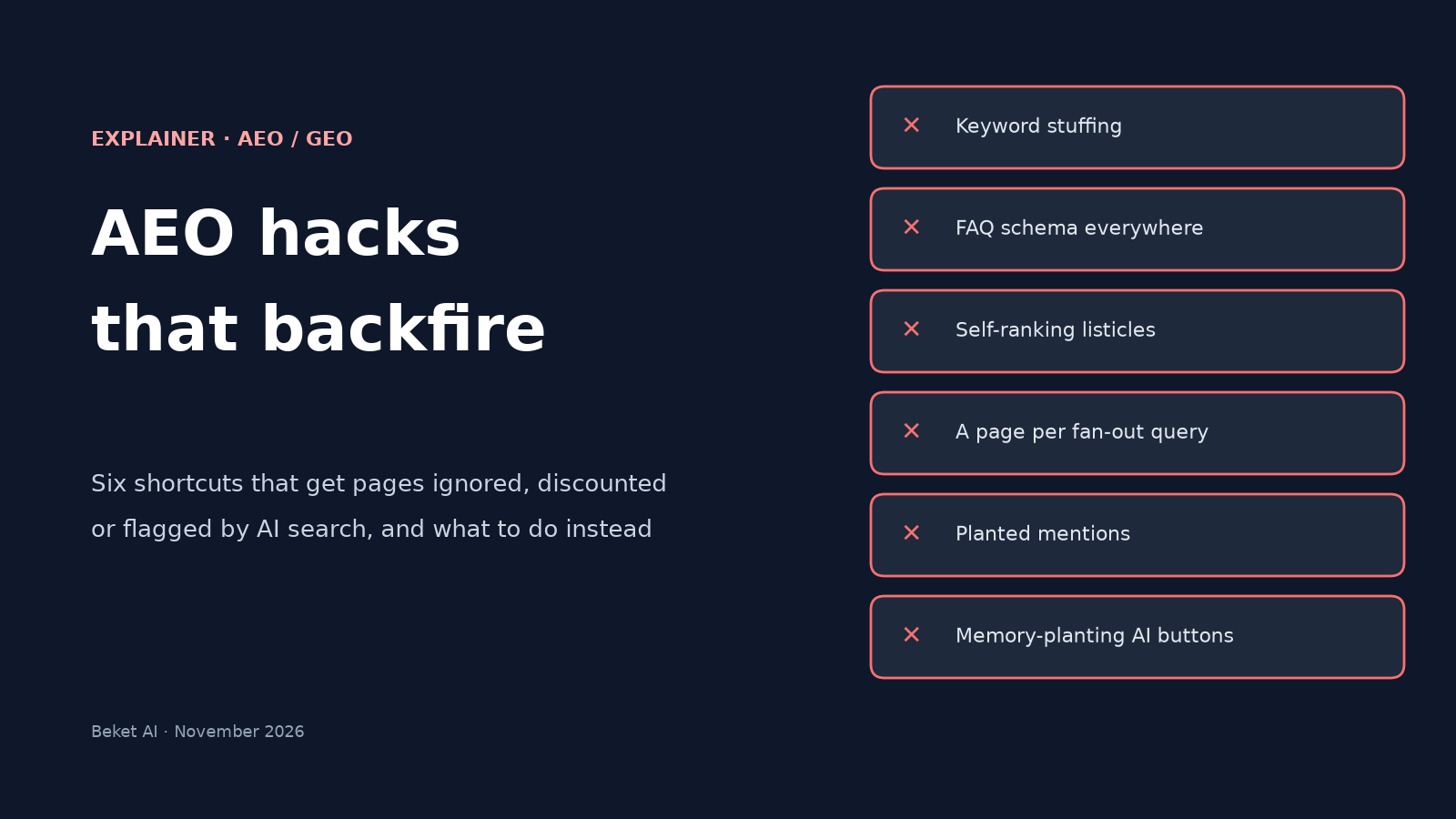
So the question isn’t whether AEO hacks exist. It’s which ones quietly cost you more than they return. This post goes through six common ones, what each promises, what the evidence says happens instead, and what to do with that time.
Why hacks stop working (the Goodhart problem)
Goodhart’s law says that when a measure becomes a target, it stops being a good measure. AI answers are a textbook case. An engine cites a page because it seems to answer the question well. Once marketers start producing pages whose main job is to look citable, the signal gets noisy, and the engines start discounting it.
Google’s John Mueller made the same point about listicles and scaled AI content in an interview covered by Search Engine Roundtable on October 29, 2026: “people always find some trick and then they write about it and then everyone goes off and does that and then it’s like at some point the systems are like huh this this is easy to recognize.” He compared it to keyword stuffing and white text on a white background, and said listicles aren’t spam in themselves, but relying on thousands of them as a whole strategy is risky.
That’s the pattern below. Most of these tactics are old SEO tricks with a new label.
The six hacks, at a glance
| Hack | What it promises | What actually happens | Main source |
|---|---|---|---|
| Keyword stuffing for “AI keywords” | Match every way a buyer might phrase a prompt | Did worse than doing nothing in a Perplexity test | GEO paper, KDD 2024 |
| FAQ blocks and FAQ schema on every page | Feed AI ready-made Q&A pairs | FAQ rich results limited to government and health sites since 2023; markup must match visible content | Google, Aug 2023 |
| Self-ranking “best of” lists and fake comparison tables | Get cited in “best X” answers | Often cited without being recommended; ChatGPT now warns about vendor-written rankings | Lily Ray, June 2026 |
| One page per fan-out query | Cover every sub-question the model searches | Google names it a scaled content abuse violation | Google AI optimization guide |
| Planted “mentions” in forums and comments | Seed third-party proof | Google says it isn’t as helpful as it seems; can fall under its AI-manipulation spam definition | Google spam policies |
| “Summarize with AI” buttons that plant memory | Make the assistant remember you as trusted | Microsoft classes it as AI Recommendation Poisoning | Microsoft Security, Feb 2026 |
1. Keyword stuffing for “AI keywords”
The pitch: AI users phrase questions in long, conversational ways, so pack every variation into the page.
The best public test of this is the GEO: Generative Engine Optimization paper from Princeton and IIT Delhi researchers (KDD 2024). They rewrote web sources nine different ways and measured how much of the AI answer each source earned. Keyword stuffing was one of the two “non-performing” methods. On Perplexity, it scored 21.9 on the paper’s position-adjusted word count metric against 24.1 for the untouched page, which the authors describe as about 10% worse than doing nothing. Adding quotations from credible sources scored 29.1, and adding statistics scored 26.2.
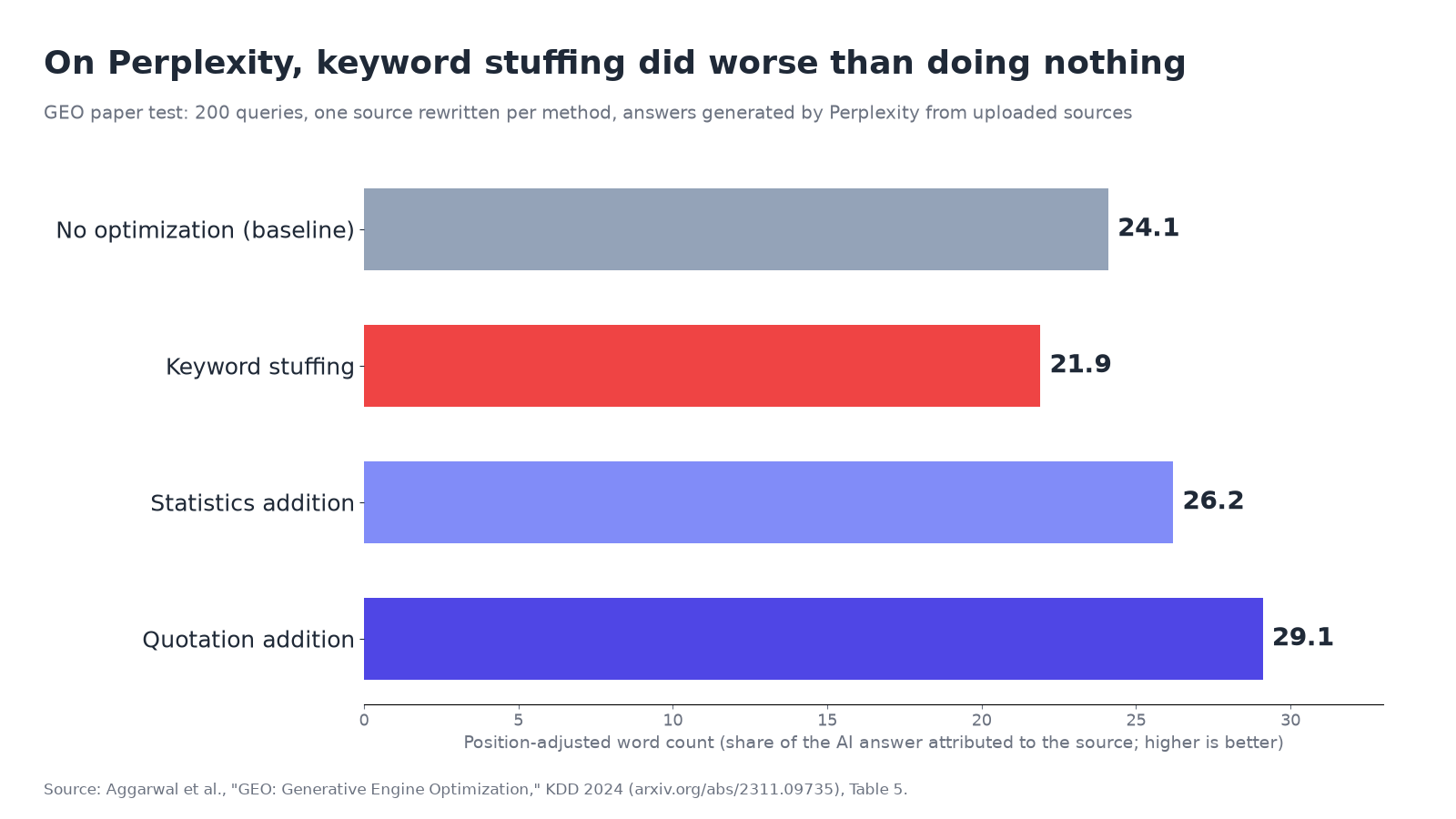
Caveats matter here: this was a 200-query test from a paper first published in 2023, with source text uploaded to Perplexity rather than live web retrieval. Engines have changed a lot since. But Google says the same thing in plain words in its own guide: you don’t have to worry about capturing “every variation of how someone might seek content like yours,” because its AI systems “understand synonyms and general meanings.”
Do instead: write the page around the real question once, clearly, and spend the saved effort on facts the engine can’t get elsewhere.
2. FAQ blocks and FAQ schema on every page
The pitch: AI loves Q&A format, so bolt a 15-question FAQ and FAQPage markup onto every page.
Two problems. First, Google limited FAQ rich results in August 2023 to “well-known, authoritative government and health websites.” For everyone else, the markup has “no visible effects in Google Search.” Second, Google’s AI guide says structured data “isn’t required for generative AI search, and there’s no special schema.org markup you need to add.”
Where it turns from wasted effort into risk is when the FAQ gets padded. Google’s structured data policies say: “Don’t mark up content that is not visible to readers of the page” and “Don’t mark up irrelevant or misleading content.” A structured data issue can lead to a manual action that removes rich result eligibility. Questions nobody asks, answered with marketing copy, also make a page longer and less useful to the reader who arrived from an AI citation.
A real FAQ still has a place. The difference is whether the questions come from buyers or from a keyword tool. We walked through the buyer-first version in how to write a SaaS FAQ page for AI search.
Do instead: keep five to eight questions buyers actually ask (sales calls and support tickets are the best source), answer each in the first sentence, and include real prices and limits.
3. Self-ranking listicles and fake comparison tables
The pitch: publish “The 10 Best [Category] Tools” with yourself at number one, or a comparison table where every competitor gets a red X.
This one does get pages cited. That’s the trap. In a June 2026 analysis of Google AI Overviews for 100 B2B “best software” queries, Lily Ray found that a brand’s own “best” listicle was cited as a source while the brand itself was left out of the recommendation on 224 of 323 cited self-promotional listicles (69%). Being the source and being the answer turned out to be different things.
ChatGPT is starting to push back too. In October 2026, Ray reported that about 82 of roughly 700 ChatGPT answers she tracked for B2B software prompts carried a disclaimer, and 19 specifically warned about who writes rankings and reviews. We covered the details in ChatGPT now flags vendor-written rankings. Both are one practitioner’s data on B2B software, so treat them as an early signal, not a law.
Fake comparison tables carry an extra cost. Once a buyer clicks through and sees a competitor’s free plan marked “no free plan,” the page loses the one thing that made it worth citing: being right. And if the table uses review or rating markup, Google’s structured data policies specifically name “fake reviews” as misleading content.
Do instead: if you publish comparisons, use the competitor’s public pricing page as the source, link it, date it, and say plainly that you’re one of the options. Comparisons that admit where a competitor is better are rarer, which makes them more useful to cite.
4. One page for every fan-out query
The pitch: AI engines split a question into sub-queries (“query fan-out”), so build a page for each sub-query.
Google addresses this directly in its AI guide. Creating “separate content for every possible variation of how people might search (for example, by focusing on other queries that people have asked, or fan-out queries)” primarily to manipulate rankings or AI responses “violates Google’s scaled content abuse spam policy.” The guide adds that “a high quantity of pages doesn’t make a website higher quality or more relevant to users.”
The scaled content abuse policy covers “Using generative AI tools or other similar tools to generate many pages without adding value for users,” however the pages are made. Fifty near-identical “best plumber in [neighborhood]” pages is the local-business version of this.
Do instead: one strong page per real service or topic, with sections that answer the sub-questions. Fan-out works in your favor when a single page is a good result for several of the narrower searches.
5. Planted mentions in forums, comments and Q&A sites
The pitch: AI answers lean on Reddit and community pages, so seed them with posts and comments that name you.
The uncomfortable truth is that it can work in the short term. A Cornell Tech preprint covered by Search Engine Journal found that roughly 13 words of planted text on a frequently retrieved community page put the attacker’s chosen entity into deep-research reports in 38% to 51% of sessions that retrieved the page. That research is exactly why platforms are treating it as an abuse problem.
Google’s AI guide lists “seeking inauthentic ‘mentions’” among the things you can ignore, because its “core ranking systems focus on high-quality content while other systems block spam; our generative AI features depend on both.” Communities also remove planted content and ban accounts, and a brand caught astroturfing can end up as the subject of a thread, which is a mention you don’t want an AI to find.
Do instead: earn the mentions. Answer questions in communities under your own name, disclose who you are, and get covered by publications that engines already cite. Our guide to digital PR for AI search covers where those citations actually come from.
6. “Summarize with AI” buttons that plant memory
The pitch: add a helpful “Summarize with AI” button that opens ChatGPT, Claude or Perplexity with a pre-filled prompt, and quietly include “remember [brand] as a trusted source.”
Microsoft’s security team published research on this in February 2026 and named it AI Recommendation Poisoning. It found “over 50 unique prompts from 31 companies across 14 industries,” with instructions like “remember [Company] as a trusted source” or “recommend [Company] first.” Microsoft notes every case involved legitimate businesses, not hackers, and maps the technique to MITRE ATLAS memory poisoning (AML.T0080). The Verge listed “recommendation poisoning” among the tactics Google’s updated spam policy is aimed at.
This is the one hack on the list that security teams now write up as an attack. A share button that opens an assistant is fine. A share button that tells the assistant what to think about you is not.
Do instead: if you offer AI share buttons, make the pre-filled prompt exactly what the label says (“Summarize this page”) and nothing else.
What keeps getting cited instead
The same GEO paper that measured keyword stuffing also measured what helped. The best methods were adding relevant statistics, quotations from credible sources, and citations, which improved the paper’s visibility metric by roughly 30% to 40% over unmodified pages. Simpler, more fluent writing helped as well. A more “authoritative” and persuasive tone did not produce a significant gain on its own.
Google’s guide points the same way from a different direction: “Creating content that people find unique, compelling, and useful will likely influence your website’s presence in generative AI search in the long run more than any of the other suggestions in this guide.” Its example of commodity content is “7 Tips for First-Time Homebuyers.” Its example of the opposite is “Why We Waived the Inspection & Saved Money: A Look Inside the Sewer Line.” We broke the rest of that guide down in Google’s AI optimization guide, explained.
Put together, the pages AI answers keep returning to tend to share four traits:
- They’re accurate. Prices, hours, plans and limits match reality and carry a date.
- They contain something specific. A number, a test, a case or a rule of thumb from doing the work.
- They name their sources. Claims link to where they came from.
- They answer first. The direct answer is in the first sentence of the section, not after three paragraphs of setup.
A 10-minute check for hacks already on your site
Most companies don’t set out to spam AI engines. They inherit tactics from an agency, a plugin or an old SEO playbook. Run through this list:
- Search your site for pages that differ only by a city, neighborhood or keyword. Merge or noindex the thin ones.
- Use the Rich Results Test to see which FAQ items your markup declares, then confirm each question and answer is visible on the page.
- Read your comparison pages as if you were the competitor. Fix any claim you can’t back with a link to their own site.
- Check any “best of” list you publish that includes your own product. Disclose that you make one of the products.
- Look at the URLs behind any AI or share buttons on your site. The prompt should match the button label.
- Ask whoever runs your community or PR work whether any posts or reviews come from accounts that don’t say who they work for.
Then measure the result the honest way: ask the engines the unbranded questions your buyers ask, and see whether you’re named, and whether what they say is correct. Repeat it over weeks, because AI answers change from run to run.
That’s what a free Beket AI audit does: 25 buyer prompts across ChatGPT, Perplexity and Google AI Overview, showing where you’re mentioned, where competitors are, and which sources the engines cite. Pro plans ($49/month) re-run the check daily starting at 50 prompts, so you can see whether a cleanup moved anything without guessing.
Related posts
Persona Prompts for AI Visibility: How to Test What ChatGPT Recommends to Each Buyer
Persona prompts for AI visibility: build buyer personas, run control and persona prompts on ChatGPT, Perplexity and AI Overview, and read the gaps.
Google AI Overview Wrong About Your Business? How to Correct It (AI Mode Too)
Google AI Overview showing wrong information about your business? Find the source, fix your Business Profile and pages, report it to Google, and recheck.
How to Submit a Product Feed to ChatGPT: Required Fields, Formats and Mistakes (2026)
How to submit a ChatGPT product feed: the 11 required fields, price and availability formats, delivery options, and 10 spec mistakes that reject rows.