
How to Choose a GEO Agency: 8 Questions to Ask Before You Sign (2026)

A typical pitch arrives with a screenshot. Someone asked ChatGPT about your category, a competitor got named, you didn't, and an agency offers a "GEO package" to fix it: an llms.txt file, "AI-optimized" schema, content chunked for language models, and a promise of placement within 90 days.
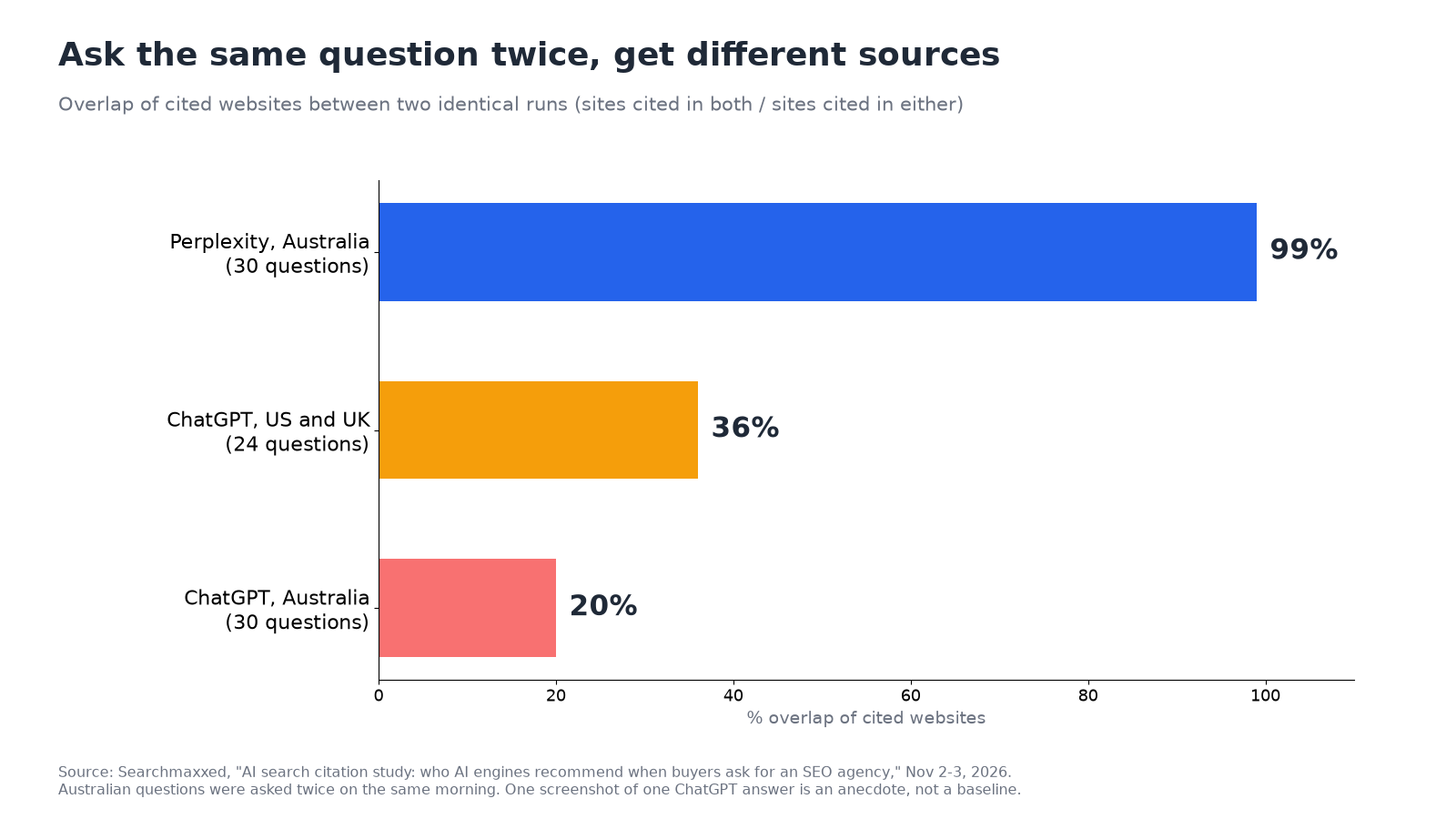
Some of that work is useful. Some of it, by Google's own account, does nothing for Google Search. And the screenshot itself proves less than it looks: in one November 2026 test in Australia, only 20% of the websites ChatGPT cited appeared again when the same questions were asked a second time the same morning (Searchmaxxed).
This guide gives you eight questions to ask any GEO or AEO agency before you sign, what a strong answer sounds like, and the red flags, with a public source behind each one. You can run the whole thing in one 45-minute call.
The scorecard
Print this, or keep it open during the call. A good agency gives a specific, checkable answer to most of these. A weak one answers with a score, a screenshot or a promise.
| # | Ask this | A strong answer | Red flag |
|---|---|---|---|
| 1 | Which parts of your plan are ordinary SEO, and which are specific to AI answers? | A candid split: most technical and content work is shared; AI-specific work is prompt tracking, off-site sources and checking how answers describe you | "SEO is dead, GEO is a new discipline" |
| 2 | Can I see the exact questions you'll track? | A written list of unbranded buying questions, agreed with you before work starts, kept fixed | "Our tool generates the prompts" |
| 3 | Which engines, how many runs, and how do you handle answers that change? | Named engines, more than one run per question, results reported as a share over time | One screenshot, or "we checked ChatGPT" |
| 4 | What will you report, and can I see the raw answers? | Mentions, citations and accuracy reported separately, with the answer text and sources | One blended "AI visibility score" |
| 5 | What will you do off our website, and is any of it paid? | Earned coverage, accurate listings and profiles, disclosed sponsorships | "Our network of sites" with no list |
| 6 | Will you sell us llms.txt, chunking or "AI schema"? | Only as a small extra, with an honest note on what each engine documents | Sold as the core of the package |
| 7 | What results do you guarantee? | No placements guaranteed; a baseline, a checkpoint date and what you'll change if numbers don't move | "Guaranteed ChatGPT placement" |
| 8 | What does AI say about your own agency? | They show you their own tracked questions and results, flaws included | They change the subject |
The rest of this post explains why each question matters and what to listen for.
1. "Which parts of this are just SEO?"
Start here, because Google has already answered half of it. Its guide to generative AI features in Search says: "From Google Search's perspective, optimizing for generative AI search is optimizing for the search experience, and thus still SEO." The next sentence is aimed squarely at buyers like you: "If you're considering third-party 'AEO' or 'GEO' advice or services, review our guidance on evaluating third-party SEO advice."
That doesn't make GEO a scam. ChatGPT, Perplexity and Copilot don't run on Google's ranking systems and pick their own sources, and Google speaks only for Google. We walked through what the guide does and doesn't cover in our breakdown of Google's AI optimization guide. But it means an agency should be able to tell you plainly which line items you'd get from a competent SEO team anyway, and which are new.
Listen for: a short list of genuinely AI-specific work. Tracking a fixed set of buyer questions across engines. Finding which third-party pages the engines cite for your category. Checking whether answers describe your prices, locations and products correctly. Fixing the sources behind wrong answers.
Red flag: "SEO is dead." If the plan ignores crawlability, indexing and the pages AI Overviews already pull from, it's missing the foundation the engines retrieve from.
2. "Can I see the exact questions you'll track?"
Every AI visibility number depends on which questions were asked. Ask for the list in writing before work starts.
Listen for: unbranded questions a real buyer would type ("best payroll software for a 20-person restaurant," "who installs heat pumps in Tacoma"), split by intent, agreed with your sales team, and frozen so month two is compared with month one. Branded questions ("is [your brand] any good") belong in a separate group. They tell you how you're described, not whether you're found.
Red flag: a prompt list the agency won't share, or one that changes every month. If the questions move, the trend line means nothing. We wrote a longer guide to building a weekly AI brand monitoring routine if you'd rather set the list yourself before talking to anyone.
3. "Which engines, how many runs, and how do you handle answers that change?"
This is the question that separates measurement from screenshots.
AI answers aren't stable. In the Searchmaxxed study, the team asked ChatGPT and Perplexity the same agency-hiring questions twice (the Australian set on the same morning). Perplexity's cited websites overlapped 99% between runs. ChatGPT's overlapped 20% in Australia and 36% in the US and UK (Searchmaxxed, November 2–3, 2026; overlap = sites cited in both runs divided by sites cited in either).
Our own daily audits show the same thing over a longer window. Between two consecutive daily runs of the same prompt on the same engine, the list of brands named was identical only 30.1% of the time (how often AI answers change). And engines disagree with each other: in the 103 Beket AI audits behind our brand monitoring guide, which track the same brand on two or more engines, the median brand's best engine named it 12 percentage points more often than its worst one.
Listen for: named engines chosen for where your buyers actually are (ChatGPT, Gemini, Perplexity, Microsoft Copilot, Google AI Overviews, Google AI Mode), each question run more than once, and results reported as a share of answers over weeks.
Red flag: "We checked and you're not in ChatGPT." One answer from one engine on one day is an anecdote. So is the "after" screenshot in a case study.
4. "What will you report, and can I see the raw answers?"
Being mentioned, being cited and being described correctly are three different results. An answer can name you without linking to you, cite your page while recommending a competitor, or name you with last year's prices.
Listen for: those three reported separately, plus a raw log you can re-check: question, engine, date, answer text and cited sources. Ask for a sample report on the first call. Ask which numbers come from first-party tools (Google Search Console, Bing Webmaster Tools, your analytics) and which come from a tracking tool, and which tool.
Red flag: a single proprietary "AI visibility score" with no definition. If you can't see the answers behind a number, you can't check whether the work moved it.
5. "What will you do off our website, and is any of it paid?"
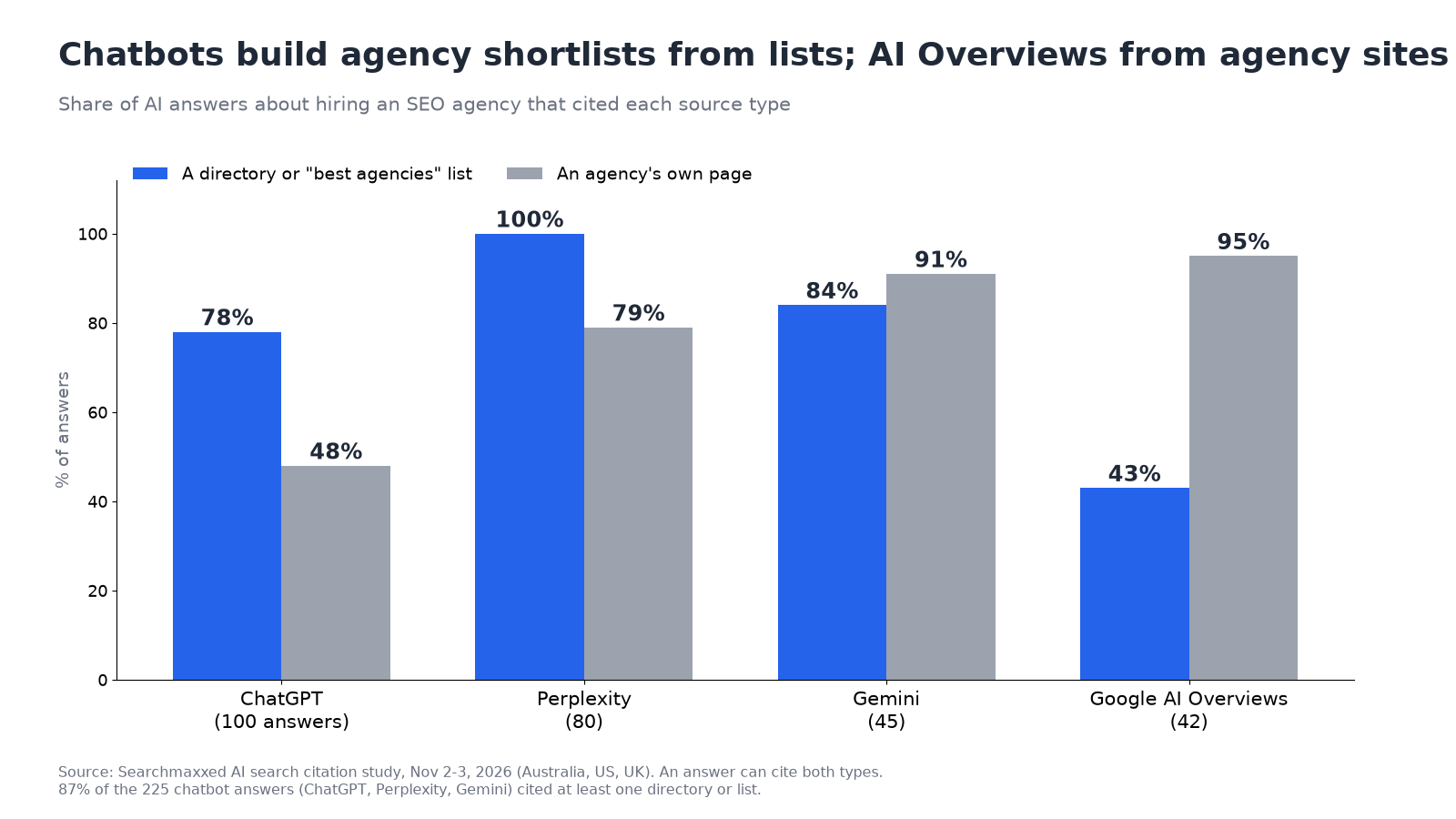
For many categories, the shortlist an AI engine gives comes mostly from other people's pages. When Searchmaxxed asked ChatGPT, Perplexity and Gemini which SEO agency to hire, 87% of chatbot answers (196 of 225) cited a directory or a "best agencies" list. Google AI Overviews did so far less often (18 of 42 answers) and leaned on agencies' own pages instead.
So off-site work is legitimate and often the biggest lever. The question is how it's done.
Listen for: earned coverage, accurate business profiles and directory listings, reviews from real customers, expert contributions, and any paid placement named and disclosed.
Red flag: "We'll place you on our network of sites," fake review campaigns, or lists of "independent" sites that all trace back to the agency. This is where the rules have tightened:
- Google's spam policies now name "attempting to manipulate generative AI responses in Google Search" as spam.
- Google's AI guide lists "pursuing inauthentic mentions" among the "AEO/GEO hacks" you can ignore.
- Anthropic's usage policy, in effect since November 12, 2026, bars using Claude to "manipulate the sources from which search engines or AI systems draw answers by seeding them with content that misrepresents its origin, authorship, or independence," and bars selling those activities as a service (Search Engine Journal).
- Engines read the small print. In the Searchmaxxed study, Perplexity noted that one list "explicitly states that its top-ranked agency is run by the publisher and is not an independent ranking" and left that agency out; in three answers it warned that some rankings are "self-published."
Fabrication can work in a lab, which is why some vendors are tempted. In one 2026 preprint testing three commercial models, persuasion-style copy using authority claims, including invented clinical evidence, broke a well-known brand's hold on AI recommendations 73.3% of the time (Chu and Hou, arXiv). That's a reason to ask exactly what will be published in your name, not a tactic to buy. We covered the shortcuts that tend to cost more than they return in AEO hacks that backfire.
6. "Will you sell us llms.txt, chunking or 'AI schema'?"
These are the easiest items to put in a package because they're quick to deliver and easy to show. Ask what each is expected to change.
Google's guide is direct: "you can ignore tactics like 'chunking' content, creating unnecessary AI text files (like llms.txt), or pursuing inauthentic mentions." It says an llms.txt file "will neither harm nor help your site's visibility or rankings in Google Search," and that "there's no special schema.org markup you need to add" for generative AI search, while still recommending structured data for rich results. Outside Google, the evidence is thin too: across 137,000 domains using Ahrefs Web Analytics, 97% of the llms.txt files got zero requests in May 2026 (Ahrefs).
Listen for: "This takes an hour, it's harmless, and here's what it does and doesn't do." Ordinary structured data that describes your business accurately is still worth having.
Red flag: these items as the centerpiece of a monthly retainer.
7. "What results do you guarantee?"
Google's page on hiring an SEO says it plainly: "No one can guarantee a #1 ranking on Google." The same logic applies with more force to AI answers, which change from one run to the next and differ by engine.
Listen for: a baseline measured before work starts, a checkpoint date (say, 90 days), the specific numbers you'll review then, and what the agency will change if they haven't moved. Ask what they can't control: model updates, what third parties write, and which engines your buyers use.
Red flag: "guaranteed placement in ChatGPT," a "special relationship" with an AI company, or "it just takes time" with no checkpoint.
8. "What does AI say about your own agency?"
An agency selling AI visibility should be tracking its own. Ask which buyer questions they track for themselves, on which engines, and what the results are. A candid answer, including where they don't show up, is a good sign. A polished screenshot of one branded question isn't.
Then check for yourself. Ask ChatGPT, Perplexity and Gemini the question your next client would ask ("best GEO agency for B2B SaaS," "AEO agency in Vancouver"). Note who gets named and which lists get cited. If the agency's only presence is a ranking on its own site, you've learned how it plans to get you visible.
Before you sign: five contract checks
- You own the question list and the raw answer logs, and you keep them if you leave.
- Access is minimal. Google's own advice when hiring an SEO is to grant Search Console read access only at the start, not write access (Google).
- Every off-site placement is listed, with any payment disclosed.
- Deliverables are dated. Baseline, audit, fix list, first report: things you can tick off in the first 90 days.
- The exit is clear. Minimum term, notice period, and what happens to content published in your name.
Get your own baseline first
The strongest position in any agency conversation is knowing your numbers before the pitch. Pick 10 to 25 unbranded buying questions, run them on the engines your buyers use, and save the answers with dates. Then you can judge every claim on the call against something real, and check the agency's results later without relying on its report.
You can do that by hand, or with a free Beket AI audit: 25 prompts on any 3 of 6 engines, showing whether you're named, how the answers describe you and which competitors show up instead. If you hire an agency, Beket AI Pro ($49 per month per website) re-runs your questions daily on the engines you choose and sends change detection alerts, so you have an independent record of whether the work is moving anything.
AI answers change, and any snapshot, ours included, shows what the engines returned on the day it was run.
Related posts
Does llms.txt Work? We Checked 3,844 Sites AI Engines Cite (2026 Data)
We checked 3,844 sites cited by ChatGPT, Perplexity and AI Overviews for llms.txt. The most-cited sites had it least. Our data, other studies, what to do.
We Checked 40 Local Searches in Vancouver and Seattle: The Google Local Pack Is Still There (Mostly)
An AI Overview showed on 40 of 40 local searches we checked in Vancouver and Seattle, and a separate map pack on about 35. What we saw vs Semrush's 79 of 80.
How ChatGPT and Gemini Decide Which Brands to Name: What Two New Studies Show (2026)
Two new studies show live search, not memory, picks most brands in ChatGPT and Gemini answers. What they found, their limits, and what your site must confirm.