
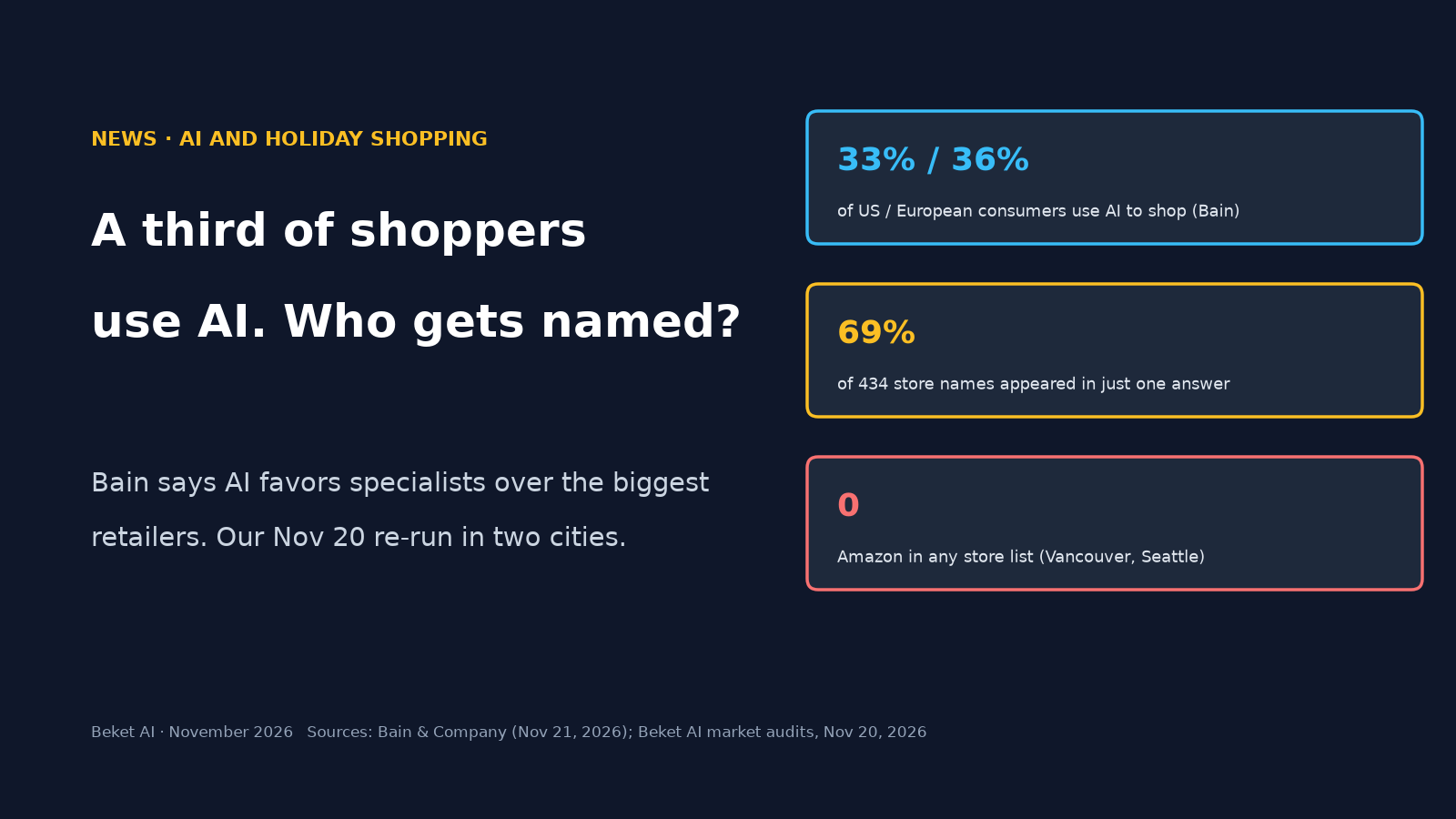
A Third of Shoppers Now Use AI: Why Specialists Beat Big Retailers in AI Answers (2026)

A third of shoppers in the US now use an AI assistant for some part of buying, and Bain & Company says the assistants don't simply send them to the biggest store. In a report published November 21, 2026, Bain writes that AI "picks the best fit, not the biggest retailer," and that it often favors category specialists over generalists.
We can't test Bain's market-share claim. We can show what the same kind of question returned in two cities a day earlier. On November 20, we re-ran 25 unbranded shopping questions in Vancouver and Seattle, and the answers were spread across hundreds of different stores, not a few giants.
How many people use AI for shopping?
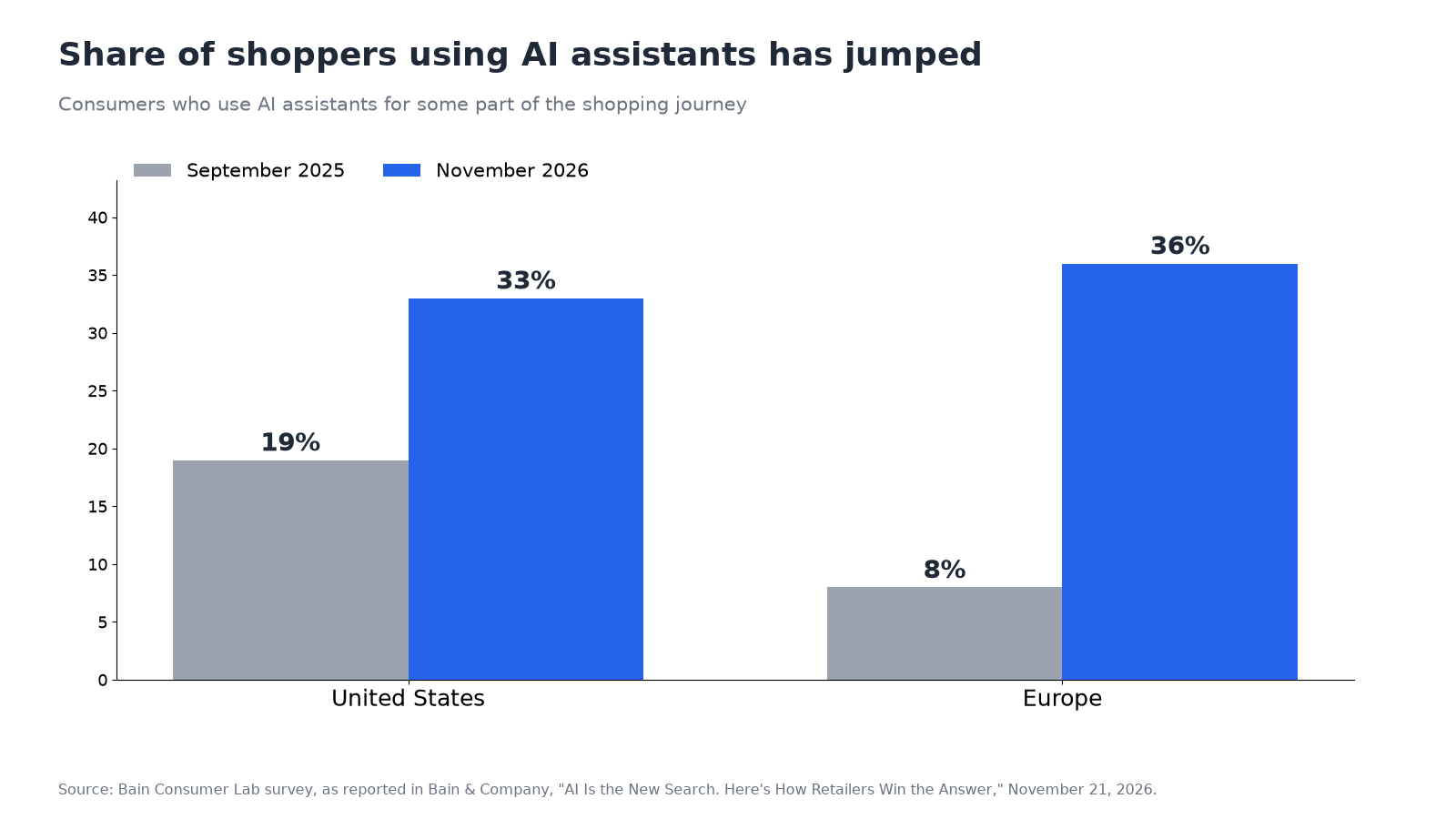
Bain's Consumer Lab survey, as reported in its November 21, 2026 article, found that 33% of consumers in the US and 36% in Europe say they use AI assistants for some part of the shopping journey as of November 2026. In September 2025 those figures were 19% in the US and 8% in Europe.
The other figures in the article:
| Bain figure | Value |
|---|---|
| ChatGPT weekly users | 1.2 billion |
| Share of ChatGPT prompts that are shopping-related (Bain's estimate) | 15% to 20%, up from 9% in 2025 |
| AI assistants' share of retailers' directly linked web traffic (Bain's analysis of Similarweb estimates) | Less than 1% |
| Conversion of AI referral traffic vs non-AI traffic | 90% better |
| Top 100 US retailers with their own AI assistant | 27 |
Two cautions. The 15% to 20% is an estimate of prompts that are shopping-related, which is a broader net than purchase intent. SparkToro's panel counted 6.9% of ChatGPT conversations as showing buying intent, as we covered in how many ChatGPT chats are about buying. And the traffic is still small: under 1% of direct traffic. Bain's argument is that clicks undercount influence, because many shoppers use AI to research and then visit a retailer on their own.
Why specialists can beat big retailers in AI answers
Bain analyzed more than 4,400 shopping prompts across four retail verticals, with more than 300,000 unique runs on the most used large language models, using data from a third-party AI marketing platform. Its finding: for many categories, specialists appear in AI answers more often than generalist retailers, relative to their market share. The exact gaps are in a chart in the article, so we don't repeat them here.
Bain gives these reasons:
- The answer is a short list. Asked something like "Help me host a holiday dinner for eight," an assistant recommends a basket of goods from a handful of retailers, a far shorter list than a page of search results.
- Mentions follow fit, not size. In grocery, Bain says one chain appears more often for promotions and loyalty prompts and another for dietary needs and product selection.
- Complexity hurts. The more complex a retailer's offering is, such as add-on services, a rewards program or quality differences between similar products, the less likely it is to surface.
- Sources are scattered. In Bain's grocery analysis the top 10 sources made up roughly 30% of citations, and earned media led for most models.
Bain's advice is to spell out who you're best for, which products are exclusive and which occasions you serve, and to keep testing, because answers shift.
What we saw in Vancouver and Seattle on November 20
We can't reproduce Bain's analysis. Our data is much smaller, but it asks a related question: when AI names stores for shopping questions, how many go to the big chains?
On Friday, November 20, 2026, we ran the same 25 unbranded shopping questions in each city on ChatGPT, Perplexity and Google AI Overview, using Beket AI. That's 150 answers, and 126 of them listed at least one store.
- The long tail was huge. The 126 lists contained 434 different store names (a store counted once per city). 300 of them, 69%, appeared in a single answer.
- Best Buy was the one big-box name that kept showing up. It was named in 19 answers, 9 in Vancouver and 10 in Seattle, as we reported in our Black Friday study. But in Seattle, Pike Place Market was named in 12 answers, and REI in 9. In Vancouver, MEC was named in 9 and Granville Island Toy Company in 7.
- Amazon wasn't in any store list. Walmart, Costco or Target were named in 9 answers (4 in Vancouver, 5 in Seattle).
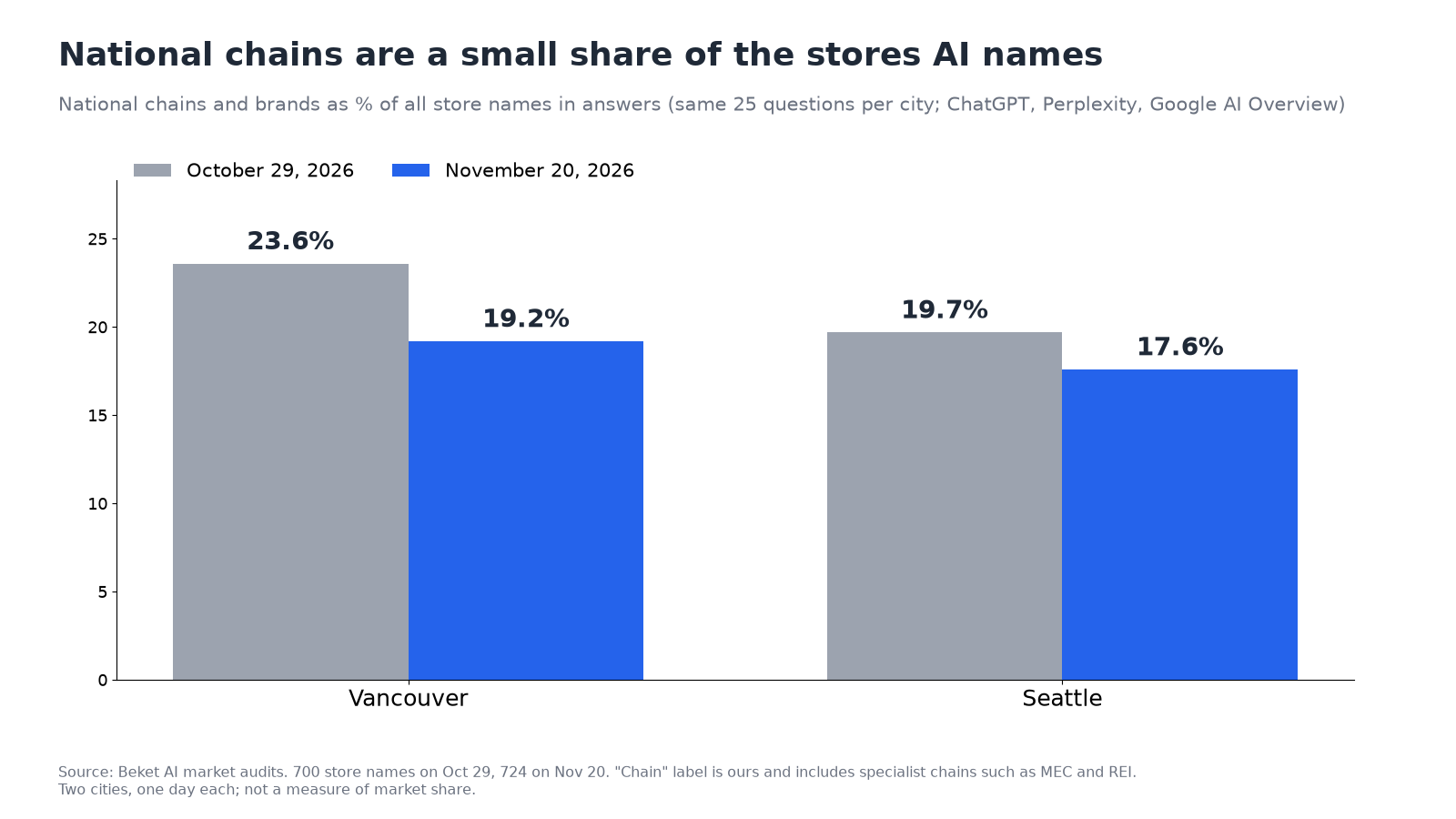
- Chains were a small share of the names. Counting every store name in every answer, national chains and brands were 18.4% (133 of 724) on November 20, down from 21.6% (151 of 700) on October 29, on the same questions. That label is ours, and it includes specialist chains like MEC and REI.
In Vancouver, the six stores named in the most answers were MEC, Best Buy, Granville Island Toy Company, Old Faithful Shop, Valhalla Pure Outfitters and Dilly Dally Kids. Apart from Best Buy, each is a specialist or a local shop.
This lines up with Bain's direction, but it isn't a match for its finding. Bain compares mentions with market share, and we didn't have market-share data. We counted which names appeared. Our October test found the same split by engine: ChatGPT named more local independents than Google AI Overview did, as we showed in Google AI Overview vs ChatGPT: which one names the local shop?
What to do before the holiday rush
- Test your own questions first. Bain's first item on its checklist is a prompt audit. Use the questions your customers ask, not your brand name.
- Say who you're best for. State plainly on your pages which products, services and occasions you cover, in your customers' words.
- Put offers and details in plain text. Our guide on getting a Black Friday offer into Google AI Overviews covers the specifics.
- Check more than once. In our November 20 re-run, every ChatGPT answer's list of stores had changed since October 29. One check is a snapshot.
Beket AI's free audit runs 25 unbranded prompts on any 3 of its 6 engines, and shows which businesses each answer names and which sources it cites. What you change on your site and listings is up to you.
Caveats
- Bain's report is a consulting firm's analysis with data from a third-party AI marketing platform, and its adoption figures come from its own consumer survey. We read the text of the article. The chart values behind the specialist finding aren't in the text, so we haven't checked them.
- Our data is two cities, 25 questions each, three engines, one day, and the store types are our own labels. It isn't a measure of market share and can't say whether specialists are named more often than their share of sales.
- Some store names may be counted separately when engines spell them differently, which would raise the "named once" count slightly.
- AI answers change from day to day. Google's November core update and its switch to Gemini 4 Hydrogen landed between our two runs, so changes between October 29 and November 20 can't be put down to anything the stores did.
Related posts
We Checked 40 Local Searches in Vancouver and Seattle: The Google Local Pack Is Still There (Mostly)
An AI Overview showed on 40 of 40 local searches we checked in Vancouver and Seattle, and a separate map pack on about 35. What we saw vs Semrush's 79 of 80.
AI Search Market Share in 2026: Why ChatGPT Is 20% of Google, or 1.4%, or 0.09%
AI search market share in 2026: six estimates put ChatGPT at 20% to 0.09% of Google. What each one divides, and which number to use for which decision.
How to Choose a GEO Agency: 8 Questions to Ask Before You Sign (2026)
How to choose a GEO or AEO agency: 8 questions to ask before you sign, what a strong answer sounds like, and the red flags, each backed by a public source.